Paris at night: a guide to the illuminated city
What is there to do in Paris at night?
Paris after dark centres on illuminated monuments, walks along the Seine and viewpoints such as Trocadéro or Montmartre. Formal evenings like a cabaret show or a Seine dinner cruise exist as separate, bookable formats rather than something you improvise on the spot.
What changes after dark in Paris
Daytime Paris is a city of queues and daylight glare on stone. After dark, the same monuments are lit from below and the crowds thin at the sights that close for the evening, while the streets around the Seine, Le Marais and Montmartre fill with a different, slower kind of activity: people out for dinner, a walk, or a drink rather than a checklist of sights. Nothing here is about a single spectacular event — it is about how the ordinary geography of the city reads differently once the light changes.
This guide covers Paris at night as a whole: the Eiffel Tower and Trocadéro, the Seine, Montmartre, and the walkable core between Île de la Cité and Notre-Dame and the Champs-Élysées and Opéra district. Two specific evening formats sold on the site, a cabaret show and a Seine dinner cruise, are mentioned below only as options to be aware of. They have their own dedicated guides — the Paris cabaret guide and the Seine dinner cruises guide — because each is a distinct, bookable product with its own logistics, not a variation on a night walk.
No illumination schedule or ticket price appears anywhere in this guide. Lighting times are set locally and change through the year, and prices move; check current details close to your visit rather than trusting a fixed figure written months earlier.
Illuminated monuments worth building an evening around
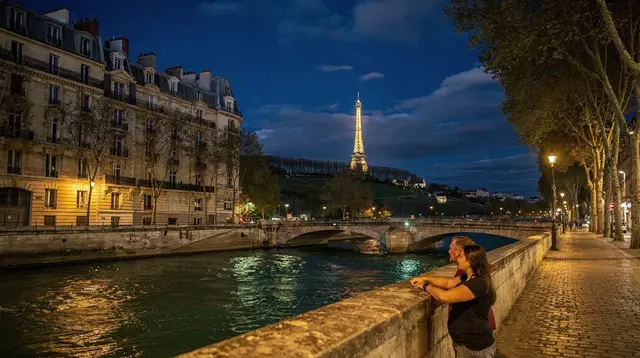
The Eiffel Tower is the obvious anchor. At roughly 330 m, built for the 1889 World’s Fair, it is visible from a long way off once lit, which makes it a natural point to walk toward rather than a single stop. Two areas frame it well: the Trocadéro esplanade across the river, which faces the tower directly and gets crowded at peak viewing times, and the Champ de Mars underneath it, which offers a closer, more vertical view with more room to sit. The Eiffel Tower tickets and tours guide covers visiting the tower itself; this page is about the surrounding walk, not the ascent.
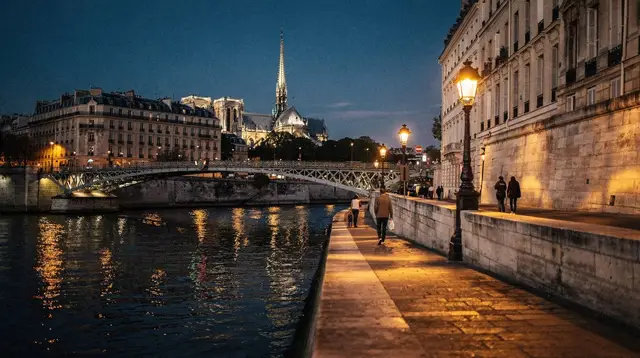
Along the Seine, the stretch between the Eiffel Tower and the Île Saint-Louis is a UNESCO World Heritage listing in its own right (inscribed in 1991), and it is the single best corridor for an evening walk in the city: bridges, quays, and monuments on both banks without needing to plan a route. Notre-Dame de Paris, reopened on 7 December 2024 after the 2019 fire, sits at the eastern end of this stretch on the Île de la Cité, alongside the Sainte-Chapelle and the Conciergerie — the cathedral’s exterior and the surrounding square are part of the same riverside walk covered in the Île de la Cité and Notre-Dame guide and the Notre-Dame and Sainte-Chapelle tours guide.
Further west, the Arc de Triomphe at the top of the Champs-Élysées and the Palais Garnier opera house both photograph well after dark and sit within an easy walk of each other; see the Arc de Triomphe and Palais Garnier tours guide for detail on visiting either. None of these require a guided tour to appreciate from outside — a guided option simply adds narration and, in some cases, transport, which matters more on a first visit or a cold night than on a repeat one.
For visitors who prefer not to walk the whole route on foot, a panoramic bus tour with an audioguide that runs past the main illuminated monuments after dark covers most of the same ground from a seat, with commentary in several languages. It is a reasonable option on a short layover or after a long day of walking, though it trades the ability to stop and linger for coverage and comfort.
The Louvre and the Tuileries gardens sit on the same riverside walk, west of Île de la Cité. The glass pyramid in the main courtyard is lit after dark and makes for a quieter approach than the daytime queues in front of it — the museum itself closes well before evening, so this is strictly an outside view, not a visit. The Louvre and Tuileries destination guide and the Louvre museum guide cover the site during opening hours; at night it is simply another stop on the same riverside route as the Île de la Cité and the Champs-Élysées.
Montmartre and Le Marais after dark
Montmartre has a different character at night than during the day: the crowds around the Sacré-Cœur and the place du Tertre ease off once the tour groups head back down, and the steep streets below the basilica become quieter and more residential. The view from the top, over the rooftops of Paris, is one of the better vantage points in the city and does not require any ticket. The Sacré-Cœur guide covers the basilica itself; this page is only about the surrounding walk and the view.
Le Marais, on the Right Bank between the Centre Pompidou area and the Bastille, keeps its bars, restaurants and small shops open later than most residential neighbourhoods, which makes it one of the more pleasant places for an evening without a fixed itinerary — narrow streets, older architecture, and enough foot traffic to feel lived-in rather than staged for visitors.
A cyclist’s or segway rider’s view of these areas covers more ground per hour than walking. A guided night bike tour through the illuminated centre of Paris or a guided Segway tour of Paris by night both move at a pace that suits covering several neighbourhoods — the Seine banks, the Île de la Cité, and often Trocadéro — in a single outing, with a guide handling navigation and traffic. Either suits a visitor who wants a broad overview of the illuminated city in one evening rather than a slow walk through one or two areas.
Choosing a structured night out
Beyond a self-guided walk, a few bookable formats exist for a more organised evening, each with a different focus. A general Paris city by night tour typically combines transport with a route past the main monuments, which suits visitors without much walking stamina or those short on time. For something more social and less monument-focused, an evening built around live jazz — Paris has a long-standing jazz scene concentrated in cellar venues around Saint-Germain and the Left Bank — offers a very different kind of night; a live jazz night with a local guide pairs a knowledgeable host with a venue visit rather than a monument tour.
Two other formats deserve a mention without a detailed treatment here, because each has a dedicated guide covering it properly. A cabaret show — the best-known names sit in and around Montmartre — is a ticketed theatre performance with its own seating tiers, dress expectations and timing; it is not an activity to combine casually with a walking evening, and the Paris cabaret guide is the place to compare venues and formats. A Seine dinner cruise is a separate, seated evening on the water with a multi-course meal, distinct from the shorter sightseeing cruises that run earlier in the day; the Seine dinner cruises guide covers what differs between operators and how it compares with a standard cruise. Both are legitimate ways to spend an evening in Paris — they are simply specific enough, and detailed enough, to warrant their own pages rather than a paragraph here.
Practical notes for an evening out
A few things are worth knowing before heading out after dark, without turning this into a safety guide in its own right — that ground is covered fully in the safety and scams guide and the related is Paris safe at night page.
- The areas covered in this guide — the Seine banks, Trocadéro, the Champ de Mars, central Montmartre and Le Marais — stay busy and well lit well into the evening, which is part of why they work for an unplanned walk.
- Pickpocketing, not violent crime, is the more relevant risk in crowded viewpoints and on the metro; keep bags closed and be aware of anyone crowding you at a busy overlook.
- Paris’s metro and RER network runs into the evening; check the current line schedule for a return trip rather than assuming service continuity, particularly on the RER outside the city centre. The Paris metro guide has the full network detail.
- Dress for the season: riverside walks and open viewpoints such as Trocadéro are noticeably colder and windier at night than the surrounding streets, especially in autumn and winter.
- If the evening includes a guided tour, cabaret show or dinner cruise, book ahead — these formats sell out, especially on weekends and around holidays, well before the date.
- Getting home after an evening out usually means the metro or RER; both run into the night but service thins out, so check the last train on the relevant line before setting out rather than assuming a late connection exists. The Paris metro guide and the Paris metro tickets and Navigo guide cover how the network and its tickets work. A taxi or ride-hailing app is the fallback once the network winds down, particularly from a dinner cruise dock or a cabaret venue outside the centre.
Night out by season
Paris at night looks and feels different depending on when a trip falls. In summer, long daylight hours push the point at which the monuments are worth walking toward later into the evening, but the streets stay warm and busy well past dinner; the Paris in summer guide — see also Paris in August — notes that August in particular sees many Parisians leave the city, which can mean a quieter, more residential feel in areas like Le Marais even as the main tourist routes stay full.
Winter evenings arrive early, which works in a visitor’s favour for early illuminated walks, but the cold along open viewpoints such as Trocadéro and the Champ de Mars is more noticeable than in the surrounding streets; the Paris in winter guide covers the season in more depth, and around the end-of-year holidays the Christmas in Paris guide covers the markets and illuminations that add an extra layer to an evening walk during that window. Spring and autumn sit in between, with mild evenings that suit a longer walk without the summer crowds or the winter cold — the best time to visit Paris guide compares the seasons for a visit as a whole, beyond just the evenings covered here.
How this fits into a longer visit
An evening walk along the Seine or up to Montmartre works as a standalone activity on any night of a Paris stay, and pairs naturally with sights already on a daytime itinerary — finishing a day near the Louvre or Île de la Cité with a walk to Notre-Dame and along the river costs little extra effort. For a weekend visit that wants to fit in one evening activity alongside the daytime sights, the Paris weekend itinerary sketches how a night walk or a single booked evening activity can sit inside a two- or three-day plan.
For a broader look at where the city’s best elevated views are, by day or night, the best views in Paris guide and the Trocadéro and Champ de Mars guide go into more depth on specific vantage points than this page does. For anyone weighing up organised evening options as a full category, the things to do: night tours listing groups everything bookable after dark in one place, from bus tours to bike tours to jazz evenings, alongside the cabaret and dinner cruise options already covered elsewhere on the site.
Travellers building a longer stay around evenings out can look at the three days in Paris itinerary or a longer stay, both of which leave room for at least one evening activity alongside the daytime sights rather than treating nightfall as downtime. For a couple planning an evening specifically around atmosphere rather than sightseeing efficiency, the romantic Paris guide covers the same riverside walks and viewpoints from that angle, including which of the formats mentioned above — cabaret, dinner cruise, or a simple walk — suits that kind of evening best.
Paris at night: frequently asked questions
Is the Eiffel Tower better at night?
The tower reads differently after dark, lit against the sky rather than competing with daylight haze. Whether it is “better” is personal; some visitors prefer the daytime views from the summit, others prefer the evening silhouette from ground level.
Do I need to book anything for a night walk in Paris?
A self-guided walk along the Seine, through Le Marais or up to Montmartre needs no booking. A guided night tour, a cabaret show or a dinner cruise does, and those sell out on short notice, especially on weekends.
Is it safe to walk around Paris at night?
The main tourist areas are well lit and busy well into the evening. Pickpocketing is the more common issue than violent crime, particularly around crowded viewpoints and on public transport; see the dedicated safety and scams guide for detail.
What time do the Paris monuments turn their lights on?
Illumination schedules are set locally and change with the season, so this guide does not publish times. Check the current schedule close to your visit rather than relying on a fixed hour.
Is a Seine dinner cruise the same as a sightseeing cruise?
No. A dinner cruise is a seated, multi-course evening on a slower route, while a standard sightseeing cruise is shorter and does not include a meal. The dedicated Seine dinner cruise guide compares the two in detail.
Should I see a cabaret show while I’m in Paris?
That depends on what you want from the evening: cabaret is a specific, ticketed theatre format with its own dress expectations and seating tiers, not a general night-out activity. The cabaret guide covers venues and what to expect.
Which neighbourhood is best for an evening walk?
The Seine banks between the Eiffel Tower and Île Saint-Louis, the Marais, and the base of Montmartre are the most walkable after dark, each with a different mood: monumental, residential, and hillside respectively.
Can I combine a night tour with dinner?
Some bookable formats combine transport with dinner or drinks, such as a guided evening tour that ends near a restaurant district. Read each tour’s description carefully, since “by night” does not automatically mean a meal is included.
Paris night and illuminations tours on GetYourGuide
Verified deep-linked GetYourGuide tours. Book through these links and we earn a small commission at no cost to you.
GetYourGuide does not provide a product photo for this activity — the image shows the meeting point, photographed by us.