Sacré-Cœur guide: visiting the basilica and Montmartre
What do I need to know before visiting the Sacré-Cœur?
The Sacré-Cœur sits at the top of Montmartre, reached by climbing streets and steps rather than crossing a bridge or a square like Paris's island monuments. The steps below the basilica are a known pickpocket hotspot, and the friendship-bracelet scam targets tourists there, so keep bags closed and decline anyone who approaches with string bracelets or petitions.
A hilltop basilica, not an island monument
The Sacré-Cœur is the white-domed basilica that sits above Montmartre, in the north of Paris. It is easy to lump it in with the city’s other must-see churches, but the way you actually get to it is different from anywhere else on a typical Paris itinerary. Notre-Dame de Paris and the Sainte-Chapelle sit on the Île de la Cité, reached by crossing a bridge over the Seine onto a small island. The Sacré-Cœur has no island and no bridge. It sits at the top of a hill, and reaching it means walking up through a real, lived-in neighbourhood of steep, narrow streets before you even see the building.
That distinction matters for how you plan the visit. This page focuses specifically on the basilica and its immediate surroundings in Montmartre, including the place du Tertre a short walk away, and on the practical and safety points specific to this hill. It does not repeat the history or visiting mechanics covered elsewhere for Notre-Dame de Paris or the other monuments of the Île de la Cité — those sit on flat ground in a different part of the city entirely, with a different visiting rhythm.
Getting up the hill
Montmartre rises well above the rest of central Paris, and the Sacré-Cœur sits close to the top. Depending on which metro stop you start from, reaching the basilica means either a sustained uphill walk or a shorter climb helped by a funicular that runs up the last stretch of the slope. Either way, expect stairs and sloped streets rather than flat pavement. The steps directly below the basilica, looking back out over the city, are the most iconic approach — and also the most crowded.
This is a walking neighbourhood by nature. The Montmartre walking tours that cover the area typically route through a mix of cobbled lanes, small squares, and the steps up to the basilica itself, which is a reasonable way to get oriented before or after seeing the church on your own. If you are coming from elsewhere in Paris, budget real transit time: Montmartre is not a short stroll from the Louvre and Tuileries or the Île de la Cité and Notre-Dame area, and treating it as an add-on to those stops on the same afternoon usually means rushing one or the other.
Getting to the foot of the hill is ordinary Paris metro travel; it’s only the last stretch that’s different from the rest of the city. Once you’re at street level in Montmartre, the funicular fare works like any other single-journey trip on the network, so a Metro-Train-RER ticket loaded onto a Navigo Easy card or phone, a Navigo week pass, or a Paris Visite pass covers it the same as a metro ride — there’s no separate ticket just for the hill. The Paris metro guide and the Paris metro tickets and Navigo guide cover which of those makes sense for the length of your stay. Renting a bike is another option for the approach if you’d rather skip a second metro change, and the cycling in Paris guide covers the city’s bike-share system, though the final climb up to the basilica itself is steep enough that most cyclists walk the last stretch alongside their bike.
What the visit actually involves
The basilica’s interior holds a large central dome and a wide mosaic covering much of the apse ceiling, along with the usual furnishings of a working church that still holds regular services. It is a stop of maybe twenty to thirty minutes for most visitors rather than an extended visit — there is no ticketed timed-entry system and no equivalent of the room-by-room pacing of a museum like the Louvre. The building can and does close to visitors during services, so treat any single approach as provisional rather than guaranteed if you time it around a Sunday morning.
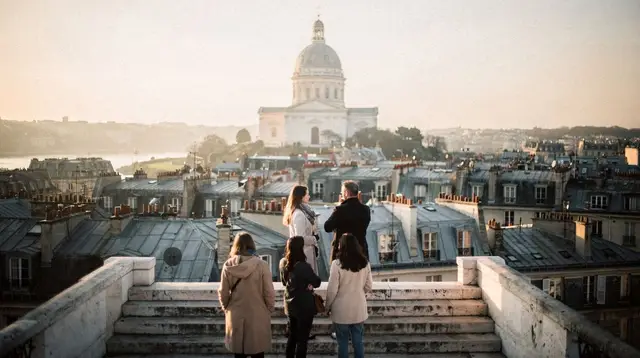
Outside, the terrace in front of the basilica is one of the better vantage points over the city, with rooftops stretching south toward the centre of Paris. It gets busy, particularly toward sunset when both visitors and locals gather on the steps. For a broader look at how this view compares with other high points around the city, see best views in Paris.
A short walk from the basilica, the place du Tertre is the small square most visitors add to a Sacré-Cœur stop. It is lined with portrait artists working in the open, along with cafés and souvenir stalls, and it captures a version of the artists’-quarter reputation Montmartre built over the twentieth century. It is worth a slow ten or fifteen minutes of wandering, though it is also thoroughly geared toward tourists rather than being a quiet corner. For more of the neighbourhood’s other draws, things to do in Montmartre covers the wider area beyond the basilica and the square.
The one thing to actually watch for
Montmartre in general, and the steps and terrace below the Sacré-Cœur specifically, are consistently named among the parts of Paris where pickpockets are most active. The mix of a slow-moving, photograph-taking crowd, a natural bottleneck on the stairs, and a constant stream of first-time visitors makes it an obvious target area, alongside other dense spots like the base of the Eiffel Tower and the crowded platforms of metro line 1.
The specific scam tied to this location is the so-called friendship bracelet: someone approaches, usually with a length of coloured string, and starts wrapping or tying it onto your wrist before you have a chance to say no. Once it’s on, they demand payment for it, and the exchange can turn insistent if you hesitate. Variants of the same approach — a clipboard with a fake petition to sign, or someone with sleight-of-hand card tricks near the steps — show up in the same spot for the same reason: a captive, distracted crowd.
None of this makes Montmartre unsafe in any serious sense — it is one of the most visited parts of Paris for good reason, and the great majority of visits pass without incident. The practical response is simple and doesn’t require changing your plans: keep bags zipped and worn in front in a crowd, don’t let anyone put something on your wrist or hand you anything unsolicited, say no clearly and keep walking rather than engaging, and treat the steps as a spot to be a little more alert rather than a place to avoid. For the wider picture of scams across the city, see paris scams and pickpockets and the broader safety notes in is Paris safe for tourists.
Fitting it into a day
Because Montmartre sits apart from the rest of central Paris, most visitors treat the Sacré-Cœur and its surrounding streets as a half-day on their own rather than one stop among several. A typical version starts with a walk up through the lower streets of the neighbourhood, takes in the basilica and the view from the terrace, continues to the place du Tertre, and finishes with time to wander the quieter residential lanes nearby before heading back down. If you’re building out a longer stay, one day in Paris and the multi-day itineraries show where a Montmartre half-day tends to fit against the rest of the city’s sights.
A general city tour is a reasonable way to see Montmartre alongside other neighbourhoods without managing the metro connections yourself. A guided tour of Paris in a vintage Citroën 2CV covering several districts often threads through the base of the hill, and a similar route is available with a guided bike tour through several Paris neighbourhoods, including a pass by Montmartre. For a slower, food-focused way to spend part of the day nearby, a guided food tour through central Paris is worth pairing with a Montmartre afternoon. Those short on time sometimes prefer a 1.5-hour guided Segway tour covering multiple Paris landmarks to cover more ground without the climb feeling like the whole activity. German-speaking visitors have the option of a guided city tour available with a Turkish-speaking guide as an alternative way to see several districts, Montmartre included, in one outing.
Where Montmartre fits among Paris’s other neighbourhoods
Paris’s sightseeing areas each have their own character, and Montmartre’s hilltop layout is part of what sets it apart. The Île de la Cité is compact and flat, built around Notre-Dame de Paris and the Sainte-Chapelle on a small island in the Seine. The Champs-Élysées and Opéra area is wide, straight boulevards and grand nineteenth-century architecture. The Louvre and Tuileries sit on flat ground along the Rive Droite. Montmartre, by contrast, is a hill village that was a separate town before it was absorbed into Paris, and its steep streets and staircases are a direct result of that geography — not a design choice made for visitors.
That layout is also why Montmartre supports a slower, more wandering style of visit than a single ticketed monument. Beyond the basilica itself, the neighbourhood holds small museums, the Moulin Rouge at its southern edge, and streets that were home to painters across the nineteenth and twentieth centuries — covered in more depth in the Montmartre art and museum tours guide. If you’re deciding where to stay for easy access to the hill, see where to stay in Montmartre, and for the destination overview of the wider area, see Montmartre and the Paris hub.
When to go
Montmartre’s steep streets and the crowded steps below the basilica make the time of year and the time of day you visit worth planning around. Spring and early autumn — April through June and September into October — bring the mildest weather for a hill that involves real walking, without the peak-summer heat that can make the uphill stretch genuinely uncomfortable. Paris summers can turn into heatwaves, and August is also when many Parisians leave the city and some smaller cafés and shops around the neighbourhood close for a stretch, which can thin out the crowd on the steps slightly but also means fewer local businesses open nearby.
Winter brings a quieter, greyer version of the hill, along with Christmas lights and markets across the city — see Christmas in Paris and Paris in winter for what that season adds and what it takes away. Whatever the month, rain is possible at any time of year, and cobbled, sloped streets get slippery fast, so shoes with real grip matter more here than almost anywhere else in the city. The Paris weather by month guide breaks down the seasonal picture stop by stop if you’re weighing this against other parts of an itinerary.
Time of day matters as much as season. Mornings are the calmest window before tour groups and the afternoon crowd build up on the steps, while the golden hour before sunset is the most crowded and, per the pickpocket risk above, the moment to be most deliberate about your bag. Both ends of the day reward the walk up in different ways — quiet streets and soft light early on, a packed but genuinely striking view over the rooftops late.
Practical notes
There is no dress code specific to the basilica beyond what applies to churches generally in France — visible shoulders and very short hemlines can occasionally draw a request to cover up, though enforcement varies. Wear shoes suited to sustained uphill walking on cobbles and steps rather than anything you’d only wear on flat pavement. The area is well served by nearby metro stations, and the Paris metro guide covers how the network connects Montmartre to the rest of the city. Evenings bring a different atmosphere, with the terrace popular for watching the sun go down over the rooftops — the same crowd-and-bottleneck conditions that call for keeping an eye on your bag apply just as much after dark as during the day.
Cash isn’t necessary for the visit itself — the basilica is free to enter and cards are accepted almost everywhere around the square and along the place du Tertre — but it’s worth carrying a small amount for a coffee at a café that only takes cash, as still happens occasionally on the smaller side streets. None of the ordinary Paris precautions change on this hill: keep valuables zipped away, and treat unsolicited offers of any kind, not just the string-bracelet approach, as a signal to keep moving.
Sacré-Cœur and Montmartre: frequently asked questions
Is the Sacré-Cœur in central Paris?
It sits in Montmartre, in the north of Paris, on a hill above the rest of the city rather than on the Seine or an island. It is reached by walking up from the surrounding streets, not by crossing a bridge.
Do I have to climb a lot to reach the Sacré-Cœur?
Yes. Montmartre is built on a hill, and the streets leading up to the basilica are steep. There is a funicular that shortens the final stretch, but most of the approach through the neighbourhood is on foot along sloped, often crowded streets.
Is the area around the Sacré-Cœur safe?
Montmartre is a busy, well-visited part of Paris, but the steps and viewpoint below the basilica are one of the areas in the city where pickpockets are consistently active, especially in dense crowds and around sunset.
What is the friendship bracelet scam at the Sacré-Cœur?
Someone approaches, ties a string bracelet onto your wrist before you can refuse, and then demands payment for it. It is a long-running scam concentrated on the steps and square near the basilica. Keep your hands to yourself, say no clearly, and keep walking.
Should I combine the Sacré-Cœur with Notre-Dame or the Louvre on the same day?
It can be done, but Montmartre is a separate part of the city from the Île de la Cité and the Louvre-Tuileries area, connected by metro rather than a short walk, so factor in travel time rather than treating them as adjacent stops.
Is the inside of the basilica worth visiting?
The interior is a working church with a large dome and mosaic ceiling, and it draws heavy foot traffic given how central it is to a Montmartre visit. It suits a stop of maybe twenty to thirty minutes rather than a long museum-style visit.
What else is near the Sacré-Cœur worth seeing?
The place du Tertre, a small square a short walk from the basilica lined with portrait artists, is the main stop most visitors add on. The surrounding streets also hold small museums and viewpoints connected to Montmartre’s history as an artists’ quarter.
Arc de Triomphe and Paris landmark tickets on GetYourGuide
Verified deep-linked GetYourGuide tours. Book through these links and we earn a small commission at no cost to you.
GetYourGuide does not provide a product photo for this activity — the image shows the meeting point, photographed by us.