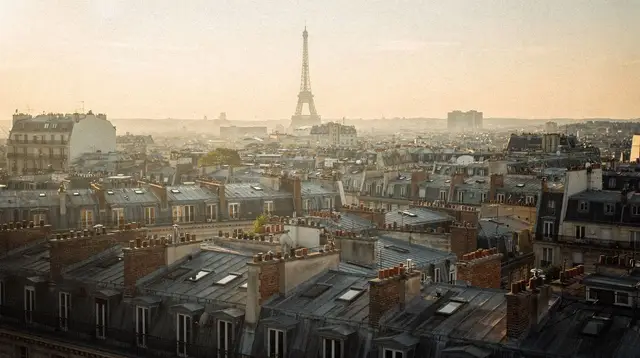
Finding your bearings in the city
Every other page on this site zooms into one piece of Paris — the Seine and its cruises, Montmartre, Le Marais, the Latin Quarter and Saint-Germain, Île de la Cité and Notre-Dame, the Louvre and the Tuileries, the Champs-Élysées and the Opéra, the Eiffel Tower and Trocadéro. This page does the opposite: it steps back and explains how the whole city fits together, so the rest makes sense before you book a single ticket.
Paris is where you sleep. That sounds obvious, but it matters for planning: Versailles, Disneyland Paris, Giverny, Fontainebleau, and the more distant excursions to Champagne, the Loire Valley, or the Mont-Saint-Michel are day trips sold from a Paris base, not alternative places to stay. You keep a hotel or apartment in the city and go out and back on the same day for those. Inside Paris itself, the neighbourhoods this site covers — Montmartre, Le Marais, the Latin Quarter and Saint-Germain, Île de la Cité, the Louvre and Tuileries, the Champs-Élysées and Opéra district, and the Eiffel Tower and Trocadéro — are simply parts of the same city. No special transport, no separate booking, no extra planning is required to go from one to the other: a metro ride or a walk is enough.
Arrondissements, in one paragraph
Paris is divided into 20 arrondissements, numbered in a clockwise spiral starting at the 1st (around the Louvre) and winding outward to the 20th. Postal codes follow the same logic, from 75001 to 75020. Low numbers cluster in the centre; higher numbers sit further out. This numbering is the single most useful thing to understand before choosing a hotel, because Parisians and listings alike refer to neighbourhoods by arrondissement as often as by name. A guide to where to stay in Paris or a closer look at how the arrondissements fit together both build on this same spiral.
The Seine runs through the middle of the city, and it splits Paris into two halves with distinct characters: the Rive Droite (Right Bank) to the north, and the Rive Gauche (Left Bank) to the south. Landmarks divide accordingly — the Louvre sits on the Rive Droite, while the Musée d’Orsay faces it from the Rive Gauche, just across the river. Neither bank is inherently “better”; they simply have different concentrations of monuments, shopping, and nightlife, and most short stays end up crossing the river daily on foot or by metro.
Arriving: three airports, three different journeys
Paris is served by three airports, and they are not interchangeable in terms of distance or convenience.
| Airport | Distance from Paris | Main way into the city |
|---|---|---|
| Paris Charles de Gaulle (CDG) | About 25 km, north-east | RER B to Gare du Nord and Châtelet; official taxi rank |
| Paris Orly (ORY) | About 13–14 km, south | Metro line 14 (since June 2024), or Orlyval to RER B |
| Paris Beauvais (BVA) | About 85 km, north | Shuttle bus to Porte Maillot, well over an hour |
CDG is the main long-haul gateway, and the RER B suburban express train runs directly from the airport into central stops like Gare du Nord and Châtelet. If you’d rather not deal with the train, official taxis wait at a marked rank outside arrivals — never follow a driver who approaches you inside the terminal touting a ride, which is a known scam at CDG. Full detail lives in the CDG airport guide.
Orly is closer to the city and has gotten noticeably easier to reach since metro line 14 was extended to the airport in June 2024, running straight into central Paris without a transfer. Orlyval, a shuttle line connecting to RER B at Antony, is the older alternative. See the Orly airport guide for the options side by side.
Beauvais is the outlier: it’s used mainly by low-cost carriers, sits roughly 85 km north of the city, and the shuttle bus to Porte Maillot takes well over an hour — factor that into any tight connection or early departure. Details are in the Beauvais airport guide.
a short guided loop built for travellers connecting through one of these airports can make sense of a long layover without needing a hotel.
Getting around once you’re here
The network is run by Île-de-France Mobilités and covers 16 metro lines, 5 RER lines, plus trams and buses across the city and the wider region. Since a January 2025 reform, single tickets come in two forms: the Metro-Train-RER ticket, which covers the metro, RER, and regional trains (including most airport journeys, aside from airport-specific fares), and the separate Bus-Tram ticket. Paper carnets are being phased out in favour of the Navigo Easy card or a smartphone, both rechargeable. For a stay of several days, a weekly Navigo pass (running Monday to Sunday, and requiring a photo) or the tourist-oriented Paris Visite pass are the usual choices. None of these have a fixed price worth quoting here, since fares change; check current rates directly with Île-de-France Mobilités before you travel. The full mechanics are covered in the Paris metro guide and the tickets and Navigo guide.
Driving into central Paris is not recommended. Traffic is dense, parking is scarce and expensive to find, and the city enforces a low-emission zone requiring a Crit’Air sticker on any vehicle entering. Traffic drives on the right. If you’re weighing options for a specific trip, metro versus taxi in Paris lays out the trade-offs plainly.
A city, not a single sight
Because this page sits at the top of the Paris region, it’s worth being explicit about what it isn’t: it isn’t a rundown of what to do at the Louvre, or when Notre-Dame reopened, or which Seine cruise to book. Those belong to the destination pages for each neighbourhood, and to the best day trips from Paris for what lies beyond the city limits, in Île-de-France and the longer excursions sold from a Paris base — Versailles, Disneyland Paris, Giverny, Fontainebleau, Chantilly, and further out, Champagne, the Loire Valley, the Mont-Saint-Michel, and the Normandy coast. What belongs here is the framework: how the city is laid out, how you arrive, and how you move once you’re inside it.
With that framework in place, a first-time visitor can reasonably plan a stay. Someone spending three days in Paris will lean on arrondissements close to the centre — the 1st through 8th roughly — to minimise transit time between sights. Someone staying longer, or asking how many days in Paris actually make sense, has room to add a neighbourhood further out, or a single day trip.
A well-chosen local experience also helps orient you fast. a two-hour walk through street art in a lesser-visited pocket of the city gets you off the main tourist axis early, and a guided food tour through a neighbourhood market and its shops is as good an introduction to daily Paris life as any monument. If your stay includes multiple museums, the Paris Museum Pass, valid for 2, 4, or 6 consecutive days across more than 50 museums and monuments in Paris and the wider region, including the Louvre, Orsay, Orangerie, Arc de Triomphe, Sainte-Chapelle, and the Château de Versailles, is worth understanding before you buy individual tickets — see the Paris Museum Pass guide or the multi-day museum pass itself for what it covers.
Money, timing, and everyday practicalities
The currency is the euro, and cards and contactless payments are accepted almost everywhere; carrying a little cash is mainly useful for smaller markets. Service is included by law in café and restaurant prices — rounding up or leaving a few euros is common but never obligatory, so don’t feel pressure to add more. A tourist tax (taxe de séjour) is charged per person, per night, by your accommodation directly; it varies and isn’t something to plan around a fixed figure for. On Sundays, many shops close, with exceptions in the international tourist zones like the Champs-Élysées, Le Marais, and the big department stores.
The city runs on Europe/Paris time, UTC+1 in winter and UTC+2 in summer. Power sockets are the standard European type C/E, 230V at 50Hz, so bring an adapter if you’re arriving from outside continental Europe.
Weather-wise, spring (April to June) and early autumn (September to October) are the most comfortable stretches, with mild temperatures and manageable crowds. Summer brings heat and occasional heatwaves, and August in particular sees many Parisians leave the city, with some smaller restaurants and shops closing for the month — worth knowing if you’re planning a summer trip around specific local spots. Winter is cold and grey but brings Christmas markets and illuminations; rain is possible in any season, so pack accordingly.
Entry rules for visitors
France is part of the Schengen area. EU, EEA, and Swiss citizens can enter with a national identity card. Visitors from visa-exempt countries — the UK, the US, Canada, Australia, Japan, and others — can stay up to 90 days within any 180-day period without a visa. Since 12 October 2025, the EU’s Entry/Exit System (EES) has been rolling out at the external border, recording fingerprints and a photo on arrival, with full deployment expected by April 2026 — expect this step at passport control if you’re arriving from outside Schengen.
ETIAS, a separate pre-travel authorisation, is not yet required; the EU has signalled a launch in the last quarter of 2026, but no firm date or fee has been confirmed, so check travel-europe.europa.eu before you fly rather than relying on any figure quoted elsewhere. Travellers from countries outside the visa-exempt list need a Schengen visa, arranged through france-visas.gouv.fr. The visa and entry rules guide tracks this as it develops.
Staying alert without being paranoid
Paris is a safe city for visitors day to day, but pickpocketing is a real and organised risk in crowded spots — the metro’s line 1, the RER B, and the areas around the Eiffel Tower, the Louvre, and the steps up to Sacré-Cœur are the most commonly reported. A handful of scams recur often enough to name: the “friendship bracelet” pushed onto your wrist near Sacré-Cœur, fake petitions asking for a signature and then a donation, someone claiming to have found a gold ring and offering to sell it to you, and shell games (bonneteau) set up on bridges. None of these require a confrontation — keep bags closed, decline firmly, and keep walking. The scams and pickpockets guide below has more detail, but the short version holds for the whole city: stay aware in dense crowds, and treat anyone pushing an unsolicited transaction with polite suspicion.
Frequently asked questions about visiting Paris
Do I need a car in Paris?
No. Driving into the centre is actively discouraged because of traffic, scarce parking, and a low-emission zone that requires a Crit’Air sticker. The metro, RER, and buses cover the city and the near suburbs well, and traffic runs on the right if you do end up behind the wheel for a trip outside the city.
Which airport should I fly into?
CDG is the main hub for long-haul flights, about 25 km north-east of the city with a direct RER B connection. Orly, about 13–14 km south, has gotten easier to reach since metro line 14 was extended there in June 2024. Beauvais, roughly 85 km north, mainly serves low-cost carriers and involves a shuttle bus of well over an hour to reach central Paris.
Are Montmartre, Le Marais, and the Latin Quarter separate trips from Paris?
No. They’re neighbourhoods within Paris itself, reachable by a short metro ride or on foot from most central hotels. No special transport or separate excursion booking is needed, unlike trips to Versailles, Disneyland Paris, or further destinations like the Loire Valley.
How many arrondissements does Paris have, and does it matter for planning?
Paris has 20 arrondissements, numbered in a clockwise spiral from the 1st in the centre to the 20th on the outskirts, with postal codes 75001 to 75020. Knowing roughly where an arrondissement sits helps when choosing accommodation, since listings are usually described by number.
What’s the difference between the Rive Droite and the Rive Gauche?
The Seine splits Paris into the Rive Droite (Right Bank) to the north and the Rive Gauche (Left Bank) to the south. Landmarks sit on one side or the other — the Louvre is on the Rive Droite, the Musée d’Orsay directly across on the Rive Gauche — but both banks are well connected and neither requires special planning to visit.
Do I need to buy transport tickets before I arrive?
You can buy tickets on arrival, loaded onto a Navigo Easy card or your phone. Since January 2025, single journeys use either a Metro-Train-RER ticket or a Bus-Tram ticket; for a multi-day stay, a weekly Navigo pass or the tourist-oriented Paris Visite pass are usually more convenient than buying single tickets repeatedly.
Will I need a visa to visit Paris?
It depends on your nationality. Visitors from visa-exempt countries such as the UK, the US, Canada, Australia, and Japan can stay up to 90 days within any 180-day period without a visa, though the new Entry/Exit System now records fingerprints and a photo at the border. Travellers from other countries need a Schengen visa arranged in advance through france-visas.gouv.fr.
Is tipping expected in Paris?
Service is already included in café and restaurant prices by law, so a tip is never strictly required. Rounding up the bill or leaving a few euros for good service is common practice, not an obligation.