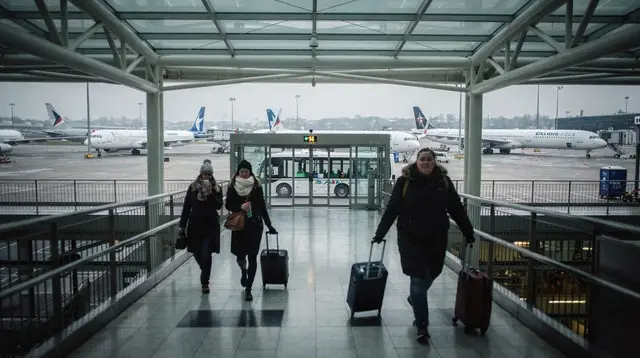
Beauvais airport to Paris: what the shuttle really takes
How long does it take to get from Beauvais airport to central Paris?
Beauvais (BVA) is about 85 km north of Paris, and the shuttle bus to Porte Maillot takes well over an hour, before you add queueing time at either end. Budget the trip as a long transfer, not a quick airport hop like CDG or Orly.
Beauvais is not a Paris airport, and the shuttle proves it
Paris-Beauvais (BVA) shows up in flight searches because it’s cheap, mostly served by low-cost carriers chasing fares that undercut Paris-Charles de Gaulle (CDG) and Paris-Orly (ORY). What the fare page doesn’t tell you is where the airport actually sits: roughly 85 km north of Paris, well past the Île-de-France Mobilités network that runs the Paris metro and RER. There’s no train station at Beauvais, no RER extension reaching it, nothing that plugs it into the same transport map as CDG or Orly. The only practical way into the city is a shuttle bus that runs to Porte Maillot, on the western edge of Paris, timed to flight arrivals and departures rather than to a clock-face schedule.
This page exists because that distinction gets flattened online into generic “airport to Paris” advice, as if the three airports were interchangeable with slightly different travel times. They aren’t. CDG connects to Gare du Nord and Chatelet by RER B in under an hour. Orly has connected to central Paris by metro line 14 since June 2024, a ride of around 30 minutes. Beauvais has neither a train nor a metro line, and the shuttle to Porte Maillot takes well over an hour on its own, before you add anything else. Treating it as a minor variation on the CDG or Orly transfer is the mistake that turns a bargain flight into a wasted afternoon.
The honest travel-time comparison
None of the figures below are prices — they’re the shape of the journey, which is what actually determines whether your flight timing works.
| Airport | Approx. distance to Paris | Main transport link | Typical journey time |
|---|---|---|---|
| Paris-Charles de Gaulle (CDG) | ~25 km northeast | RER B to Gare du Nord / Chatelet | Under an hour |
| Paris-Orly (ORY) | ~13-14 km south | Metro line 14 (since June 2024) | Around 30 minutes |
| Paris-Beauvais (BVA) | ~85 km north | Shuttle bus to Porte Maillot | Well over an hour, shuttle alone |
The Beauvais figure in that last row is the shuttle ride itself. It doesn’t include the time you’ll actually spend getting on the bus: queueing to buy a ticket or board if you haven’t pre-booked, waiting for the next departure if one just left, loading luggage, and then whatever traffic looks like on the approach into Paris, which can add meaningfully more on a bad day. A useful way to think about it: where a CDG or Orly transfer is something you can slot into a tight morning without much anxiety, a Beauvais transfer is a journey that deserves its own line in your itinerary, the same way you’d plan for getting to Versailles or a day trip, not a quick hop across town.
Why this catches low-cost travelers off guard
The pattern is consistent: someone books a low-cost flight into Beauvais because it’s noticeably cheaper than a CDG or Orly fare on the same route, without registering that “Paris” in the airport’s name is doing a lot of work. The flight itself might land at a very reasonable hour. The problem shows up afterward, when the shuttle eats most of the buffer they thought they had.
Two situations make this worse:
A short first day in Paris. If you land at Beauvais in the afternoon and had planned to see something before dinner, recalculate. By the time you’ve cleared immigration if needed, found the shuttle stop, waited for the next departure, and ridden well over an hour into Porte Maillot, then connected onward by metro or RER to wherever you’re staying, a chunk of the afternoon is simply gone. This is the scenario worth being honest about: a landing time that would comfortably allow a stop at the Louvre or a walk through Montmartre after a CDG or Orly arrival often doesn’t leave enough daylight after a Beauvais one.
A short last day before a departure. This is the direction that causes more missed flights. If your Beauvais departure is early or midday, you need to work backward from the shuttle’s last useful departure time, not from how long it would take a taxi to reach CDG. Low-cost carriers at Beauvais also tend to want passengers at the gate well before the flight, and check-in queues at a smaller airport can move slower than you’d expect precisely because it isn’t built for CDG-scale volume. A Beauvais morning flight can realistically mean leaving central Paris the evening before or very early, which eats into whatever you’d planned for a final Seine walk or a last coffee near the Latin Quarter.
Neither of these is a reason to avoid Beauvais. It’s a reason to plan around it deliberately instead of assuming it behaves like the other two airports.
Who a Beauvais flight actually suits
Beauvais isn’t a bad choice — it’s a choice that suits some trips much better than others, and being honest about which category you’re in beats discovering it at the shuttle stop.
It works well if you’re flexible on timing and travelling light. A solo traveler or a couple with carry-on bags, arriving with no fixed plan for the first evening and no early meeting the next morning, can absorb an extra hour or more of transfer time without it costing anything that matters. The same goes if you’re already planning Paris on a budget: the fare saving on a Beauvais flight can be worth more than the time it costs, especially on a longer trip where one extra hour on day one is a small fraction of the total.
It suits you less if you’re travelling with young children, a lot of luggage, or a tightly scheduled trip. A shuttle transfer of well over an hour, with queueing and luggage handling on either end, is a different proposition with a stroller and an overtired toddler than it is with a backpack. Families planning a trip built around Paris with kids or a stop at Disneyland Paris often do better paying more for a CDG or Orly fare and getting a faster, simpler transfer in exchange, particularly on the outbound leg when everyone is already tired from a flight. The same logic applies to a short trip where every daylight hour is accounted for: a two- or three-day visit can’t easily absorb a lost afternoon the way a longer one can.
Neither of these is a hard rule — plenty of families use Beauvais successfully by planning around it deliberately, and plenty of solo travelers get caught out by assuming “airport to Paris” is interchangeable regardless of which one it is. The difference is planning for the transfer explicitly rather than treating the shuttle as an afterthought.
Building the shuttle into your plan
A few practical habits make the Beauvais transfer manageable rather than stressful:
- Check the shuttle’s current schedule against your specific flight, not a general timetable. The shuttle is coordinated with arrivals and departures, and if your flight is delayed or early, you want to know what that does to your connection before you’re standing in the terminal.
- Add a buffer beyond the shuttle’s quoted ride time. Between boarding queues, luggage, and traffic on the approach to Porte Maillot, the door-to-door time from landing to actually being in central Paris runs longer than the bus ride alone.
- Don’t schedule anything time-sensitive on the same day as a Beauvais arrival, especially something like a timed-entry Eiffel Tower slot or an early dinner reservation. Give yourself the evening as a landing buffer instead.
- Work backward from your flight, not forward from a taxi estimate, when planning a Beauvais departure. Confirm the last shuttle that reliably gets you to the airport with margin for check-in and security, and treat that as your real departure time from your accommodation.
- Once you’re at Porte Maillot, the rest of Paris opens up normally through the regular metro network — the extra planning is specific to the airport leg, not the rest of your stay.
If your itinerary allows any flexibility, comparing a Beauvais fare against a CDG or Orly one that costs a bit more but saves an hour-plus of transfer time each way is worth doing before you book, not after you’ve already committed to the shuttle. For context on how the other two airports compare, see the CDG to central Paris guide and the Orly to central Paris guide — both connect far more directly into the city.
What to do once you’re in Paris
Once the shuttle has delivered you to Porte Maillot, the transfer headache is behind you and the ordinary logic of a Paris stay takes over. If your Beauvais flight ate into your first day, don’t try to force a packed itinerary to compensate — ease in instead. A Paris Museum Pass is worth planning for your first full day rather than your arrival evening, since the Louvre and other major sites still require booking a reserved time slot even with the pass in hand.
a multi-day Paris Museum Pass covering the Louvre and dozens of other sitesIf you’d rather ease into the city gently after a long transfer day, a slower-paced activity works better than a full sightseeing itinerary on arrival evening.
a guided food and tasting walk through central ParisFor getting around once you’re settled, renting a bike is a practical way to cover ground without relying on taxis, especially useful if your Beauvais arrival has already cut into your transport budget for the day.
a self-guided bike route through central ParisAnd if a later leg of your trip routes you through CDG instead — for a connecting flight or a different arrival — it’s worth knowing that transfer works very differently from the Beauvais shuttle.
a direct private transfer between CDG and central ParisPlanning the rest of your trip around this
If Beauvais is your entry or exit point, the practical move is to build slack into the days on either side of that flight rather than trying to compress your plans around it. Read up on how many days in Paris makes sense for what you want to see, and treat your Beauvais travel day as a half-day at best, not a full one. If you’re passing through Paris briefly on a longer trip, the layover guide and matching layover itinerary are written with exactly this kind of tight-margin planning in mind, and the logic transfers directly to a Beauvais arrival or departure.
For first-time visitors weighing where to stay, proximity to Porte Maillot isn’t a meaningful factor — once you’re off the shuttle, the regular Paris metro and RER network gets you anywhere in the city on the same terms as anyone who flew into CDG or Orly. Choose your neighborhood the way you would for any first Paris visit, and treat the Beauvais transfer as a one-off logistics item rather than something that should shape your whole stay. If you’d rather skip the shuttle scheduling entirely, a taxi or private transfer is worth pricing against the shuttle’s time cost, particularly if you’re arriving with a group where the per-person shuttle time adds up.
For everything else about getting around once the airport leg is done, see the taxis and ride-hailing guide and the general ticketing and Navigo guide, and for the wider list of things worth knowing before you land in any of Paris’s three airports, the pre-visit essentials guide and the CDG-specific RER-versus-taxi breakdown are useful companion reading, even though neither applies directly to Beauvais.
A few practical basics for your first hour in France
If Beauvais is your first landing point in France, a handful of practical details are worth knowing before you’re standing at immigration or the shuttle stop, none of which change based on which of the three Paris airports you land at.
Entry rules. France is part of the Schengen area. If you’re travelling on a passport that doesn’t need a visa for a short stay — the UK, the US, Canada, Australia, and Japan among others — you can generally stay up to 90 days within any 180-day period. Since 12 October 2025, the EU’s new Entry/Exit System (EES) has been rolling out at external Schengen borders, which means fingerprints and a photo at your first entry point rather than a passport stamp; the rollout is due to finish by April 2026, so depending on exactly when you travel, Beauvais may or may not have it fully in place.
ETIAS, the separate pre-travel authorisation for visa-exempt visitors, isn’t required yet — the EU has signalled a launch later in 2026, but check travel-europe.europa.eu for the current status rather than relying on a fixed date, since it keeps shifting. For the full picture, see the France visa and entry rules guide. If you hold an EU, EEA, or Swiss passport, a national ID card is enough and none of this applies to you.
Money and basics. The currency is the euro, and cards and contactless payment are accepted almost everywhere in and around Paris, including on the shuttle and the metro system you’ll use once you arrive — though it’s worth carrying a little cash for smaller purchases, especially at markets. Mains power is 230V at 50Hz, using the two-pin type C or type E sockets standard across France, so a UK or North American adaptor is worth packing rather than buying at the airport. France runs on Central European Time (UTC+1 in winter, UTC+2 in summer under daylight saving), which is worth double-checking against your shuttle and connection times if you’re arriving from a time zone that makes early-morning math easy to get wrong after an overnight flight.
None of this is specific to Beauvais, but it’s the kind of thing that’s easy to overlook when you’re focused on the shuttle logistics and it’s genuinely useful to have settled before you land rather than looked up in the arrivals hall.
The bottom line is straightforward: Beauvais can be a genuinely good deal on the flight itself, but it charges that saving back in transfer time. Plan the shuttle as its own leg of the trip, keep your first and last days in Paris light if either one touches a Beauvais flight, and the rest of your visit runs exactly as smoothly as it would from CDG or Orly.
Paris transport and getting around guides on GetYourGuide
Verified deep-linked GetYourGuide tours. Book through these links and we earn a small commission at no cost to you.
GetYourGuide does not provide a product photo for this activity — the image shows the meeting point, photographed by us.