Paris with kids: a family guide to the city
Is Paris a good destination for a family with kids?
Yes, for children old enough to handle a day of walking and a museum visit with some structure. The city works well for families with the right pacing, but Disneyland Paris is a separate excursion about 30-35 km east of the city, not a same-day add-on.
What this guide actually covers
This is a guide for families with children old enough to walk a full day and sit through a guided tour without a stroller or a nap schedule to manage — roughly primary-school age through the teenage years. If the trip involves a toddler, buggy logistics, and short attention spans, Paris with toddlers covers that ground instead and gives different, more conservative advice.
Paris itself has more for families than its reputation as a couples’ city suggests. The mix of open-air sights, hands-on workshops, and museums with real kid appeal means a week can go by without repeating an activity. The one thing to get right from the start is scope: Paris and Disneyland Paris are two separate trips stitched into one itinerary, not the same destination.
Paris itself, at a pace kids can handle
The city’s core sights work for families when they are not crammed into a single exhausting day. The Eiffel Tower and Trocadero area is a natural half-day: the Champ de Mars gives kids room to run before or after a tower visit, and the Trocadero terrace across the river gives a view of the tower without a queue at all. A timed-entry ticket booked ahead matters here more with children than with adults — a two-hour wait in a packed line tests any family’s patience, and skipping the line is one of the few genuine upgrades worth paying for.
A Seine river cruise is an easy win with kids of almost any age in this range: it is seated, it is roughly an hour, and it puts the Ile de la Cite, Notre-Dame de Paris, and the bridges in view without a single step of walking. It also works as a low-effort activity on a day when legs are tired from a museum morning.
a guided bike tour built around younger riders is a good alternative for families who want to cover more ground outdoors — it turns transit between sights into part of the day rather than dead time on the metro.
Montmartre rewards kids who like hills, stairs, and street performers more than gallery-heavy itineraries do, and the funicular up to Sacre-Coeur is itself a small adventure. The Louvre and Musee d’Orsay both work with children, but not as an all-day march through every wing — a focused hour with a handful of famous pieces holds attention far better than an open-ended visit, and both museums close one day a week (the Louvre on Tuesday, Orsay on Monday), so it is worth checking the calendar before building a day around either one.
Museums, workshops, and hands-on activities
Kids in this age range generally respond better to doing something than to looking at something. Paris has a genuine cluster of hands-on classes built specifically for children, which is worth leaning on for at least one or two days of a longer trip.
a macaron-making class aimed at kids and a similar session built around croissants both run a couple of hours, are indoors, and end with something the child made themselves — reliable on a rainy day when outdoor plans fall through. A fashion-design workshop with a sticker book aimed at younger kids works the same way for children who are more drawn to art and design than to food.
For families who prefer a guided walk over a workshop, a walking tour with a local guide pitched at a family pace covers central Paris without the forced-march feel of a standard adult tour. Paris family activities and escape games rounds up more of this category, including indoor options for when the weather does not cooperate.
Museums worth flagging specifically for kids: the natural history and science-leaning collections tend to land better than fine art for younger children, and shorter, themed visits beat trying to see an entire major museum in one sitting. For older children with an interest in art or history, a guided version of the Louvre or Orsay with a guide used to talking to families is usually a better fit than a self-guided wander. Best museums in Paris and free things to do in Paris are both worth a look when building out a longer list, since a family trip does not have to be paid activity after paid activity to fill the days — a Paris museum pass can also make sense for a family planning to see several sights in a short window, since it cuts down on separate ticket lines at each entrance.
Montmartre deserves its own mention here: beyond the funicular and the Sacre-Coeur steps, the neighborhood’s food and wine tours and art-focused walks are mostly built for adults, but things to do in Montmartre flags the parts of the hill that work for children, including the square where street artists work and the views from the Sacre-Coeur terrace that need no ticket at all.
What to skip or handle carefully
Honesty matters more here than anywhere else in a Paris itinerary. The Paris catacombs are a genuine highlight for some older kids and teenagers with a taste for the macabre, and a flat no for others — narrow passages, low light, and stacked human remains are not for every child, and there is no way to preview the atmosphere before walking in. Decide as a family in advance rather than finding out at the entrance.
The Eiffel Tower without a booked slot is the other recurring problem. The queue for tickets on the day can run past two hours in high season, which is a rough ask for any child. This is one of the few places in Paris where paying for a timed entry is a genuine quality-of-life improvement rather than an upsell.
Long, unstructured museum days are the third trap. A child who is fine for ninety focused minutes in the Louvre will often be miserable at hour four. Splitting a big museum into two shorter visits, or picking a guided family version over a self-guided one, tends to work better than trying to see everything in one pass.
Disneyland Paris: a separate trip, not a city sight
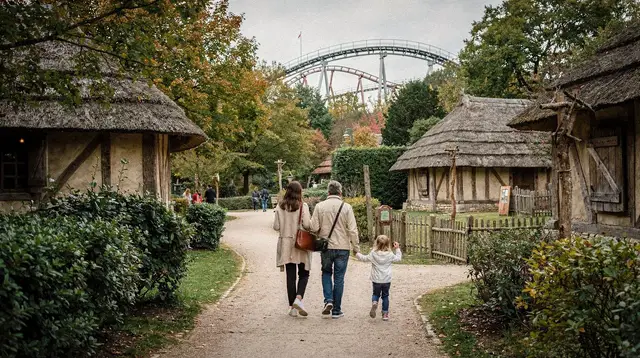
Disneyland Paris is not in Paris. It sits about 30-35 km east of the city center, at Marne-la-Vallee - Chessy, and is reached by RER A or by TGV. That distance is the single most common source of disappointment in family trip planning: treating it as a quick afternoon add-on to a Paris day means arriving late, leaving early, and getting a fraction of the park.
Give it its own full day, ideally with an early start, and treat travel time as part of the day rather than a footnote. How to get to Disneyland Paris covers the RER and TGV options in more detail, and Disneyland Paris with kids goes into ride suitability by age and how to structure the day once inside. The Disneyland Paris destination page is the place to check what is bookable for a given date.
Where Disneyland Paris fits in a longer trip
For a family spending four or more days in the region, the cleanest structure is Paris first, Disneyland Paris as a dedicated day near the end — that way, tired legs from the theme park do not have to be dragged through another museum the next morning. Families on a shorter trip sometimes have to choose between the two rather than fitting both in properly, and a rushed half-day at the park is rarely worth it compared with spending that time doing Paris well instead.
Getting around Paris with children
Paris and its region are covered by Île-de-France Mobilités, running 16 metro lines and 5 RER lines alongside trams and buses. Since the January 2025 fare reform, single tickets come in two forms — a Metro-Train-RER ticket and a separate Bus-Tram ticket — loaded onto a Navigo Easy card or a phone. Families staying several days are usually better served by a weekly Navigo pass (Monday to Sunday) or a Paris Visite pass aimed at visitors; neither has a fixed price worth quoting here since fares change.
Most metro stations were not built with strollers or wheelchairs in mind, and while children old enough to walk a full day manage stairs and transfers without much trouble, it is worth building in a little slack between stops rather than cutting connections close. Families still traveling with a stroller for a younger sibling, or anyone managing a wheelchair, should read the Paris metro with a wheelchair or stroller before relying on the metro as the default way around — some lines and interchanges are far easier than others, and a bus or taxi is sometimes the simpler choice for a specific leg. Crowded lines — line 1 in particular, along with the RER B — are also where pickpockets are most active, so keeping bags zipped and valuables out of back pockets matters more, not less, with a family in tow.
Driving in Paris is not recommended for visitors: traffic, scarce parking, and a low-emission zone requiring a Crit’Air sticker make it more hassle than it is worth for a family sightseeing on foot and by metro. Taxis and ride-hailing in Paris is the better fallback for a tired evening, a late arrival with luggage, or a stretch of the day when small legs have simply had enough of stairs and corridors.
Where to stay with a family
A short, quiet walk to a metro station matters more with kids than the neighborhood’s nightlife or restaurant scene. Where to stay in Paris covers the trade-offs by area in general terms, but a few districts stand out for families specifically. Where to stay near the Eiffel Tower puts a family within walking distance of the Champ de Mars, useful for a trip built around that sight and an easy Seine cruise. Where to stay in Le Marais sits close to Notre-Dame, the Ile de la Cite, and a dense cluster of family-friendly food options, with less distance to cover on tired legs at the end of a day. Both are quieter choices than staying near the nightlife-heavy stretches of the Latin Quarter, which suits couples and groups of friends better than a family with an early bedtime to keep.
Eating out with a family
Restaurants in Paris rarely have a dedicated kids’ menu the way some other countries do, but most cafes and bistros are used to families and will happily split a plate or bring bread and water without being asked twice. What to eat in Paris is a good starting point for picking dishes a child is likely to actually eat, and a bakery stop for a pastry between sights is an easy way to keep energy up without sitting down for a full meal. Service is included in the price at cafes and restaurants by law, so there is no obligation to calculate a tip on top of the bill — rounding up is a courtesy, not a requirement.
Sunday is worth planning around: many shops close for the day outside the main tourist areas, though bakeries and restaurants generally stay open. Tap water is safe to drink throughout the city, including from the green Wallace fountains dotted around parks and squares, which is a useful, free way to refill a bottle between sights on a hot day rather than buying one at every stop.
Practical basics for a family trip
Currency is the euro, and cards and contactless payment are accepted almost everywhere, though a little cash is useful at street markets. Tipping is not required — a service charge is already included in cafe and restaurant prices by law, though rounding up or leaving a couple of euros is common and appreciated, never obligatory.
Paris runs on Europe/Paris time, UTC+1 in winter and UTC+2 in summer, and power outlets are the standard European type C/E, 230V at 50Hz — worth packing an adapter for if traveling from outside continental Europe.
On entry rules: France is part of the Schengen area. Visitors from visa-exempt countries such as the UK, US, Canada, Australia, and Japan can stay up to 90 days within any 180-day period. The new European Entry/Exit System, which records fingerprints and a photo at the external border, has been running since 12 October 2025 and is due to be fully rolled out by April 2026. ETIAS is not yet required — the EU has flagged a launch in the last quarter of 2026 without confirming a date, so check travel-europe.europa.eu closer to a trip date rather than relying on any fixed figure written here. Travelers who do need a Schengen visa should start at france-visas.gouv.fr well ahead of departure.
Best time of year for a family trip
April to June and September to October are the most comfortable windows — mild weather, manageable crowds compared with peak summer, and outdoor sights like the Seine and Montmartre at their best. Summer brings heat and occasional heatwaves, and in August many Parisians leave the city, so some smaller restaurants and shops close for stretches — worth checking before counting on a specific place being open. Winter is cold and often gray, but the Christmas lights and markets are a genuine draw for families who don’t mind the chill, and lines at major sights tend to be shorter. Rain is possible in any season, which is another reason to keep an indoor workshop or two in reserve.
Building the itinerary
For families planning a multi-day trip, Paris with kids in four days lays out a day-by-day structure that balances museum mornings, outdoor afternoons, and one full day set aside for Disneyland Paris. Family day trips from Paris is worth a look for families staying five days or more who want a second excursion beyond the theme park, and Is Paris good for kids covers the broader question of whether the city suits a given family’s travel style before committing to a full itinerary.
Family-friendly Paris activities on GetYourGuide
Verified deep-linked GetYourGuide tours. Book through these links and we earn a small commission at no cost to you.
GetYourGuide does not provide a product photo for this activity — the image shows the meeting point, photographed by us.