The Paris Catacombs: what the visit is really like
What are the Paris Catacombs and is the visit difficult?
The Paris Catacombs are a former limestone quarry beneath the 14th arrondissement, lined with the bones of several million Parisians moved there from overcrowded cemeteries from the late 18th century onward. The visit covers around 1.5 kilometres underground on foot, including a narrow spiral staircase down and another one back up, in cool, dim, confined conditions that do not suit everyone.
Most of what fills a first-time visitor’s list of things to do in Paris sits above ground: a monument, a museum, a view. The Catacombs are the one site in this category that sits below it, and that single fact changes almost everything about how the visit works, who it suits, and what to expect when the door closes behind the group ahead.
An underground ossuary, not a museum
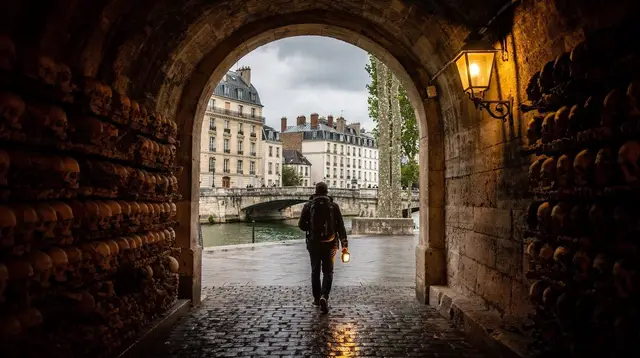
The Paris Catacombs occupy a network of former limestone quarries that were carved out from beneath the city over centuries to supply the stone Paris was built from. By the late 1700s, the quarries had a second job: Paris’s central cemeteries, above all the Cimetiere des Innocents, were overflowing and posing a public health problem, and the city began moving the bones into the emptied-out tunnels. That transfer continued into the early 1800s, and the result is what visitors walk through today — corridors where skulls and long bones are stacked and arranged along the walls, the remains of several million Parisians relocated underground.
It is worth saying plainly: this is not a museum with cases and labels at a comfortable remove. It is a walk through the actual ossuary, at close range, underground, in conditions that are cool, dim, and quiet in a way that few other Paris sites are. Visitors who arrive expecting a slightly spookier version of the Louvre or the Musee d’Orsay are usually surprised by how physical and how different the experience actually is.
What the visit is physically like
The public route runs close to 1.5 kilometres, almost all of it underground, and it is a one-way path: there is no midpoint exit, and no way to turn back once well into the circuit. Getting down means a spiral staircase of well over a hundred steps, and getting back up at the end means another flight, similarly narrow. In between, ceiling height varies — some stretches are comfortably tall, others require ducking or walking single file — and the air underground stays cool year-round, several degrees below the street above, regardless of season.
None of this makes the Catacombs a bad visit. It makes it a specific one. Anyone who finds enclosed spaces, low light, or long stretches without an easy exit genuinely uncomfortable should weigh that honestly before booking, rather than assume it will feel like any other Paris attraction. The same goes for visitors who are short on time or energy: this is not a site to fit into fifteen spare minutes between two other stops. Between the staircases, the walking distance, and the queue if arriving without a timed ticket, it is closer to an hour-long commitment at minimum, more with a guided or extended route.
Strollers and wheelchairs cannot make the descent — there is no lift, and the staircases rule both out. Large backpacks and bags are impractical in the narrower passages and are commonly restricted at the entrance. None of this is written to discourage a visit; it is written so a visitor arrives knowing what they are actually signing up for.
Why booking ahead matters here
Daily capacity underground is limited for safety and conservation reasons, and this is consistently one of the more sought-after sites in Paris. That combination — a hard cap on numbers and strong demand — means the walk-up queue at Place Denfert-Rochereau can run long with no guarantee of getting in that day at all. In the spirit of straightforward, honest planning rather than a hard sell: a dated, timed reservation booked ahead is generally the safer route for a site this popular, the same logic that applies to the Louvre or Sainte-Chapelle. Turning up without one is possible but leaves the visit to chance.
A standard entry ticket covers the fixed public route through the ossuary at a visitor’s own pace, typically with an audio guide included for context along the way. For travellers who prefer a guide who can put the history in order as they walk, a guided visit with special access to sections beyond the standard circuit covers more ground and adds live commentary rather than a recorded track. Somewhere between the two sits a timed entry ticket bundled with an audio guide, which suits visitors who want the standard route explained without committing to a guided group. And for those specifically drawn to the quarry sections closed to general admission, a dedicated special access tour of the wider quarry network goes further than the standard ossuary walk alone.
None of these routes are covered by the Paris Museum Pass, which is worth knowing before assuming it applies here the way it does at the Louvre or Versailles — the Catacombs sit outside that pass’s list of included sites.
Where it is, and what it is not near
The public entrance is at Place Denfert-Rochereau, in the 14th arrondissement on the Left Bank — well south of the river’s central tourist core. It is not close to the Ile de la Cite, Notre-Dame, or the Louvre, and it should not be treated as a quick add-on to a morning spent around those sites. It is also unconnected, geographically and thematically, to the other underground-adjacent curiosities of Paris; this is its own destination, reached on its own trip, not a stop folded into a walk through the Latin Quarter and Saint-Germain even though that district lies in the same general direction. The nearest metro station is Denfert-Rochereau itself, on the city’s metro network, which makes getting there straightforward even if the surrounding streets feel a long way from the postcard centre.
Because the entrance and exit are in different spots a short walk apart, and because the visit itself takes the better part of an hour once queueing is factored in, it is worth building real time around it rather than squeezing it between two other stops on a tight one-day plan.
Who should think twice, and what to do instead
Beyond claustrophobia and time pressure, there are a few other honest reasons to reconsider. Very young children can find the close-up display of human remains unsettling rather than fascinating, and there is no way to preview or soften that once inside — families should decide deliberately rather than assume it will land as an adventure for everyone. Visitors who use a wheelchair or need step-free access will not be able to complete the route at all, given the staircases at both ends; an accessible Paris guide covers sites better suited to limited mobility. Anyone simply pressed for time on a short stay is often better served putting that slot toward a site with a shorter, more flexible visit — the guide to what to do in Paris or a look at how many days to plan for Paris can help decide where the hour is best spent.
For everyone else, it remains one of the more distinctive things to do in the city precisely because nothing else on a typical Paris itinerary feels like it. A short, well-guided tour by vintage Citroen 2CV afterward is a common way travellers reset with fresh air and daylight after the quiet of the tunnels, though that is a matter of personal pacing rather than a rule.
Standard route or guided access: a quick comparison
| Option | What it covers | Pace | Best for |
|---|---|---|---|
| Entry ticket with audio guide | Fixed public ossuary route, self-paced | Visitor sets the pace | Independent visitors who want context without a group |
| Guided tour, special access | Standard route plus sections beyond the public circuit, live guide | Guide sets the pace | Visitors who want history explained as they walk |
| Special access tour of the quarry | Extended quarry network beyond the standard ossuary walk | Guide sets the pace | Repeat visitors or those drawn to the wider tunnel system |
None of these differ meaningfully in physical demands — the same staircases and the same underground conditions apply across all three, so the choice comes down to how much context a visitor wants and how much of the wider quarry they want to see, not to comfort.
Honesty about affluence and pacing
Because this is a fixed-capacity, one-way underground route, arrival can mean a wait even with a timed ticket if the site is running behind, and mid-morning through early afternoon tends to be the busiest stretch of the day. Visitors who prefer a quieter pass through the corridors, with less bunching against the person ahead, generally do better booking an early or late timed slot where the site allows a choice. This is a small, practical point rather than a warning: the ossuary itself does not change with the crowd, but the comfort of moving through it does.
Planning the rest of the day around it
Given the location south of the centre and the time the visit itself takes, it rarely fits neatly next to a morning at the Ile de la Cite and Notre-Dame or an afternoon at the Louvre and Tuileries. Travellers building a longer stay sometimes pair it with other Left Bank plans on the same day rather than trying to connect it to sites on the opposite side of the river; the Latin Quarter and Saint-Germain walking tours guide covers that general area if extending the day southward. For families weighing whether the visit fits the trip at all, the broader Paris with kids guide sets it in context against gentler alternatives, and the is Paris safe for tourists guide covers the ordinary safety questions that come up around any busy attraction, underground or not.
Frequently asked questions about visiting the Paris Catacombs
Are the Paris Catacombs suitable for claustrophobic visitors?
Some sections have low ceilings and narrow passages, and the route is a fixed one-way path underground with no quick way out partway through. Anyone who struggles with confined spaces should think carefully before booking, since there is no shortcut back to the surface once the visit is underway.
Do I need to book Catacombs tickets in advance?
The site is popular and daily capacity underground is limited for safety reasons, so an on-the-day queue can run long with no guarantee of entry. Booking a dated ticket ahead of time is generally the safer approach for a site this sought-after, rather than turning up and hoping.
How long does the Catacombs visit take?
Plan on roughly 45 minutes to an hour underground for the standard route, plus queuing time if arriving without a timed reservation. A guided or special access visit can run longer, since it covers areas closed to the general public.
Where do the Paris Catacombs start, and are they near Notre-Dame or the Louvre?
The public entrance sits at Place Denfert-Rochereau in the 14th arrondissement, on the Left Bank, well south of the Ile de la Cite and the Louvre. It is not within walking distance of those sites and should not be paired with them on the same short visit.
Is the Catacombs visit appropriate for young children?
The subject matter is human remains displayed at close range in a dim, enclosed underground space, which unsettles some children and some adults. Families should weigh this honestly rather than treat it as a standard sightseeing stop.
Can I bring a stroller, wheelchair, or large bag into the Catacombs?
The route involves a spiral staircase of well over a hundred steps down and another flight back up, with no lift, which rules out strollers and wheelchairs. Large bags and backpacks are also impractical in the narrow passages and are typically restricted.
What is the difference between a standard ticket and a special access tour?
A standard entry ticket covers the fixed public route through the ossuary. A guided or special access tour adds a guide’s commentary and, in some cases, entry to quarry sections beyond the standard circuit, which is not something a self-guided ticket includes.
Paris catacombs and underground tours on GetYourGuide
Verified deep-linked GetYourGuide tours. Book through these links and we earn a small commission at no cost to you.
GetYourGuide does not provide a product photo for this activity — the image shows the meeting point, photographed by us.