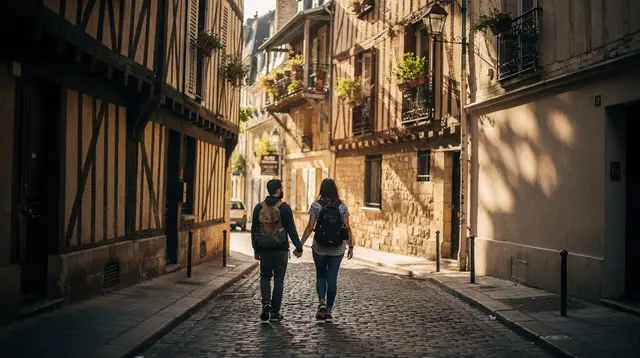
Walking the Latin Quarter and Saint-Germain-des-Prés
What is a walk through the Latin Quarter and Saint-Germain-des-Prés actually like?
It's a Left Bank neighbourhood walk built around the Sorbonne, narrow student streets, secondhand bookshops and historic cafés, not a checklist of paid monuments. Most people cover the core on foot in two to three hours, and no reservation is needed to simply wander.
A Left Bank walk, not a monument checklist
The Latin Quarter and Saint-Germain-des-Prés sit next to each other on the Rive Gauche, the south bank of the Seine, and the site groups them together because most visitors walk them as one outing. That’s the first thing to understand about this pair of neighbourhoods: they don’t organise themselves around a single ticketed monument the way Ile de la Cité and Notre-Dame or the Louvre and Tuileries do. There’s no headline sight to queue for here. What there is instead is a long, low-key promenade through one of the oldest parts of the city — narrow streets built around a university, secondhand bookshops that have sold the same stock for decades, and cafés where writers actually sat and worked, not just cafés that say they did.
That distinguishes this walk sharply from the Right Bank’s Marais, a dense historic quarter of Jewish heritage sites, narrow medieval lanes and independent designer boutiques, and from Montmartre, a hilltop village built around the Sacré-Cœur and its views. Here on the Left Bank, the Sorbonne is the organising landmark, not a basilica or a museum, and the atmosphere leans academic and literary rather than monumental. If you come expecting a must-see building every hundred metres, adjust your expectations: the reward is the texture of the streets, not a single photograph.
Where the Latin Quarter and Saint-Germain actually are
Both neighbourhoods sit in the 5th and 6th arrondissements, part of Paris’s spiral of 20 arrondissements numbered clockwise from the Louvre outward. The Latin Quarter takes its name from the Latin once spoken by students and scholars at the Sorbonne, founded in the 13th century; the university still anchors the area, and the streets around it — rue Saint-Jacques, rue de la Huchette, the square in front of the Panthéon — keep a studenty, slightly scruffy energy even where rents have climbed. Saint-Germain-des-Prés lies just to the west, centred on its Romanesque church, one of the oldest in Paris, and on the café terraces along boulevard Saint-Germain that were the meeting ground for 20th-century writers and philosophers.
The two neighbourhoods blend into each other without a clear boundary, which is exactly why they’re walked as a pair rather than as separate destinations. If you’re staying nearby, see where to stay in Saint-Germain-des-Prés or where to stay in the Latin Quarter for how each end of the walk suits a different kind of stay — one closer to the university bustle, the other closer to the antique shops and higher-end boutiques.
How long the walk actually takes
Set a realistic expectation: a relaxed loop covering the core of both neighbourhoods — the Sorbonne area, rue Mouffetard, the Panthéon exterior, boulevard Saint-Germain, the church of Saint-Germain-des-Prés and the streets around it — runs about two to three hours on foot at a normal pace, before you factor in any stop longer than a photo. Add thirty minutes to an hour if you want to browse a bookshop properly or sit down at a café rather than walk past it. This isn’t a neighbourhood you rush through in forty minutes and tick off; the appeal is in slowing down, and a walk done too fast just becomes a series of streets with no particular meaning attached.
Distances are modest. From the Sorbonne to the church of Saint-Germain-des-Prés is roughly 1.5 kilometres, an easy 20-minute walk on flat ground, so there’s no need to plan transport between the two halves of this outing unless your feet are already tired from earlier in the day.
What you’ll actually see
Rue de la Huchette and the surrounding lanes near Saint-Séverin church keep some of the narrowest, most medieval street plan left in central Paris — worth a slow pass even though the immediate area is heavily touristed with restaurants of uneven quality. A few streets south, rue Mouffetard runs downhill as one of the city’s oldest market streets, livelier and more local in tone. The Sorbonne’s courtyard and the Panthéon’s exterior (the building itself has its own separate visit) give the area its academic backbone.
The Panthéon’s dome is visible from several points along this route, and it’s easy to assume from the outside that a quick look is all there is to it — it isn’t. Going inside to see the crypt and the building’s full neoclassical interior is a separate, ticketed visit with its own pacing; see the full Panthéon guide if you want to add that stop rather than just photograph the dome from the street.
Further south and slightly off the main tourist path, rue Mouffetard’s market stalls are at their best in the morning, before the lunchtime crowd of workers and students thins the produce and the queues at the cheese and bread stalls grow. It’s one of several markets the city is known for; see the best food markets in Paris for how it compares to others worth a detour. If you’d rather taste your way through the neighbourhood with someone else doing the choosing, a guided pastry tour of the Latin Quarter stops at a handful of bakeries along a short walking route, and pairs naturally with a broader look at pastry and macaron classes in Paris if you’d rather learn to make what you’ve been eating.
Crossing into Saint-Germain, the bookshops thin out and antique dealers and clothing boutiques take over, especially around rue de Seine and rue de Buci. The café terraces on boulevard Saint-Germain and place Saint-Germain-des-Prés are the neighbourhood’s best-known feature — worth a coffee stop, less because the coffee is exceptional than because sitting there is the point. For more on ordering and pacing yourself at a Paris café, see Paris café culture and etiquette.
None of this requires a ticket. That’s worth repeating because it’s easy to assume, in a city where the Louvre and Sainte-Chapelle both require a reserved time slot, that everything worth seeing does too. Wandering these streets costs nothing and needs no booking — the only reservations that matter are for specific interiors you choose to enter along the way, such as the Musée d’Orsay, which sits on the river a short walk from Saint-Germain and faces the Tuileries on the opposite bank, or Sainte-Chapelle and Notre-Dame a little further east on Ile de la Cité.
Self-guided versus a booked walking tour
Because nothing here demands a ticket, a self-guided walk with a map is a completely reasonable way to see this area, and plenty of visitors do exactly that, especially if they’ve already spent a day on general Paris walking tours and have a feel for how the city’s streets connect. A booked guided walk adds two things a self-guided route can’t: someone who can explain what you’re looking at — why a particular café mattered, what the Sorbonne’s history actually is, how the street plan survived Haussmann’s renovations elsewhere in the city — and a fixed route that avoids backtracking or missing a turn.
a walking tour that links Saint-Germain and the Latin Quarter in one guided route covers both neighbourhoods in a single outing, useful if your time in Paris is tight and you don’t want to plan the connecting route yourself. For a version that folds in a food stop, a Latin Quarter walk paired with a quiche tasting breaks up the walking with a sit-down stop, which suits visitors who find a two-hour walk without a break tiring. If your itinerary already has Ile de la Cité on the same day, a route that extends the Saint-Germain and Latin Quarter walk toward Notre-Dame connects the two areas without doubling back.
None of these are necessary to enjoy the neighbourhood — they’re worth it mainly for context and convenience, not because the streets are otherwise inaccessible.
Where this fits against the Marais and Saint-Germain’s own food scene
Two other pages on this site cover adjacent ground, and it’s worth being clear about how they differ so you pick the right one. Marais walking tours cover a Right Bank quarter built around Jewish heritage sites, a tighter medieval street grid and a concentrated cluster of independent boutiques — a different rhythm from the university-and-literary feel on this side of the river. Separately, Saint-Germain and Latin Quarter food tours cover largely the same streets described here but built around tastings and a restaurant-focused itinerary rather than the walking route and its history. If your priority is eating your way through the neighbourhood, that page is the better starting point; if it’s understanding the streets and their past, stay with this one.
Extending the walk toward the river
Saint-Germain’s western edge and the Latin Quarter’s eastern edge both lean toward the Seine, which makes this walk easy to stretch in either direction without much extra planning. Toward the east, the streets around Saint-Séverin run straight into Ile de la Cité, so a visitor who wants to see Notre-Dame up close, not just from across the river, can fold that stop onto the end of this walk rather than treating it as a separate outing. West of Saint-Germain, past the boulevard, lies the Musée Rodin and Les Invalides — a different pace and subject entirely, sculpture gardens and Napoleon’s tomb rather than bookshops and cafés — worth knowing about even if it’s a walk for another day; see the Rodin Museum guide for what that detour involves.
Best time of year for this walk
This is an outdoor, street-level walk with no interior queues to manage, so the weather matters more here than it does for a museum day. April through June and September through October are generally the most comfortable stretches — mild enough to walk for two or three hours without rushing between patches of shade, and before or after the heaviest summer crowds settle into the narrowest lanes near Saint-Séverin.
Summer brings heat that can turn a leisurely stroll into something more tiring by mid-afternoon, and August in particular sees many Parisians leave the city, so a handful of smaller bookshops and family-run restaurants along the route may be shut for part of the month. Winter works too — the streets are quieter and the cafés feel more like refuges than tourist stops — just budget for grey skies and a coat. See the best time to visit Paris and Paris in spring for a fuller month-by-month picture.
Practical notes for the walk
Wear comfortable shoes — the pavement in the older Latin Quarter lanes is uneven cobblestone in places, and there’s no flat, paved plaza the way there is around the Louvre. The area works in any season, though summer afternoons bring crowds to the narrowest streets near Saint-Séverin, and a rainy day (possible in any season in Paris) is easier to handle here than in an outdoor park, since cafés and bookshops offer plenty of cover. If you’re building this into a longer day, How many days in Paris and a one-day Paris itinerary both show how a Left Bank walk like this one slots alongside a morning at the Louvre or an afternoon on Ile de la Cité without over-scheduling the day.
Public transport reaches both ends easily: RER B and several metro lines stop near the Sorbonne and Saint-Michel, and Saint-Germain-des-Prés has its own metro station on line 4. There’s no need to drive, and driving into central Paris is discouraged in any case given traffic, limited parking and the low-emission zone.
For a broader sense of what walking tours across the whole city look like, Paris walking tours and the citywide walking tours category list options beyond this one neighbourhood, and things to do in the Latin Quarter and Saint-Germain area rounds up activities beyond walking, from food tours to museum visits nearby.
Latin Quarter and Saint-Germain-des-Prés: questions before you go
How long does it take to walk the Latin Quarter and Saint-Germain-des-Prés?
Budget two to three hours for a relaxed loop through both neighbourhoods, longer if you stop in bookshops or a café. Rushing it in under an hour misses the point of the walk.
Do I need to book anything to visit the Latin Quarter or Saint-Germain-des-Prés?
No. Unlike the Louvre or Sainte-Chapelle nearby, there is no ticket or time slot for the streets themselves. A reservation only matters if you add a specific museum, church interior or guided walk.
Is this the same as visiting the Musée d’Orsay?
No, but they sit close together. The Musée d’Orsay is on the Left Bank facing the Tuileries across the Seine, and it’s easy to fold into the same outing, though it needs its own ticket and time.
Is the Latin Quarter walk different from a Marais walk?
Yes. The Marais, on the Right Bank, is built around Jewish heritage sites and designer boutiques in a dense historic grid. The Latin Quarter and Saint-Germain read as a university and literary district, with narrower streets around the Sorbonne and fewer standout monuments.
What’s the difference between the Latin Quarter and Saint-Germain-des-Prés?
They’re adjoining Left Bank areas usually walked together. The Latin Quarter centres on the Sorbonne and student life; Saint-Germain-des-Prés, just west, is known for its literary cafés and higher-end shopping streets.
Can I combine this walk with Notre-Dame or the Louvre?
Yes. Ile de la Cité and the Louvre are both a short walk or one Seine crossing away, so many visitors link the neighbourhoods in a single afternoon, provided they’ve reserved time slots for whichever monuments they plan to enter.
Are there paid guided tours of this area?
Yes, several guided walking tours cover the Latin Quarter and Saint-Germain, some paired with food tastings. They add context and a fixed route, but they aren’t required to enjoy the streets on your own.
Paris walking tours on GetYourGuide
Verified deep-linked GetYourGuide tours. Book through these links and we earn a small commission at no cost to you.
GetYourGuide does not provide a product photo for this activity — the image shows the meeting point, photographed by us.