Paris food markets: covered halls and open-air stalls
What is the difference between a covered market and an open-air market in Paris?
A covered market (marche couvert) is a permanent hall open most days, with the same stallholders and a slower, year-round rhythm. An open-air market (marche decouvert) sets up on specific mornings, usually two or three times a week, along a street or square, and packs away by early afternoon. Both sell fresh produce, cheese, meat, fish and prepared food side by side.
Two kinds of market, and why the difference matters
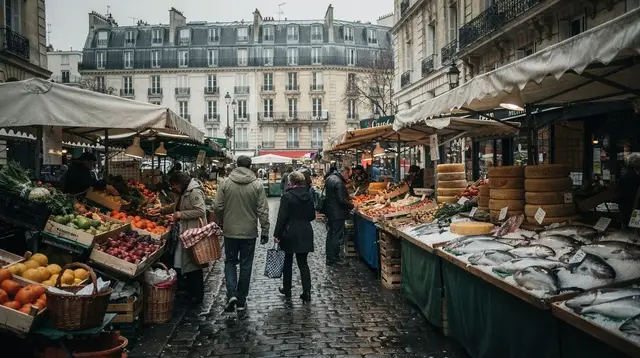
Paris runs on two distinct kinds of food market, and mixing them up is the fastest way to show up at the wrong time. A covered market, or marche couvert, is a permanent building: stone or iron-framed halls with fixed stalls, open most days of the week, run by the same butchers, cheesemongers and greengrocers year-round. An open-air market, or marche decouvert, is the opposite: a street or square that turns into a market on two or three set mornings a week and reverts to ordinary traffic by early afternoon, with stalls that pack up completely and leave almost no trace behind.
Both formats sell broadly the same range of goods: fruit and vegetables, cheese, bread, fish, meat, olives, spices, flowers, and usually a scattering of stalls selling something ready to eat on the spot. What differs is the rhythm. A covered market has a kind of permanence to it; you can drop in most days and find largely the same faces. An open-air market has urgency built in: the stalls arrive early, trade hard for a few hours, and disappear, which gives it a different, more compressed energy.
This page is about the markets themselves as something to visit and watch, not as a meal option. If the goal is understanding how and where to eat in Paris more broadly, restaurant formats, cafes, and bouillons, that ground is covered in what to eat in Paris rather than repeated here.
What you will actually see
A market visit rewards slow walking more than a checklist. The interesting part is rarely a single stall, it is the pattern across the whole market: how a cheese stall arranges its wheels, how a fishmonger lays out the morning’s catch on ice, how regulars greet stallholders by name and skip the browsing entirely because they already know what they want. Watching a market work is closer to watching a neighbourhood’s daily rhythm than to sightseeing.
Expect noise, movement and a certain amount of good-natured jostling, particularly on a Saturday morning when a market is at its busiest. Expect also a mix of registers within the same market: a producer selling a handful of vegetables from a small farm next to a wholesaler moving crates at volume, an artisanal cheese stall next to a stand of imported citrus. Prepared food is common, crepes, rotisserie chicken, fresh oysters shucked to order, pastries, roasted chestnuts in colder months, and it is entirely normal to eat while walking rather than sitting down.
Markets in different parts of the city carry a slightly different character depending on the neighbourhood around them. A market near Le Marais tends to reflect that district’s mix of old artisan shops and newer food trends. One near Montmartre sits closer to a village atmosphere, on a hill above the rest of the city. One in the Latin Quarter and Saint-Germain area often has a slightly more academic, long-established feel, close to old bookshops and cafes. None of this is a promise of a specific market by name; it is a reason to treat a market as tied to the neighbourhood you are already exploring in Paris, rather than a separate destination to plan a whole morning around.
When to go, and when not to bother
Morning is the answer for both formats, and earlier is generally better than later. Open-air markets are the more time-sensitive of the two: they set up early, trade through the morning, and start packing away well before mid-afternoon, so arriving after lunch usually means arriving after the market has effectively ended. Covered markets are more forgiving, since they are open across most of the day, but even there the stock is freshest and the choice widest earlier rather than later.
Sunday is where visitors most often get caught out. A large share of shops in Paris close on Sundays by default, and only the international tourist zones (places like the Champs-Elysees or parts of Le Marais) keep something close to weekday hours by exception. Markets do not automatically follow that exception. Some run a Sunday morning session, particularly the larger or more central ones, and some do not open at all. The honest approach is to treat a Sunday market as something to verify on the day or the evening before, rather than something to assume is running because it ran on a Wednesday.
August carries its own version of the same problem. This is the month when a significant share of Parisians take their own holiday, and that includes market stallholders. A market that looked full and lively in May or September can feel visibly thinner in August, with some stalls simply absent for a week or two at a stretch. It is still worth going, the ones that stay open are still worth seeing, but arriving expecting the same range as in spring will set the wrong expectation. For a wider read on what else slows down or shuts in that month, see Paris in August.
Weather matters more for open-air markets than covered ones, for the obvious reason that one is outdoors and the other is not. A wet morning will thin out both stallholders and shoppers at an open-air market; a covered hall is unaffected either way. If the forecast is against you, a covered market is the safer choice, and there is a broader take on wet-weather planning in Paris on a rainy day.
Covered markets in more detail
A covered market’s defining feature is that it behaves like a small, permanent shopping street folded into one building. Stalls are fixed in place, which means loyal customers and repeat visits, and it means the atmosphere is calmer and less rushed than an open-air market at its Saturday peak. You can circle back to a stall you liked twenty minutes later and it will still be there.
Because covered markets run close to daily, they suit a visitor with a flexible schedule far better than a single tight morning window does. If a trip only allows one attempt and the weather is uncertain, a covered market removes one variable from the plan. The trade-off is atmosphere: a covered hall, however handsome the ironwork or stonework, rarely has the outright energy of an open street market in full swing.
Open-air markets in more detail
An open-air market’s appeal is precisely its temporary nature. Because the whole thing exists for a few hours on set days, stallholders often bring produce that would not justify a permanent stall: a seasonal glut of a particular fruit, a smaller producer who cannot commit to daily trading, a specialty that only makes sense at certain times of year. The result tends to be a market that changes more visibly through the seasons than a covered hall does.
The other side of that temporary nature is that showing up on the wrong day means there is simply nothing there, not a quieter version of the market, an empty street. Confirming the specific days a given open-air market operates before planning around it is worth the two minutes it takes, since the schedule is neighbourhood by neighbourhood and does not generalise across the city.
Market etiquette that is easy to get wrong
Markets in Paris run on a set of informal rules that are not written down anywhere but are noticeable once you are paying attention. Queue discipline matters: at a busy stall it is common to keep a mental note of who arrived before you rather than forming a visible line, and jumping that unspoken order draws attention. Touching produce before it is offered to you is generally frowned on at fruit and vegetable stalls in particular; stallholders often prefer to select for you, especially for anything ripe or delicate.
Sampling is normal at some stalls, cheese in particular, but it is offered rather than assumed, and it is not a substitute for buying something if you have worked your way along a whole counter. A polite greeting and a clear sense of what you want speeds things up considerably; markets move fast during their peak hours and hesitation at the front of a queue is felt by everyone behind you.
Small change and a mix of payment methods help. Card and contactless payment have become common even at open-air stalls, but a handful of coins still smooths small purchases, a bag of fruit, a crepe, a coffee, faster than a card tap at a stall with a queue behind it. For the wider picture on cash, cards and how payments generally work across the city, see money, cards and payments in Paris.
Markets versus a guided food experience
A market visit on your own has one clear advantage: no schedule, no route, no commentary, just whatever catches your eye that morning. That also means no context. A stallholder busy serving a queue rarely has time to explain what a particular cheese is or why one variety of a fruit costs more than another.
A guided street food outing solves that gap by adding a local guide who already knows which stalls and streets are worth the stop and can explain what you are eating as you go. A guided street food walk with a local guide works well for a visitor who wants the food of the city explained rather than stumbled into. For a more specific appetite, there are also tightly focused options such as a curated tasting route through the city’s spicier dishes, or, for something narrower again, a guided sampling of the city’s Japanese food scene. None of these replace a market visit; they sit alongside it as a more structured, explained way into the city’s food culture, useful on a day when unstructured browsing is not what you are after.
For visitors who would rather build their own market route as part of a broader walk, the neighbourhood guides for Le Marais food tours, Saint-Germain and Latin Quarter food tours and Montmartre food and wine tours cover the wider eating and browsing options in those areas, of which a local market is usually one part.
Practical notes before you go
Bring a bag. Many stallholders in Paris do not automatically provide one, and a foldable tote or similar makes carrying anything you buy considerably easier, whether that is a few pieces of fruit or a full morning’s shopping. Bring small change alongside a card. And bring an appetite for wandering without a fixed target, since the markets that reward a visit most are usually the ones explored without a shopping list rather than the ones treated as an errand.
If budget planning is part of the trip, a market visit is one of the more affordable ways to spend a Paris morning, since browsing costs nothing and a snack from a stall is typically cheaper than a sit-down meal. For more ideas along the same lines, see cheap eats in Paris. And if food markets turn out to be a highlight rather than a single stop, the broader food and wine tours category brings together the guided options across the city, from walking tastings to cooking classes, for a visitor who wants to go further than a single market morning.
Paris food market FAQ
Are Paris food markets open on Sundays?
Some are, many are not, and it varies by neighbourhood and by market. Sunday trading in Paris is uneven outside the international tourist zones, so check a market’s actual days before building a morning around it rather than assuming it runs on the same schedule as during the week.
Are food markets open in August?
Partially. August is when a large share of Parisians leave the city, and some stallholders close for a week or more, so a market that feels full in May can feel noticeably thinner in August. It is still worth a visit, just with lower expectations on variety.
What time should I visit a Paris food market?
Morning, generally before midday. Open-air markets in particular wind down and pack up by early afternoon, and the best produce and the liveliest atmosphere are both earlier rather than later.
Do I need cash at a Paris food market?
Carrying some cash is useful. Larger covered markets increasingly take cards, but small open-air stalls, especially for a quick snack or a bag of fruit, are more likely to prefer cash or a fast contactless tap.
Can I eat at a food market, or is it only for buying ingredients?
Both happen at once. Stalls selling cheese, charcuterie or vegetables sit next to others selling ready-to-eat crepes, rotisserie chicken, oysters or pastries, so a market visit works equally well as a browse, a shopping trip, or an impromptu breakfast or lunch.
Is a food market worth visiting if I am not cooking during my stay?
Yes. The point of a market visit for most visitors is not what goes home in a bag but watching how the neighbourhood actually shops and eats on an ordinary morning, which is a different experience from a restaurant meal.
How is a food market different from a food tour or tasting experience?
A market visit on your own is unstructured and free: you walk, look, and buy what interests you, with no narration. A guided street food or tasting tour adds context, stops chosen in advance, and someone who can explain what you are eating, which suits visitors who want the food explained rather than discovered.
Paris food and wine tasting tours on GetYourGuide
Verified deep-linked GetYourGuide tours. Book through these links and we earn a small commission at no cost to you.
GetYourGuide does not provide a product photo for this activity — the image shows the meeting point, photographed by us.