The Panthéon: Paris's monument to its great citizens
What is the Panthéon in Paris?
The Panthéon is a domed monument in the Latin Quarter that serves as a secular mausoleum for France's great citizens, from writers and scientists to Resistance figures. It began as a church dedicated to Sainte-Geneviève and was repurposed during the Revolution. It is a separate site from Les Invalides, which holds Napoleon's tomb.
A secular mausoleum in the Latin Quarter
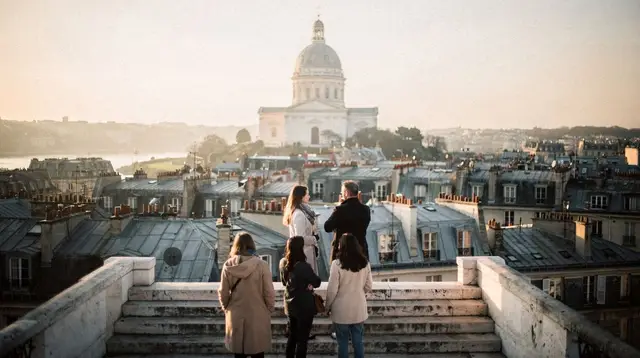
The Panthéon sits on the high ground of the Latin Quarter and Saint-Germain, its dome visible above the rooftops for anyone walking up from the Seine toward the Sorbonne. It is easy to assume, from the outside, that this is simply another Paris church. It is not. Since the French Revolution the building has served, on and off, as a secular mausoleum for the men and women the French state has chosen to honour as grands hommes — great citizens, in the literal translation — regardless of their religion or lack of one.
That distinction matters for how to read the building once inside. The Panthéon is not a war memorial and it is not connected to the French military establishment. Visitors sometimes confuse it with Les Invalides and Napoleon’s tomb, a genuinely different kind of monument across the river, built as a veterans’ hospital and now home to the emperor’s tomb under its own gilded dome. The two buildings share a certain grandeur and a certain silhouette on the skyline, but they commemorate different things for different reasons, and a visitor pressed for time should pick based on which story interests them rather than treating the two as substitutes.
From church to monument, and back again
The building began as a commission from Louis XV, who vowed to build a grand church dedicated to Sainte-Geneviève, the patron saint of Paris, after recovering from illness. Construction ran through the second half of the eighteenth century under the architect Jacques-Germain Soufflot, whose design borrowed the scale and the columned portico of classical antiquity rather than the ornament of earlier French churches. By the time the building was finished, the Revolution had already begun, and the new government secularised it almost immediately, turning it into a resting place for citizens judged to have served the nation through their contributions rather than their birth or their faith.
The building’s status shifted more than once over the following century, reverting to a working church under different regimes before settling into its present role. That back-and-forth history is part of why the interior reads the way it does: a church’s proportions and a church’s nave, filled instead with the statuary, murals and inscriptions of a national memorial. The murals along the walls tell episodes from the life of Sainte-Geneviève and from French history more broadly, a reminder that the building’s two identities were never fully separated, only reassigned.
Inside the dome: the nave and Foucault’s pendulum
The nave itself is vast, lit by a dome that rises well above the columned aisles below. Suspended beneath that dome is a reconstruction of Léon Foucault’s 1851 pendulum experiment, which used the building’s height to demonstrate, visibly and without any equations, that the Earth rotates on its axis. The pendulum’s slow, steady swing against a marked ring on the floor remains one of the most recognisable single features of any guide to the best museums in Paris or major monument in the city, and it draws attention even from visitors who arrived only for the tombs below.
The building’s scale is worth acknowledging honestly rather than as a superlative: it takes real time to walk the nave, read the murals and take in the pendulum before even reaching the crypt stairs. A visit that treats the Panthéon as a five-minute detour tends to leave with a photo of the dome and little else. The building rewards a visitor who is willing to slow down inside it, in the same way that a rushed pass through Notre-Dame de Paris and the Sainte-Chapelle nearby tends to miss the detail that makes either site worthwhile.
The crypt: who rests there
Below the nave, a network of stone corridors holds the tombs of the men and women interred as grands hommes. The list includes writers such as Voltaire, Jean-Jacques Rousseau, Victor Hugo and Émile Zola; the scientist Marie Curie, the only woman interred there on her own scientific merit for many decades; and Resistance figures including Jean Moulin, whose remains were transferred there in recognition of his role coordinating the wartime Resistance. More recent additions have included writers and public figures chosen by successive French presidents, a process that keeps the roll of names slowly growing rather than fixed at the Revolution.
Walking the crypt corridors is a different experience from the nave above: quieter, cooler, and organised in a way that makes clear this is a working site of national memory rather than a museum display. Some visitors move through quickly; others spend as long down here as they did upstairs. Either way, the crypt is included in a standard visit, and skipping it means skipping the actual reason most visitors come.
Panthéon or Les Invalides: which to choose
Because both buildings sit under large domes and both are described loosely as “the tomb of famous French people,” it is worth being direct about how they differ.
| Panthéon | Les Invalides | |
|---|---|---|
| Character | Republican monument to civilians | Military site and Napoleon’s tomb |
| Who rests there | Writers, scientists, Resistance figures | Napoleon Bonaparte and military leaders |
| Original purpose | Church dedicated to Sainte-Geneviève | Veterans’ hospital and home for wounded soldiers |
| Neighbourhood | Latin Quarter and Saint-Germain | Near the Eiffel Tower and Champ de Mars |
| Known feature | Foucault’s pendulum, crypt corridors | Napoleon’s tomb, military museum |
Neither site substitutes for the other, and a visitor building a first trip to Paris who only has time for one should choose based on whether they are more drawn to a story about republican memory or a story about Napoleon and French military history. Both are legitimate half-day stops in their own right, not quick add-ons to a longer itinerary.
The Panthéon in its neighbourhood
The building anchors a quiet, academic corner of the Rive Gauche. It sits a short walk from the Sorbonne, from the Luxembourg Gardens, and from the narrow streets that make up the rest of the Latin Quarter’s sights. This is a part of Paris built around students, booksellers and old cafés rather than large avenues, and the Panthéon’s dome is the one landmark in the area visible from a genuine distance.
Treating the monument as part of a longer walk through the quarter, rather than an isolated stop reached by metro and left immediately after, tends to make more sense of both the building and the neighbourhood around it. A walking tour of the Latin Quarter and Saint-Germain will typically pass close to the Panthéon on its way between the Seine and the Luxembourg Gardens, and pairing the monument with a stop for lunch or a market visit through a food tour of Saint-Germain and the Latin Quarter turns a single site into a fuller half day.
For a broader base, this is also a reasonable area to consider staying near Saint-Germain-des-Prés, close enough to the Panthéon, the Seine and the Latin Quarter’s other sights to reach most of them on foot.
a small-group food tour through the Latin Quarter and Saint-Germain that stops for local specialities on the way to the PanthéonGetting there and moving through the building
The Panthéon is reached most easily on foot from the Seine or from the Luxembourg Gardens; it is not tied to a single metro station in the way some Right Bank monuments are, and its position at the top of a gentle hill means the last stretch of any approach is uphill. Visitors arriving from further away in Paris often combine the walk with other Latin Quarter stops rather than treating the Panthéon as a standalone metro trip.
Once inside, the building has no shortcuts: the nave, the pendulum and the crypt are all part of the same visit, and moving through all three properly takes real time rather than the few minutes some visitors expect from a photo stop. This is not a building that offers a fast circuit the way a small chapel might. If a Paris Museum Pass is part of the trip, the Panthéon is typically one of the sites it covers, though the pass does not shorten how long the building itself takes to see properly.
a guided walking tour of central Paris with a Turkish-speaking guide, covering major Rive Gauche landmarks including the area around the PanthéonWhat the Panthéon is not
It is worth being clear about a few things the building does not offer, mostly to avoid disappointment. It is not primarily a viewpoint: while the dome does offer a vantage over the city, that is not the reason to visit, and anyone specifically chasing a Paris skyline view is better served by the dedicated coverage in the best views in Paris rather than treating the Panthéon as a lookout point first and a monument second.
It is also not a quick stop between two other sights. Visitors trying to fit the Panthéon into a tight schedule alongside Notre-Dame, the Sainte-Chapelle and the Luxembourg Gardens in a single afternoon often find they have to cut one of the four short, and the Panthéon is usually the one that suffers, because its crypt corridors reward unhurried walking rather than a glance. Anyone planning how many days to spend in Paris or building out a three-day Paris itinerary should give the Panthéon its own slot rather than squeezing it in as an afterthought.
Finally, it is not the resting place of Napoleon, of any French king, or of any military figure by default — those stories belong at Les Invalides, not here.
Pairing a Panthéon visit with the rest of the quarter
Because the building sits within easy walking distance of several other monuments and landmarks, it works well as the centrepiece of a half-day rather than a solo errand. A morning at the Panthéon followed by a walk down to Notre-Dame de Paris and the Sainte-Chapelle, or across to the Luxembourg Gardens, uses the neighbourhood’s compactness rather than fighting it. Visitors who prefer not to plan the route themselves sometimes bring in a private guide for Paris, who can thread the Panthéon into a wider Rive Gauche walk without doubling back.
a four-hour guided city tour in German that takes in Rive Gauche landmarks, including the Panthéon’s surroundingsFor a longer stay, the Panthéon also sits within reasonable range of Père Lachaise Cemetery on the other side of the city, another site built around the memory of notable French figures, though the two could not be more different in form: one an open-air cemetery spread across a hillside, the other a single domed building holding its residents underground.
An honest note on pace
None of this is meant to discourage a visit — the building is one of the more substantial civic monuments in Paris and rewards the visitor who treats it that way. But it is worth saying plainly, in the spirit of planning honestly rather than promising something quick: this is not a fifteen-minute stop. Between the scale of the nave, the pendulum overhead, and the crypt corridors below, a visitor who gives the Panthéon the time it needs tends to leave with a genuinely different sense of the building than one who ducks in for a photo and leaves. Build the time in rather than hoping to find it on the way past.
Panthéon visiting questions
What is the Panthéon in Paris?
The Panthéon is a domed monument in the Latin Quarter that serves as a secular mausoleum for France’s great citizens, from writers and scientists to Resistance figures. It began as a church dedicated to Sainte-Geneviève and was repurposed during the Revolution. It is a separate site from Les Invalides, which holds Napoleon’s tomb.
Who is buried in the Panthéon?
The crypt holds the remains of figures such as Voltaire, Rousseau, Victor Hugo, Émile Zola, Marie Curie, Jean Moulin and, more recently, Résistance figures and writers honoured by the French state. Entombment there is a formal decision, so the roll of names changes only occasionally.
Is the Panthéon the same as the Invalides?
No. The Panthéon is a republican monument to civilian achievement, while Les Invalides is a military site built as a veterans’ hospital that also holds Napoleon’s tomb. They sit in different parts of the city and are not interchangeable stops for a visitor short on time.
How long does a Panthéon visit take?
Plan for a proper block of time rather than a quick stop. Between the nave, the crypt corridors and the building’s scale, a visit that is rushed misses most of what makes the site worth entering in the first place.
Can you see Foucault’s pendulum at the Panthéon?
Yes, a pendulum recreating Léon Foucault’s 1851 experiment demonstrating the Earth’s rotation hangs beneath the dome and is one of the building’s best-known features.
Is the crypt included in a Panthéon visit?
Yes, standard entry covers both the nave above and the crypt below, where the tombs are arranged in long stone corridors under the building.
What neighbourhood is the Panthéon in?
The Panthéon stands in the Latin Quarter and Saint-Germain area on the Rive Gauche, near the Sorbonne and a short walk from the Luxembourg Gardens and Notre-Dame de Paris.
Arc de Triomphe and Paris landmark tickets on GetYourGuide
Verified deep-linked GetYourGuide tours. Book through these links and we earn a small commission at no cost to you.
GetYourGuide does not provide a product photo for this activity — the image shows the meeting point, photographed by us.