Paris catacombs tickets and tours
What are the Paris catacombs and how are they different from other Paris sights?
The Paris catacombs are a former limestone quarry beneath the city, converted into an underground ossuary holding the remains of millions of Parisians. Unlike the Louvre, Notre-Dame, or Montmartre's museums, there is no facade to admire or collection to walk through above ground: the entire experience takes place below street level, in narrow tunnels and chambers.
An underground experience, not a monument to look at
Most of what draws visitors to Paris sits above ground and has a facade: the Louvre’s glass pyramid, the towers of Notre-Dame, the white dome of Sacre-Coeur. The catacombs are the opposite kind of sight. There is no building to photograph from the street, no grand entrance hall, no collection of paintings to move through room by room. You queue at a modest doorway, descend a spiral staircase cut into limestone, and walk through tunnels that were never designed to be seen by the public in the first place. The visit is defined by going down, not by anything you look up at.
That makes the catacombs a genuinely different kind of stop on a Paris itinerary, and it is worth being clear-eyed about what that difference means before you book anything. This guide treats it that way: as an underground ossuary experience to weigh on its own terms, not as one more box to tick alongside the Louvre or Notre-Dame de Paris and the Sainte-Chapelle.
What the catacombs actually are
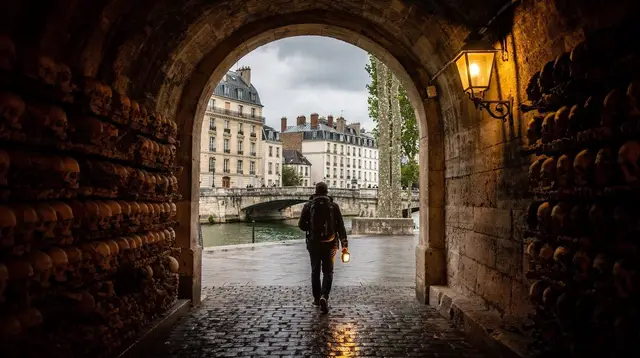
The tunnels beneath the 14th arrondissement began as limestone quarries, dug over centuries to supply the stone that built much of Paris above them. By the late 18th century, the city’s central cemeteries were overflowing and creating serious public health problems. The solution was to move the remains, bone by bone, into a section of these disused quarry tunnels. What visitors see today is that ossuary: corridors lined and stacked with the bones of several million Parisians, arranged deliberately rather than dumped, with carved plaques marking where different cemeteries’ remains were placed.
It is not a museum in the usual sense. There are no paintings, no glass display cases of artifacts, no rooms curated around a theme the way you would find in Montmartre’s art and museum circuit or at the Musee d’Orsay. The site itself is the exhibit: stone walls, low ceilings, and bones stacked with a kind of grim order that has stayed largely unchanged for two centuries. Some sections carry inscriptions warning entrants what lies ahead, in the same spirit as when the ossuary was first arranged.
The catalogue for this experience is comparatively small next to Paris’s blockbuster sights: around ten products cover entry tickets, small-group tours, and special-access options that go beyond the standard circuit. That is itself informative. This is a single, fixed underground site with one basic route, not a category with dozens of competing operators and angles the way Seine river cruises or city sightseeing tours are.
How it differs from the Louvre, Notre-Dame, and Montmartre’s museums
It is easy to lump the catacombs in with “Paris museums” on a checklist, but the comparison breaks down quickly once you think about the actual visit.
At the Louvre, you move through vast galleries at your own pace, choosing which wings and which centuries to prioritize. At Notre-Dame and the Ile de la Cite, the draw is a building: its architecture, its history, and since its reopening, the fact that it is once again open to visitors after years of restoration work. Both are, fundamentally, above-ground experiences built around looking at things: paintings, sculpture, stained glass, stone facades.
The catacombs offer none of that kind of looking. There is one route, one direction of travel, and no branching galleries to wander between. You cannot linger the way you might in front of a painting you like, because the passage keeps moving and there is usually a queue of other visitors behind you. The comparison to Montmartre’s museums and art spaces is similarly limited: Montmartre’s draw is a hillside neighborhood with viewpoints, studios, and a basilica you can walk around and photograph from multiple angles. The catacombs give you none of that variety. What they give you instead is unusual: an unbroken, physically confined passage through a place built for the dead, with an atmosphere that no amount of description quite prepares you for until you are actually inside.
None of this makes the catacombs better or worse than Paris’s headline monuments. It makes them a different category of visit entirely, and that is the honest way to frame a decision about whether to add them to your trip.
Planning ahead, without pretending to know rules that can change
Because the catacombs occupy a fixed physical space with a single entrance and a controlled flow of visitors, access is limited in a way it simply is not at an open-air neighborhood like Le Marais or a large complex like the Louvre. The practical upshot is straightforward: organize this visit ahead of your Paris trip rather than deciding on the day. Exactly how far in advance, what the booking window looks like, and whether same-day entry is realistic in a given season are details that shift and are best confirmed at the point of booking rather than repeated secondhand here.
What is worth planning around, regardless of the specifics, is timing within your day. The catacombs sit apart from the central sightseeing core covered by things to do in Paris, and reaching the entrance, queuing, completing the underground circuit, and finding your way back up at a different exit point all take real time. Treat it as an anchor for part of a day rather than a quick add-on squeezed between two other stops.
If your priority is simply seeing the ossuary without extra commentary, a standard entry ticket covers that. If you want context on the quarrying history, the public health crisis that led to the ossuary’s creation, or access to sections beyond the default route, a guided or special-access option is the better fit.
a special access tour of the catacombs that goes beyond the standard visitor route is one way to get that fuller picture with a guide managing the logistics. For a more conventional visit with a smaller group and a guide’s commentary along the way, a two-hour small-group tour of the catacombs covers the ossuary itself along with some of its history. A third option, a guided catacombs tour with special access, is worth comparing against the others on group size and exactly which sections are included before you choose.
Whichever option you pick, build in a buffer either side. Arriving late to a fixed-time entry can mean losing the slot altogether, and rushing straight into another major sight afterward undercuts both visits.
What to expect once you are inside
The descent itself is a spiral staircase, tighter and steeper than most visitors expect from photographs. From there, the route runs through several hundred meters of tunnel before reaching the ossuary sections proper. The air underground stays cool year-round, noticeably different from a Paris summer afternoon or a damp winter day above ground, so a light layer is worth carrying regardless of season.
Once in the ossuary, the pace is set by the flow of the group ahead of and behind you rather than by personal preference. There is no seating, no cafe, and no rest stop along the way: it is a continuous walk from entrance to exit. The exit itself emerges at a different, unremarkable street location some distance from where you went in, which catches some visitors off guard if they expected to loop back to the same starting point.
This is not a visit to approach with dread, but it is not one to approach as a curiosity to be ticked off quickly either. The atmosphere is genuinely distinct: quiet, close, and built around the presence of human remains handled with a certain formal order rather than displayed as spectacle. Visitors who find that kind of setting affecting should expect it to affect them here too. There is no requirement to rush, but there is also no way to skip ahead once you are partway through the ossuary corridors.
Getting there and fitting it into a Paris day
The reassuring part of planning around the catacombs is that, unlike a day trip to Versailles or Giverny, there is no trip out of the city involved. The site sits within Paris proper, reachable on the regular Paris metro network like any other city stop. This is squarely a Paris activity, not an excursion, and it fits inside a normal city day the same way a museum visit or a walking tour would.
Because the catacombs sit south of the central sightseeing cluster around the Seine and the Ile de la Cite, most visitors treat it as a dedicated half-day rather than a stop tacked onto a morning at the Louvre or an afternoon in the Latin Quarter. If you are mapping out a broader trip, a resource like how many days to spend in Paris or a structured plan such as one day in Paris can help you see where an underground visit like this realistically fits without crowding out the monuments most first-time visitors prioritize.
Practical safety notes apply here as anywhere else the city draws crowds of visitors: queues outside the catacombs entrance can be a target for the same kind of opportunistic pickpocketing described in is Paris safe for tourists and Paris scams and pickpockets. Keep bags closed and valuables out of back pockets while waiting in line, just as you would near the Eiffel Tower or the steps of Sacre-Coeur.
Who this suits, and who might skip it
The catacombs work best as a complement to a Paris trip that already includes the major above-ground sights, not as a substitute for them. Visitors who have already spent a day moving through the Louvre’s galleries or standing in front of Notre-Dame’s rebuilt facade, and who want to see a side of the city that has nothing to do with paintings or architecture, tend to find the contrast worthwhile. It is also a natural fit for anyone drawn to the city’s less polished history: the quarries that literally built Paris, repurposed to solve a public health crisis two centuries ago.
It suits some visitors less well. Anyone uneasy in enclosed, dimly lit spaces, or unable to manage a spiral staircase down and a separate one back up, should think hard before booking. Families with very young children may find the content simply too intense for that age group, even without a formal age restriction to point to. And travelers with only a day or two in Paris, trying to prioritize the Louvre, the Eiffel Tower, and the Ile de la Cite, may reasonably decide the catacombs are a trip for a return visit rather than a must on a first, tightly packed itinerary.
If you want more offbeat Paris without going underground twice
For visitors who like the idea of stepping outside the standard museum circuit but want to stay above ground, a couple of alternatives sit at a similar angle. the Paradox Museum in Paris, an optical-illusion and perspective-based exhibit space offers a different kind of unconventional visit, built around interactive rooms rather than historical artifacts. It has nothing to do with the catacombs’ subject matter, but it shares the same instinct: a Paris stop that breaks from the Louvre-Notre-Dame-Eiffel Tower pattern most first-time visitors default to.
If your day instead leans toward art but you want a quieter, smaller-scale alternative to the Louvre’s crowds, a guided, skip-the-line visit to the Rodin Museum is worth comparing against a catacombs visit when deciding how to spend a free afternoon. Both are valid ways to diversify a trip that might otherwise be built entirely around the same handful of headline sights covered in best museums in Paris.
Catacombs de Paris: frequently asked questions
Are the Paris catacombs the same as the sewers or the Louvre’s underground moat?
No. The catacombs are a separate network of former quarry tunnels used as an ossuary, entirely unrelated to the Paris sewer museum or to any underground areas of the Louvre. They sit under the 14th arrondissement, well south of the Seine and the main monument cluster.
Do I need to book the catacombs in advance?
Organizing your visit ahead of time is strongly advisable, since access to the tunnels is limited and demand is high, especially in the warmer months. The exact booking window and process are best confirmed directly when you reserve, rather than assumed from a guidebook.
Is the catacombs visit suitable for children?
It depends on the child. The site displays human bones at close range in dim, enclosed passages, which some children find fascinating and others find unsettling. There is no official age rule to quote here, so use your own judgment about your child’s temperament rather than a fixed cutoff.
How long does a catacombs visit take?
A standard self-paced visit runs a little over an hour underground, plus time queuing and passing through the exit at street level well away from the entrance. A small-group or special-access tour with a guide typically takes longer, since it includes commentary and sometimes areas beyond the standard circuit.
Can I combine the catacombs with the Louvre or Notre-Dame on the same day?
You can, but treat it as a deliberate pairing rather than an afterthought. The catacombs sit in a different part of Paris from the Ile de la Cite and the Louvre, involve a walk down narrow stairs and a walk back up a separate staircase, and are physically and mentally a different kind of visit. Many visitors prefer to give the catacombs their own half-day rather than squeeze it in after a full morning of museums.
Are the catacombs claustrophobic or physically demanding?
The tunnels are narrow in places, the ceiling is sometimes low, and there is no lift: visitors descend and later climb a spiral staircase. There is no seating along the route and no way to turn back partway through once inside the ossuary section, so anyone with claustrophobia or limited mobility should weigh this carefully before booking.
Is photography allowed in the catacombs?
Casual photography without flash is generally tolerated in the ossuary, though rules can be adjusted by the site at any time, and tripods or professional equipment may not be welcome. Treat the space with the same restraint you would show in any place that holds human remains.
What should I wear to visit the catacombs?
Comfortable, closed shoes and a light layer are sensible, since the underground temperature stays cool and constant regardless of the season above ground. The stairs and uneven tunnel floors are not forgiving of sandals or high heels.
Paris catacombs and underground tours on GetYourGuide
Verified deep-linked GetYourGuide tours. Book through these links and we earn a small commission at no cost to you.
GetYourGuide does not provide a product photo for this activity — the image shows the meeting point, photographed by us.