Giverny day trip from Paris: Monet's gardens, done right
Is Giverny worth a day trip from Paris?
Yes, if you care about Claude Monet and Impressionism — the house and gardens at Giverny are the reason the trip exists. It's about 75 km northwest of Paris, reached by train to Vernon and then a shuttle, or by a guided tour, and it only opens seasonally from spring to autumn, so the date on your calendar matters as much as the ticket.
Getting to Giverny from Paris
Giverny is not in Paris, and it’s not a place to sleep — it’s a village about 75 km northwest of the city, and every visitor comes and goes the same day. There’s no train station in Giverny itself, so the route runs in two legs: a train from Paris to the town of Vernon, then a shuttle bus or taxi for the final stretch into the village. It’s a workable connection, but it’s a connection, not a straight shot, and the shuttle only runs on a schedule tied to the trains — arrive at Vernon between shuttles and you’ll be waiting.
The alternative is a guided day trip that handles both legs for you, usually in a minibus or coach direct from central Paris. You lose the flexibility of doing it on your own time, but you gain a fixed departure, a driver who knows the route, and — in most cases — a pre-booked garden ticket, which matters more than it sounds in the best time to visit Paris months when Giverny is busiest.
Either way, treat this as a full day, not a quick half-day errand. Between the outbound journey, time in the gardens, and the return, you’re committing most of your daylight hours. If you’re trying to fit a lot into a short Paris itinerary, Giverny competes for a full day slot with the other day trips beyond Paris, and it’s worth deciding early which one you’d rather have.
A half-day guided option exists and covers the essentials — the Half Day Trip to Giverny from Paris handles the return transport and garden entry in one booking, which removes the Vernon-to-Giverny connection as a variable. For travellers who’d rather not share a coach, a private version of the same idea runs on your own schedule: a private half-day tour to Giverny with a dedicated vehicle from Paris costs more but skips the group pickup points.
Why Giverny, specifically
Giverny exists on the day-trip map for one reason: this is where Claude Monet lived for over four decades, and where he painted the water lilies, the Japanese bridge, and the garden that became as much a subject of his work as any canvas. The house and gardens are preserved and open to visitors, and walking through them is the closest thing to standing inside an Impressionist painting that a day trip from Paris offers.
Compare that to the other Île-de-France excursions and the difference in scale is obvious. Versailles is a palace, a court, and formal gardens spread over a domain — grand, historical, built for spectacle. Fontainebleau and Vaux-le-Vicomte are châteaux with their own architectural stories. Giverny is a single house and a garden shaped by one painter’s eye. If your interest is art rather than architecture or royal history, Giverny is the more direct match — a detailed comparison sits in our Giverny versus Versailles guide if you’re weighing the two against each other.
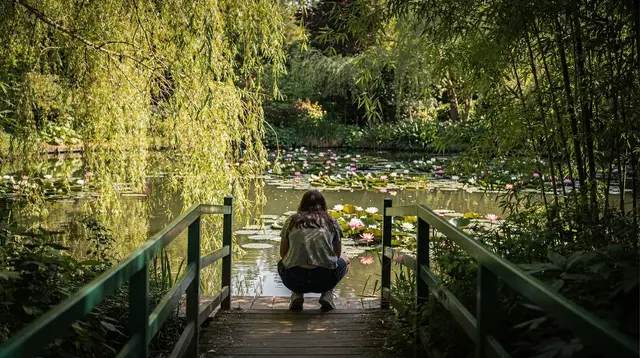
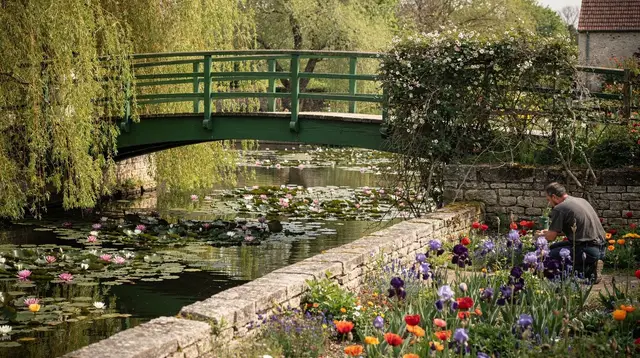
The gardens themselves are split into two parts: the flower garden in front of the house, laid out in dense, structured beds, and the water garden across the lane, home to the pond, the lilies, and the green Japanese bridge that shows up in dozens of Monet canvases. The house holds Monet’s collection of Japanese prints and gives a sense of how he lived alongside the garden he painted for decades. None of it is large. Most visits move at a walking pace through both halves in a couple of hours, which is part of why pairing Giverny with something else in the same day is common — more on that below.
Visiting the gardens: what to actually expect
Giverny draws heavy visitor numbers relative to its size, particularly through the warmer months when the flower garden is at its fullest. The paths are not wide, and the water garden in particular can feel crowded around the bridge at peak times. None of that makes it not worth seeing — it means arriving early in the day, whether independently or on a tour, makes a real difference to how much room you have to look rather than queue.
The catalogue for Giverny runs to around 40 products, which breaks down roughly into three approaches:
| Approach | What it covers | Best for |
|---|---|---|
| Self-guided (train + shuttle) | Transport to Vernon and Giverny, ticket bought separately or in advance | Independent travellers comfortable managing a connection |
| Group guided tour | Return coach transport from Paris, garden entry, guide commentary | First-time visitors who want the logistics handled |
| Private guided tour | Dedicated vehicle and driver, flexible pace | Travellers prioritising comfort and time over cost |
| Combined tour (Giverny + another village) | Giverny plus a second stop, usually Auvers-sur-Oise | Travellers who want two Impressionist-adjacent sites in one day |
If you’d rather see the numbers for Giverny specifically against other Île-de-France options before deciding, the Giverny destination page and the Giverny and Monet activities hub both list what’s currently bookable.
The one thing to get right: opening dates
This is the detail that trips up more planning than anything else about Giverny: the house and gardens are not open year-round. Opening runs seasonally, from spring through autumn, and the site closes for the winter months. There’s no fixed calendar date to quote here that will still be accurate by the time you read this — the exact opening and closing dates can shift slightly from year to year — so the only safe approach is to check the current dates directly before you book transport or a tour.
This matters more than it might seem, because unlike a museum in central Paris that you can swap for another day, Giverny outside its open season simply isn’t visitable — there’s no indoor fallback, no rain-day alternative. If you’re planning a trip for late autumn through early spring, verify Giverny is open before it goes on your itinerary at all; if it isn’t, that day is better spent on something inside Paris or on a year-round excursion like Versailles instead. Our note on when Monet’s gardens in Giverny are open is a starting point, but the booking page for whichever tour or ticket you choose will always have the current season’s dates.
Pairing Giverny with another stop
Because Giverny itself takes a couple of hours rather than a full day, some tour operators combine it with a second stop to make fuller use of the day trip. The most common pairing is Auvers-sur-Oise, the village north of Paris associated with Vincent van Gogh’s final months — different painter, different period, but geographically closer to a logical loop than most other options in day trips beyond Paris.
A combined itinerary along these lines is sold as the Van Gogh and Monet villages full-day tour, which covers both Giverny and Auvers-sur-Oise in one departure from Paris — a longer day, but one that groups two Impressionist-era sites instead of splitting them across separate trips. If you’d rather do Auvers-sur-Oise on its own terms and at its own pace, a dedicated half-day trip to the Van Gogh village of Auvers-sur-Oise runs separately from Paris and pairs well with a different day’s plans; see the Auvers-sur-Oise day trip guide for what that covers on its own.
Whichever way you combine it, resist stacking Giverny onto an already packed Paris day. A morning at the Louvre followed by an afternoon dash to Giverny is a hard combination logistically — the travel time alone works against it. Treat Giverny, on its own or paired with Auvers-sur-Oise, as its own day on the calendar.
Practical notes before you book
A Paris Museum Pass does not cover Giverny — it’s a separate site outside Paris with its own ticketing, so don’t assume the pass extends your reach here the way it does for museums inside the city. Buy or reserve Giverny entry separately, whether independently or as part of a tour package.
If you’re travelling independently by train to Vernon, build in margin for the shuttle connection rather than cutting it close — missing a shuttle means waiting for the next one, which can eat into the time you actually spend in the gardens. A guided option removes that risk entirely, which is often the deciding factor for travellers with a tighter overall Paris schedule.
Wear shoes suited to gravel paths and, if visiting during the open season’s warmer stretch, expect both sun exposure in the flower garden and shade near the water garden — the two halves of the site feel noticeably different underfoot and overhead.
For a broader sense of how Giverny fits against the rest of the region’s excursions — Versailles, Fontainebleau, Chantilly, and the longer trips into Normandy and the Loire — the best day trips from Paris guide lays out the full set side by side, including which ones run year-round versus seasonally like Giverny.
Who Giverny suits — and who it doesn’t
Giverny rewards a specific kind of traveller: someone who wants to slow down for half a day and look closely at one garden rather than tick off a list of sights. If you’re the type who wants a full day’s worth of stops packed into one outing, Giverny on its own can feel light — which is exactly why the combined tour with Auvers-sur-Oise exists, and why some travellers prefer to fold it into a longer stay rather than treat it as a headline day.
It’s also a poor fit for a first, short trip to Paris. If this is your only visit and you have two or three days, the city itself — the Louvre, Notre-Dame, Montmartre, the Seine — will fill the time more efficiently than a half-day round trip to a village garden. Giverny earns its place once you’ve already answered how many days in Paris you actually have and the answer includes room for at least one day trip beyond the city. Our guide to multi-day tours from Paris covers the broader question of when it’s worth leaving the city at all, and for travellers building a longer stay, the five days in Paris itinerary shows where a Giverny day slots naturally alongside the core sights.
Families travelling with young children should also weigh the practicalities: it’s a half-day-plus commitment by train and shuttle or coach, with a garden that’s beautiful but not built around entertaining kids the way Disneyland Paris is. It’s not a hard no, but it suits older children and adults with an interest in art more than toddlers.
Weather, timing, and what to bring
Giverny’s open season overlaps with spring and early autumn as much as it does peak summer, and each part of that window looks different in the gardens. Spring brings the flower beds into their fullest bloom and tends to draw smaller crowds than midsummer; early autumn has a quieter, later-season look with fewer visitors but still-green water garden foliage. Neither is better than the other so much as different, and both tend to be more comfortable for a day spent mostly outdoors and walking than the hottest weeks of summer, which can bring real heat with little shade over the open flower garden. Our best time to visit Paris guide and Paris weather by month breakdown both apply here, since Giverny’s climate tracks the wider Paris region.
Because the whole day is outdoors and involves a fair amount of walking between the station, the shuttle, and the gardens themselves, dress for the season rather than for the city. A layer for cooler mornings, comfortable shoes, and rain protection are worth having regardless of month, since weather in this part of France can turn with little warning even in the middle of the open season — see what to pack for Paris for the fuller list. Bring a bottle of water too; there isn’t much shade once you’re inside the gardens themselves.
Questions about visiting Giverny from Paris
How far is Giverny from Paris?
Giverny is roughly 75 km northwest of Paris. There’s no direct train to the village itself: you take a train to Vernon, then a shuttle bus or taxi covers the last stretch to Giverny.
Is Giverny open all year?
No. Monet’s house and gardens open seasonally, from spring to autumn, and close for winter. Always check the current opening dates before you book anything, since they can shift slightly year to year.
Can you visit Giverny without a guided tour?
Yes — you can take the train to Vernon and a shuttle to Giverny independently, then buy entry to the gardens on site or in advance. A guided tour adds transport, commentary, and usually a fixed schedule, which suits travellers who’d rather not plan the connection themselves.
How much time do you need at Giverny?
Most visitors spend a couple of hours walking the gardens and house, plus the village itself. Combined with the return trip from Paris, it fills most of a day rather than a half-day, even on the faster train-based routes.
Can you combine Giverny with another day trip?
Some tours pair Giverny with Auvers-sur-Oise, the village associated with Van Gogh, since both sit in the Impressionist orbit northwest of Paris. Combining them makes for a longer day, so check the itinerary before booking if you’d rather move slowly.
Do you need to book Giverny tickets in advance?
Booking ahead is strongly advisable, especially in the open season’s peak months, since the gardens are compact and demand is high. A guided tour typically handles the ticket for you as part of the package.
Is Giverny better than Versailles as a day trip?
They cover different ground. Versailles is a palace and formal gardens on a much larger scale; Giverny is a single artist’s house and garden, intimate and specific to Monet and Impressionism. Choose based on what matches your interest, not which site is more widely known.
Giverny and Monet's house and garden tours on GetYourGuide
Verified deep-linked GetYourGuide tours. Book through these links and we earn a small commission at no cost to you.
GetYourGuide does not provide a product photo for this activity — the image shows the meeting point, photographed by us.