Montmartre art and museum tours: what to see beyond the Sacré-Cœur
What counts as an art and museum tour in Montmartre?
It means the place du Tertre, where artists paint and sketch in public, plus the neighbourhood's small galleries, artist-history museums and street-art walks. It does not include the Sacré-Cœur basilica or the Moulin Rouge show, which are separate experiences with their own pages.
Montmartre’s other side: art, not just a view
Most visitors arrive in Montmartre for one thing: the white domes of the Sacré-Cœur and the view over the rooftops. That visit has its own page — see our Sacré-Cœur guide — and it is worth doing. But it is only half of what the neighbourhood offers. A few streets away from the basilica steps, Montmartre keeps a working art identity that predates the crowds: a square where painters still work in public, a scatter of small galleries and studios, and lanes that trace the district’s history as a low-rent artists’ quarter from the late nineteenth century onward.
This page is about that side of Montmartre — the art and small-museum side, not the monument on top of the hill and not the cabaret in the evening. If you came here looking for the Moulin Rouge, that is a separate, ticketed evening show and belongs on its own page. If you came looking for the basilica itself, go to the Sacré-Cœur guide instead. What follows covers what there is to see and do in Montmartre in the daytime, around art: 17 bookable products in the catalogue, from museum-ticket bundles to guided street-art walks with a working artist.
Because Montmartre is a neighbourhood of Paris and not a separate town, none of this requires special transport planning. It sits on the standard Paris metro network like any other district — you simply ride up, get off, and start walking.
The place du Tertre: the square, not a museum
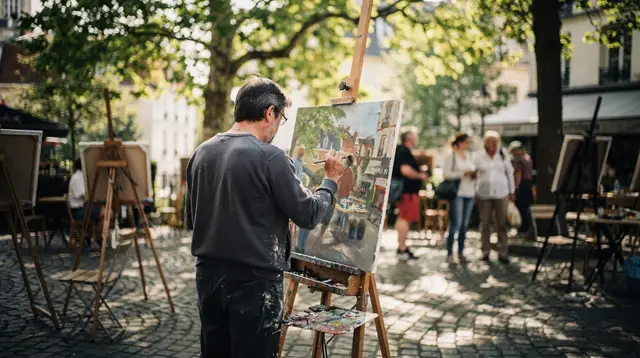
The place du Tertre is the small square at the centre of Montmartre’s art identity, a short, steep walk from the basilica. Painters and caricaturists set up easels here through the day, working on canvases, offering portraits, and selling finished pieces directly. It is not a museum in the formal sense — there is no admission fee to enter the square, no fixed collection, and no curated rooms. It functions more like an open-air studio that has operated in more or less the same spot for well over a century.
Be honest with yourself about what this is before you go: it is touristy, it is often crowded at midday, and the artists working there are running small businesses, not staging a free show. A portrait sketch is a paid commission, and prices are agreed with the artist directly, not posted like museum tickets. The square is at its best either early in the morning, when a handful of painters are setting up and the light is good, or later in the afternoon when the day-trip coach groups have moved on. If your interest is genuinely in watching working artists rather than in the square as a photo backdrop, timing your visit outside the midday peak makes a real difference to how it feels.
Galleries, studios and small museums
Beyond the square itself, Montmartre’s streets hold a scatter of small galleries, artist studios and modest museums dedicated to the district’s own art history — the Belle Époque cabaret scene, the painters (Renoir, Toulouse-Lautrec, Utrillo and others) who lived and worked in the neighbourhood when it was still a semi-rural hill on the edge of Paris, and the bohemian identity that grew up around cheap rents and open studios. These venues are small by design: expect single rooms or a handful of galleries rather than the wings and floors of a national institution. That scale is part of the appeal for visitors who find large museums exhausting, but it also means you should not expect the depth of a major collection here — for that, other Paris districts have their own dedicated pages.
A guided visit or a district-ticket bundle is the most efficient way to see several of these smaller sites without doubling back on foot, since Montmartre’s streets are narrow, hilly and not laid out on a grid. A guide who knows the neighbourhood can also route you past studios and courtyards that are easy to walk straight past without knowing their history.
a combined museum ticket and guided walk through the district’s art sites covers several of these smaller venues in one outing, with someone explaining what you are looking at rather than leaving you to read a wall panel.
Street art and the artist’s-eye walk
Beyond the historic galleries, Montmartre’s back streets carry a newer layer: contemporary murals and street art tucked into stairwells, courtyards and side lanes away from the main tourist path. A tour led by a working artist covers this layer specifically, pointing out pieces that are easy to miss and giving context on the artists behind them — a different register from the place du Tertre’s live painting, but part of the same broader identity of Montmartre as a district shaped by people who make things.
a street-art walk through Montmartre led by a working artist is built around this contemporary layer rather than the nineteenth-century history, and suits visitors who want a fresher angle on the neighbourhood’s creative reputation.
Walking the art lanes without a fixed itinerary
Not every visitor wants a ticketed venue or a themed tour — plenty are happy simply walking the lanes around the square at their own pace, stopping at galleries that catch their eye and taking in the district’s steep streets and older buildings. A general guided walk of Montmartre, rather than one built specifically around art, still passes most of the same territory: the square, nearby studios, the old vineyard, and the quieter residential lanes just off the tourist track.
a general walking tour through Montmartre’s historic lanes and squares is the flexible option if you want context and orientation without a narrow theme, and it works well paired with independent gallery browsing afterward.
For a broader look at what else the district covers outside the art angle — cafés, viewpoints, the old vineyard, and practical orientation — see things to do in Montmartre and the wider Montmartre activity listings.
Families and smaller groups
The place du Tertre and the surrounding galleries are manageable for families, since there is no fixed indoor route to follow and children can watch the painters work without needing to stay quiet in gallery rooms. Steep cobbled streets and stairs are the main practical consideration rather than anything about the content itself. A family-oriented or private version of a Montmartre walk keeps the pace flexible and lets a guide skip anything that is not holding a child’s attention, which matters more here than in a formal museum with a fixed circuit.
a smaller, personally guided walk through Montmartre works well for a couple or a small family group that wants a slower pace and room to ask questions, rather than a set commentary delivered to a larger crowd.
Where this fits against Montmartre’s other two draws
It is worth repeating plainly what this page is not, because the three experiences sit within a few minutes’ walk of each other and are easy to conflate when planning a day.
| Experience | What it is | Where to read more |
|---|---|---|
| Art and museums (this page) | Place du Tertre painters, small galleries, artist-history museums, street art | You’re here |
| Sacré-Cœur | The basilica at the summit — a religious and architectural landmark | Sacré-Cœur tours |
| Moulin Rouge | An evening cabaret show, ticketed performance | Moulin Rouge tickets and shows |
Most visitors combine the art side and the basilica in a single morning or afternoon, since they sit close together on the same hill. The Moulin Rouge is a separate evening plan and does not naturally fold into a daytime art walk.
Getting there and getting around
Montmartre is a Paris neighbourhood like any other, reached on the ordinary metro network — no special ticket, no separate train, and no day-trip logistics. Once you are there, though, the terrain itself is the main practical factor: Montmartre sits on a genuine hill, with steep streets, staircases and cobbles rather than flat pavement. Comfortable shoes matter more here than almost anywhere else covered on this site. If you plan to combine the art lanes with the basilica at the top, budget more time than the straight-line distance suggests — the climb is slower than it looks on a map.
For a wider sense of how to fit Montmartre into a first Paris visit, our one-day Paris itinerary shows where a Montmartre morning typically sits alongside the rest of the city, and where to stay in Montmartre covers the neighbourhood as a base if you’d rather sleep close to it than just visit for a few hours.
A district tour that covers the art angle alongside the rest
If you would rather see the art side folded into a fuller Montmartre visit — the square, the basilica approach, the old vineyard and viewpoints — a full sightseeing tour of the district covers more ground in one outing than a narrowly art-focused walk, while still passing the same galleries and the place du Tertre.
a full Montmartre sightseeing tour that also includes museum entrance suits visitors who want one guided outing to cover the district broadly, with the art venues included rather than treated as a separate booking.
Making the most of a quiet morning
Montmartre earns its bohemian reputation honestly in the early hours, before the coach groups and the midday crush arrive: the light on the square is better, the painters have more room to work, and the narrow lanes feel closer to a residential neighbourhood than a tourist set piece. If atmosphere is what you came for rather than ticking off a landmark, an early visit — ideally before mid-morning — is the single biggest factor in how the experience actually feels, more than which specific tour or venue you choose. For a sense of Montmartre away from its busiest corners entirely, see quiet corners of Paris away from the crowds, and for how the art-focused visit compares with the rest of Paris’s museum landscape, best museums in Paris and Paris museum tours put it in context — Montmartre’s offering is smaller and more local by nature, which is exactly its appeal for the right visitor.
Montmartre art and museums: frequently asked questions
Is the place du Tertre a museum?
No. It is a small square where working artists paint, sketch portraits and sell canvases in the open air. It is the visual heart of Montmartre’s art identity, but there is no admission and no fixed collection — it is closer to an open-air studio than a museum.
Do I need to book museum tickets in advance for Montmartre?
Montmartre’s art venues are small and neighbourhood-scale, not blockbuster national museums, so long queues are rare. A guided walk or a small workshop still benefits from booking ahead simply to secure a time slot and a group size that keeps things personal.
Is this the same as visiting the Sacré-Cœur?
No. The Sacré-Cœur is a working basilica at the top of the butte, covered separately. This page is about the art side of the neighbourhood — the square, the galleries, the workshops — which sits a short walk from, but is not, the church.
Is this the same as the Moulin Rouge?
No. The Moulin Rouge is an evening cabaret show, ticketed and performance-based. The tours on this page are daytime, art-focused and walkable, aimed at people who want atmosphere and craft rather than a stage production.
How much time does a Montmartre art visit take?
Most people spend two to three hours: enough for the place du Tertre, a short gallery or two, and a slow walk through the surrounding lanes. A guided street-art or artist-led tour usually runs 90 minutes to two hours.
Do I need to travel specially to reach Montmartre?
No. Montmartre is a Paris neighbourhood, not a separate town — it sits within the city like any other district, reachable by metro. No special transport, train ticket or day-trip planning is required, unlike the excursions further from Paris.
Are these tours good for people who don’t normally visit art museums?
Yes, that is largely the point. The format is closer to a neighbourhood walk with an artist or a guide than to a formal museum visit, so it suits visitors who find large national collections overwhelming but like watching a painter work or hearing how the district shaped artists’ lives.
Louvre, Orsay and Paris museum tours on GetYourGuide
Verified deep-linked GetYourGuide tours. Book through these links and we earn a small commission at no cost to you.
GetYourGuide does not provide a product photo for this activity — the image shows the meeting point, photographed by us.