Why the river gets its own page
Paris has plenty of ways to see the Eiffel Tower, Notre-Dame de Paris and the Louvre from dry land, and those monuments have their own pages here. This one is about a different activity: getting on the water. A Seine cruise, whether a short sightseeing loop or a longer dinner cruise, is a way of experiencing the riverbanks themselves — the bridges, the stone quays, the façades — rather than a way of visiting any single building. Treat it as its own activity with its own timing, not as a substitute for walking up to Notre-Dame de Paris or standing under the Eiffel Tower.
The catalogue for Paris carries around 211 river-related products, from classic sightseeing loops to dinner cruises, brunch cruises, a private boat, and a handful of combined formats that pair the river with cycling or a walking tour. That range is worth knowing about before you book, because a generic search will surface the dinner cruises and the classic loops first, and they are not interchangeable.
The stretch that earns the reputation
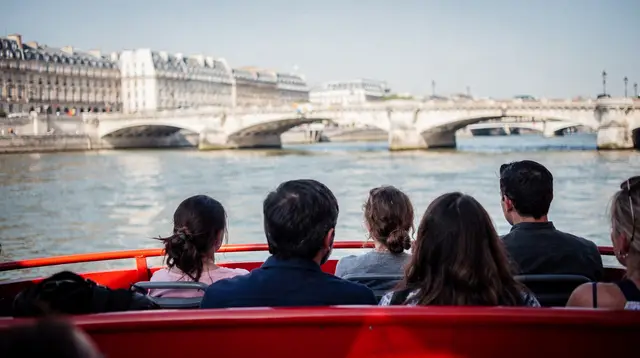
The reason a river cruise in Paris is worth considering at all, rather than just a boat ride, is the specific stretch of riverbank it covers. The banks of the Seine between the Eiffel Tower and the Île Saint-Louis were inscribed on the UNESCO World Heritage List in 1991, under the listing “Paris, Banks of the Seine.” That is the water-level view most sightseeing cruises are built around: passing beneath bridges that have stood for centuries, alongside quays that have barely changed in outline since the 19th century, with the Eiffel Tower at one end and the islands at the heart of the city — Île de la Cité and Île Saint-Louis — near the other.
It is a genuinely different vantage point on a city most visitors otherwise see from the pavement. That is the honest case for doing it. It is not, on its own, a reason to build a whole day around it.
Sightseeing cruise or dinner cruise — they are not the same trip
This is the distinction that matters most when choosing what to book, and it is where a lot of first-time visitors get the timing wrong.
A classic sightseeing cruise is short. It is built to slot into a day that already has other things in it — a morning at a museum, an afternoon walk through the Latin Quarter and Saint-Germain, an evening stroll through Montmartre. Book it as an add-on, not as the reason you cleared your schedule. A [riverside sightseeing cruise](along the UNESCO-listed banks) fits neatly between two other stops without reshaping your day.
A dinner cruise is a different commitment. It occupies an entire evening — boarding, the meal itself, and the return — and it is priced and paced as an evening out, not a quick add-on. If you are choosing between an evening dinner cruise with a glass of champagne and a short afternoon loop, decide first whether you actually want to give up a whole evening to it. Neither format is wrong; the mistake is booking a dinner cruise expecting the pace of a short sightseeing loop, or booking a short loop expecting a full meal experience.
If you’re still weighing the two formats against each other, the dedicated sightseeing cruise vs dinner cruise comparison walks through the trade-offs in more depth, and the is a Seine dinner cruise worth it piece is worth reading before committing a whole evening to one.
Choosing a format that fits your trip
Beyond the basic split between sightseeing and dinner cruises, the Paris catalogue has enough variety that it is worth matching the format to what you actually want out of the river, rather than booking the first result.
For a quiet, low-key evening on the water. A dinner cruise remains the standard choice if you want the river, a meal and the illuminated monuments handled in one booking, without planning a restaurant separately.
For daytime and brunch. A Seine river brunch cruise covers similar ground in daylight, which suits travellers who would rather see the riverbanks and bridges clearly than in evening light, or who prefer to keep evenings free.
For a small group or a special occasion. A private Seine river cruise removes the fixed schedule and shared boat of a standard departure, at the cost of being the more involved option to plan.
For travellers who want to cover more ground. A combined bike tour and river cruise ticket pairs a cycling tour of the city with a boat ride, useful for a single day that needs to do double duty.
For something less standard. A singing tour along the riverbanks in the historic heart of Paris, and a slower-paced walk with coffee, a croissant and sketching along the Seine, both treat the riverbanks as a place to linger on foot rather than from a boat — worth knowing about if the classic cruise format doesn’t appeal but the location still does.
None of these needs to be booked months out for an ordinary visit, but the more popular sunset and dinner departures can sell out on short notice in high season, so book ahead rather than assuming you can turn up on the day.
How this compares to other ways of seeing the city
A Seine cruise isn’t the only way to cover ground in central Paris without walking the whole route yourself. A hop-on-hop-off bus covers more of the city on land, including neighbourhoods the river doesn’t reach, at the cost of the water-level view; a cruise wins on atmosphere and loses on ground covered, so the choice comes down to whether you want breadth or a slower, more atmospheric pass along one stretch of the riverbank. Within the river-cruise category itself, Bateaux-Mouches isn’t the only operator worth knowing about — the differences between operators mostly come down to boat size, departure frequency and price rather than the view, since every operator covers roughly the same UNESCO-listed stretch.
When to go
Late afternoon into sunset gives the best light for photographs of the bridges and the riverside façades, and puts a sightseeing cruise on a natural path toward the evening illumination of the monuments if you time it right. An after-dark departure trades the daylight views for the lit-up Eiffel Tower and bridges, which is part of the appeal of the dinner cruise format specifically.
On the calendar, April through June and September through October bring milder weather and thinner crowds on the quays than the peak of summer, which matters more for boarding queues than for the cruise itself. Winter cruises still run and give a quieter, colder view of the same riverbanks; rain is possible in any season, so a covered boat is worth checking for if the forecast looks unsettled.
For a closer look at how the seasons and time of day change the experience, the best time for a Seine river cruise guide breaks down sunset timing through the year, which is useful if photography is the main reason you’re booking.
Boarding points and getting there
Departure points sit along the central quays, generally within walking distance of the Eiffel Tower, Notre-Dame and the Louvre — this is a central-Paris activity, not one requiring a special trip out of the city. Most visitors reach the boarding points on foot as part of a day already spent in the area, or by metro or RER into central Paris. Arrive with time to spare before a fixed-departure sightseeing or dinner cruise; boarding for popular time slots can take longer than expected once the queue forms.
Because the boarding points sit inside the same central stretch covered by the metro and RER network, there’s no need to build extra travel time into your day beyond what a normal stop in central Paris would take — this isn’t a day trip destination like Versailles or Giverny, both of which require a dedicated outbound and return journey. If you’re coming into the city from one of the airports, check the CDG to Paris or Orly to Paris guides first, then treat the cruise as one stop among several once you’re already in the centre.
The one thing to be careful about
The quays and bridges along this stretch of the Seine are among the most photographed, most walked spots in Paris, which also makes them a reliable spot for pickpockets working the crowds waiting to board, and for the bonneteau shell game set up on some of the bridges. Neither is a reason to avoid the area — it is simply one of several well-known pickpocket zones in the city, alongside the crowds around the Eiffel Tower and the Louvre. Keep bags closed, don’t get drawn into a game on a bridge no matter how it’s framed, and treat a crowded boarding queue the way you would any crowded tourist spot.
What a cruise is not for
Worth saying plainly: a sightseeing or dinner cruise on the Seine is not a way to get between neighbourhoods in Paris. The boats run a fixed loop for sightseeing, not a point-to-point route, so they don’t replace the metro or RER for moving around the city. If you want to get from the Eiffel Tower area to the Marais, or from Notre-Dame to Montmartre, that’s a job for the metro, not the river. For getting around the rest of the city, the Paris metro guide covers the lines and tickets in detail.
Pairing a cruise with the rest of your day
Because a sightseeing cruise is short, it pairs naturally with other central Paris activities rather than standing alone. A common pattern is a morning around the Louvre and Tuileries or the Musée d’Orsay, an afternoon cruise timed for good light, and an evening walk or dinner elsewhere. Travellers focused on Notre-Dame de Paris and the Île de la Cité often add a late-afternoon cruise to see the same cathedral from the water before or after visiting in person. If the Eiffel Tower is the anchor of your day, see the Eiffel Tower and Trocadéro page for the view from land, and treat the cruise as the complementary view from the water rather than a repeat of the same visit.
Couples planning an evening around the river might also look at the romantic Paris guide for how a dinner cruise fits alongside other low-key evening options in the city.
For a first visit, see how many days in Paris makes sense before deciding how much time a river cruise should take out of it, and check a sample one-day or two-day itinerary for where a short cruise typically slots in. If a dinner cruise is what you’re after specifically, it belongs on the shortlist alongside other Paris night tours rather than being treated as an afternoon activity squeezed into an evening slot.
For more detail on cruise formats generally, including comparisons between operators and boat types, see the dedicated Seine river cruises guide. If pickpocket risk on the quays is a concern beyond this one stretch of river, the Paris scams and pickpockets guide covers the other known hotspots, including the Sacré-Cœur steps and the crowds around the Louvre.
Seine river cruises in Paris: FAQ
How long does a Seine river cruise take?
A classic sightseeing cruise is short, built to fit around a day of sightseeing rather than replace it. Treat it as an add-on, not the main event of your day.
How long does a Seine dinner cruise take?
A dinner cruise is a different product: it fills a whole evening, from boarding through the meal and the return. Plan your evening around it rather than fitting it in after another activity.
Can I use a Seine cruise to get around Paris?
No. Sightseeing and dinner cruises are tourist experiences on a fixed loop, not a way to travel between neighbourhoods. For getting around, use the metro or RER.
Which stretch of the Seine is UNESCO-listed?
The banks of the Seine between the Eiffel Tower and the Île Saint-Louis were inscribed as a UNESCO World Heritage Site in 1991, which is the stretch most sightseeing cruises follow.
Are the river cruise boats the same as Bateaux-Mouches?
Bateaux-Mouches is one well-known operator among several running sightseeing and dinner cruises on the Seine; the catalogue here covers a range of operators and formats, not one brand exclusively.
Is it safe to wait on the quays for a cruise?
The riverbanks and bridges are busy tourist spots and a known area for pickpockets and for the bonneteau shell game, so keep bags closed and ignore anyone inviting you to play. It is not a reason to avoid the area, just to stay alert.
Do I need to book a Seine cruise in advance?
Popular departure times, especially sunset and dinner cruises, can fill up, so booking ahead removes the risk of arriving to a sold-out boat rather than queuing on the day.
What should I do instead if I only have a short stop?
A short sightseeing cruise fits well into a single afternoon between other stops; a dinner cruise only makes sense if you are happy giving it the whole evening.