Hop-on-hop-off bus vs Seine cruise in Paris
Should I take the hop-on-hop-off bus or a Seine cruise in Paris?
A Seine cruise is the better first look at the city's monuments and runs on a fixed loop with no stops, while the hop-on-hop-off bus covers more ground on land and lets you get off at a site and rejoin later. Many visitors do a short cruise for the view and use the bus, metro or walking for actual sightseeing stops.
Two low-effort ways to take in Paris
Neither of these is a way to get from one point to another. They are both, in different ways, activities in themselves: a fixed loop on the water, or a longer circuit on land with stops built in. If you’ve already read about the metro or a taxi as a way to move around efficiently (see metro vs taxi in Paris and our comparison of the two), put that aside here. This page is about spending an hour or more of your day looking at Paris rather than walking through it, and about which of the two ways of doing that fits the day you actually have.
The Seine carries 211 cruise and dinner-cruise products in the catalogue, more than any single land-based sightseeing format in the city, and the stretch of riverbank between the Eiffel Tower and the Ile Saint-Louis has been inscribed on the UNESCO World Heritage list since 1991 as “Paris, rives de la Seine.” That listing is not a marketing line; it means the river frontage itself, not just the buildings on it, is treated as something worth protecting and worth looking at closely. A cruise is the only way to see that frontage the way it was designed to be seen, from below, at water level, with no traffic and no crossings to navigate.
The hop-on-hop-off bus takes a different approach entirely. It runs an open-top double-decker on a fixed road route, with stops at or near the main landmarks, and a ticket that lets you get off at one, look around, and catch a later bus to continue. It doesn’t give you the water view, but it gives you flexibility the boat cannot: the ability to actually stop.
What the Seine cruise actually shows you
A standard sightseeing cruise departs from a dock near the Eiffel Tower or near Notre-Dame de Paris and runs a loop lasting roughly an hour, passing under a series of bridges and alongside the riverside facades of the Louvre, the Musee d’Orsay, the Ile de la Cite, and the Eiffel Tower itself from the water. Operators such as Bateaux-Mouches run this format, and it is worth being precise about what you’re buying: a fixed circuit, not a stop-and-go tour. You board, you sit (or stand on an open deck), you watch the city pass, and you disembark back where you started.
That fixed rhythm is the cruise’s main trade-off. There’s no choice to linger at any one point, no way to step off partway through if something catches your eye, and no way to shorten the ride if you’re restless. In exchange, you get a genuinely different vantage point on the city: monuments seen from below, at the level the river designers and the Haussmann-era planners intended, with the water itself doing the framing. It is a low-effort, seated, roughly hour-long look at a version of Paris you can’t get any other way, and our guide to Seine river cruises covers what the various formats include and where they leave from.
An evening or dinner cruise is a related but separate product: longer, with a seated meal, and priced and booked differently from the shorter sightseeing circuit. If you’re deciding between a dinner cruise and a plain sightseeing one, our comparison of the two is worth reading before you book, and our piece on whether a Seine dinner cruise is worth it is a useful gut check if you’re on the fence.
What the hop-on-hop-off bus actually shows you
The hop-on-hop-off bus covers considerably more physical ground than a river cruise, because it runs on roads rather than a river, and its routes are built to string together the Eiffel Tower, the Champs-Elysees, the Louvre and Tuileries, Notre-Dame de Paris, and usually Montmartre as well. A full loop, ridden straight through without getting off, takes a couple of hours; the actual value of the ticket is in stopping.
That’s the format’s real distinction from the boat: you can get off at a stop, spend an hour at a museum or a monument, and catch a later bus on the same route to continue. Tickets are typically valid for a full day or two, so the bus becomes less a single sightseeing ride and more a transport backbone for a day built around several stops. It doesn’t get you onto the water and it doesn’t get you the riverside view of the Louvre or the Ile de la Cite that the cruise does, but it does let you actually visit the places it passes rather than just look at them from a seat.
Traffic is the honest caveat here. Central Paris streets can be slow at peak times, and an open-top deck in a traffic queue is a less pleasant version of the experience than the brochure photo suggests. It’s also fully exposed to weather on the upper deck; a wet or windy day pushes most riders to the lower, covered level, which loses some of the view. Our guide to the hop-on-hop-off bus has route-specific detail if you want to plan stops around it.
Rhythm: fixed loop vs flexible stops
The clearest way to separate these two is by rhythm, not by scenery.
| Seine cruise | Hop-on-hop-off bus | |
|---|---|---|
| Format | Fixed loop, roughly an hour, back to start | Multi-stop circuit, get off and rejoin later |
| Where it looks | River level, monuments from the water | Street level, monuments from the road |
| Can you stop partway | No | Yes, at any marked stop |
| Weather exposure | Open deck optional on most boats, covered seating usually available | Open top deck exposed; lower deck covered |
| Best for | A single, contained view of the river and its UNESCO-listed banks | A day built around several actual stops |
| Pace | Passive, seated, no decisions required | Semi-active, requires planning which stops to use |
Neither format is objectively slower or faster; they solve different problems. The cruise answers “I want to see the river and its landmarks without deciding anything.” The bus answers “I want to see several landmarks and actually get off at some of them.”
Who each one suits
A first-time visitor with limited time. The cruise is the faster win: roughly an hour, no route to plan, a genuine highlight in its own right. It pairs well with an Eiffel Tower and Trocadero stop or a walk through the Latin Quarter and Saint-Germain either side of it. If your day also needs actual stops at the Louvre or Notre-Dame de Paris, the bus is the better spine for that day, since it’s built to let you off at both.
Families with young children. A shorter, fixed cruise is often easier on a young child’s patience than hours of on-and-off bus stops with waiting between rides. If the day does need multiple real stops — a museum in the morning, a monument after lunch — the bus’s flexibility outweighs the boat’s simplicity, but budget realistic downtime between stops rather than trying to chain several in one afternoon. Our guide to Paris with kids has more on pacing a family day around either format.
A reader who wants something entirely passive. The cruise wins outright here. There is no decision-making involved beyond choosing a departure time: you sit, the boat moves, the city passes. The bus, by contrast, asks you to decide where to get off, how long to stay, and how to time the next departure, which is a mild but real planning load.
Someone trying to cover the most ground in a single ticket. The bus wins on raw coverage, since its routes span several districts on land that the river simply doesn’t reach, including the Champs-Elysees and Opera district and often Montmartre.
What neither one replaces
Neither the cruise nor the bus is a substitute for going inside a monument. Both give you an exterior view — the cruise from the water, the bus from the road, with a stop nearby — but neither includes entry to the Louvre, Notre-Dame de Paris, or the Musee d’Orsay. If a museum or monument interior is the actual priority for a given stop, book that separately and treat the bus or the cruise as the way you get the outside view, not the whole visit. For a broader first-day framework, our how many days in Paris guide sketches where a cruise or a bus loop typically fits into a longer itinerary, and one day in Paris shows one way to sequence a cruise against actual stops if time is genuinely tight.
Alternatives if neither format fits
If you’d rather cover central Paris at a slower, more personal pace than either the boat or the bus offers, a small-group option such as a vintage open-top car tour past the main landmarks gives some of the same passive, seated sightseeing as the bus, on a shorter and more flexible route. For a more active alternative that still avoids the crowds of central foot traffic, a guided bike ride through the city’s central districts covers similar ground to the bus loop at your own pace. And if the day is less about covering distance than about sitting down and enjoying Paris at a fixed point, a guided food and tasting walk through a central neighbourhood is worth weighing against either option.
Combining both in one trip
There’s no rule against doing both, and for a stay of three days or more it’s a reasonable way to split the two vantage points rather than choosing one. A short Seine cruise on arrival day or an early evening gives you the water-level view of the Ile de la Cite and the riverside facades while you’re still getting oriented, without asking much of you after a travel day. The hop-on-hop-off bus then works better later in the trip, once you know which stops you actually want to use it for — the Louvre and Tuileries one day, Montmartre another — rather than riding the full loop cold.
What doesn’t make sense is treating them as redundant. They don’t show you the same city from the same angle, and a reader who books one expecting it to replace the other is likely to be disappointed either by the cruise’s lack of stops or the bus’s lack of river view. Choose based on the day you actually have: a fixed hour with no decisions, or a flexible day built around a few real stops.
Hop-on-hop-off bus vs Seine cruise in Paris: your questions answered
Can I get off a Seine river cruise partway through?
No. A standard sightseeing cruise runs a fixed loop back to its starting dock, typically near the Eiffel Tower or Notre-Dame de Paris. You stay on board for the whole circuit; it is not a hop-on-hop-off service on the water.
Does the hop-on-hop-off bus go past the Eiffel Tower and the Louvre?
Yes, the standard routes are built around Paris’s main landmarks, including the Eiffel Tower, the Louvre, Notre-Dame de Paris and the Champs-Elysees, with stops near each one so you can get off and explore.
Which is better for a first visit to Paris?
A short Seine cruise gives a fast, orienting view of the river and its monuments and works well on arrival day. The hop-on-hop-off bus suits a first visit better when you want to actually stop and walk around several sites in one ticket.
Is the hop-on-hop-off bus or the Seine cruise better with young kids?
The boat tends to hold a young child’s attention better for a shorter, fixed period, with no traffic and an easy view. The bus is more useful if the day includes actual stops, since a moving open-top deck for hours with no break can wear a small child out.
Do both options run in winter?
Both run year-round, though winter departures are less frequent and river conditions occasionally affect cruise schedules. Open-top bus seating is far less pleasant in cold or wet weather; check whether a covered lower deck is available.
Can I do both the cruise and the bus in the same trip?
Yes, and it is a common combination: a short Seine cruise for the water view of central Paris, paired with the bus or walking for the stops that interest you most. The two are not competing tickets for the same experience.
Is a dinner cruise the same thing as a sightseeing cruise?
No. A sightseeing cruise is a shorter daytime or evening circuit focused on the view. A dinner cruise runs longer, includes a seated meal, and is priced and booked as a separate product.
Paris tour and pass comparisons on GetYourGuide
Verified deep-linked GetYourGuide tours. Book through these links and we earn a small commission at no cost to you.
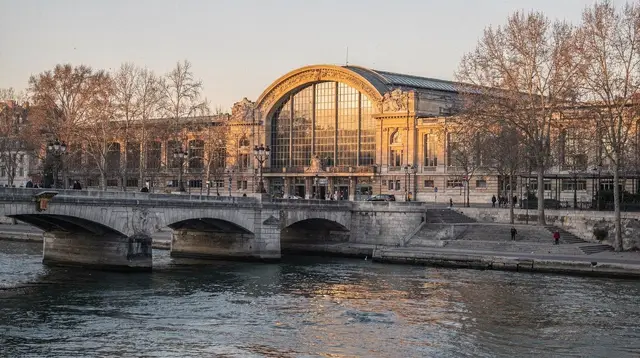
GetYourGuide does not provide a product photo for this activity — the image shows the meeting point, photographed by us.