Eiffel Tower tickets and tours
Do you need to book Eiffel Tower tickets in advance?
Yes. Access to the Eiffel Tower, and especially the elevator to the summit, is controlled by timed entry, and slots for popular hours sell out days or weeks ahead. Reserve a specific time slot before you travel rather than turning up and hoping to buy on the spot.
Why the Eiffel Tower still needs a plan
The Eiffel Tower was built for the 1889 World’s Fair and stands about 330 m tall including its antennas. It has been open to visitors for well over a century, and it is the single most photographed structure in Paris. None of that makes it a walk-up attraction. Access is timed, the queues at ground level are long even outside peak season, and the elevator to the summit has a hard capacity limit per slot. The catalogue for this destination runs to 94 products under Eiffel Tower and Trocadéro, and almost all of them exist to solve the same problem: getting you inside on a fixed schedule instead of gambling on same-day availability.
This guide is about the tower itself: which ticket gets you where, why a reserved time slot is the one detail worth getting right, and how the visit fits around the rest of a Paris trip. It is not about arranging a professional photo session in front of the tower — that is covered separately in our Paris photo shoots guide, where a photographer works with you rather than a timed-entry ticket taking you inside. It is also not a guide to exploring the surrounding streets on foot; for that, see Paris walking tours, which covers neighbourhoods rather than the logistics of one monument.
Second floor or summit: what you’re actually booking
Most Eiffel Tower tickets fall into one of two categories, and the difference matters more than it sounds.
A second floor ticket gets you partway up the tower, by elevator or by stairs, to a platform with an enclosed viewing area and a genuine sense of the ironwork up close. It is the ticket most visitors end up with, either by choice or because summit slots for their preferred time were already gone.
A summit ticket includes the second floor and then a further elevator, running only from the second floor, up to the top. This is the ticket people mean when they say they went “to the top” of the Eiffel Tower. It costs more, requires an additional short wait for the second elevator, and its time slots are the first to sell out, particularly for early evening and sunset.
There is no stair route to the summit. Stairs only cover the ground-to-second-floor section; above that, it is elevator only, and if the summit elevator is fully booked for your slot, there is no workaround on the day.
| Ticket type | Reaches | Elevator required | How far ahead to book |
|---|---|---|---|
| Second floor | Partway up the tower | Optional (stairs available) | Several days |
| Summit | Top of the tower, about 330 m | Yes, from second floor | One to a few weeks, more for evening slots |
| Guided or skip-the-line tour | Second floor or summit, with a guide | Depends on tour | Similar to the matching ticket type, often with steadier availability |
A guided option such as the Eiffel Tower tickets combined with a city bus tour bundles entry with transport and narration, which suits a first visit where you’d rather not manage the booking window alone. For visitors set on reaching the top, the guided tour to the summit is built specifically around that elevator, with a guide managing the queue and the two-stage ascent.
Stairs, elevator, or a guided climb
Climbing the stairs to the second floor is allowed on a standard ticket and is often easier to book than an elevator slot, since it draws a smaller share of visitors. It is a genuine workout: several hundred steps, no seating on the way, and no option to switch to the elevator partway if you change your mind, though the elevator does run in parallel for anyone who prefers it on the way down. For travellers who want the stair route as the main point of the visit rather than a fallback, the Eiffel Tower climbing experience is built around going up on foot, with the structure and pacing of a guided ascent rather than a self-timed elevator ticket.
Whichever route you take to the second floor, plan for security screening at the base, similar to airport-style checks, before you reach the elevators or stairs. This adds to the queue time even once you’re holding a valid ticket for your slot.
Reserving a time slot: the one thing to get right
This is the single point worth repeating: a reserved time slot is strongly advised, not a nice-to-have. Unlike the Louvre, which closes on a fixed day each week, the Eiffel Tower’s constraint isn’t a closing day, it’s capacity per hour. Every ticket, whether bought directly or through a guided tour, is tied to an entry window, and popular slots, particularly for the summit and for evening visits, can be gone well before the date.
A few practical points, without pinning down times or prices that change:
- Book before you arrive in Paris, ideally as soon as your dates are fixed, especially if a summit visit or a specific time of day (sunset, for instance) matters to you.
- Arrive at the entrance ahead of your slot, since security screening and finding the correct queue line both take time.
- A slot missed cannot generally be moved to a later one on the same day; the capacity limit that made booking necessary in the first place also makes same-day rebooking unreliable.
- The Eiffel Tower is not included in the Paris Museum Pass. A pass covering dozens of other sites still requires a separate, separately booked ticket for this one.
If your priority is seeing the tower’s structure and the city view without committing to the summit elevator’s tighter booking window, the second floor ticket is the more forgiving choice logistically, not just financially.
The Trocadéro: the view of the tower, not from it
Every visit plan built around going up the tower should also account for looking at it from outside. The Trocadéro, across the Seine on the opposite bank, faces the tower head-on and is the standard viewpoint for photographing the whole structure in one frame, something that’s difficult to do from directly underneath it. The esplanade and gardens there are open and free to walk, no ticket or time slot required, which makes the Trocadéro a natural complement to a timed entry into the tower itself rather than a substitute for it.
Because the destination groups the Eiffel Tower and Trocadéro together, it’s worth treating them as one outing: book your tower entry for a specific slot, and use time before or after it to cross to the Trocadéro for the view back. Late afternoon into early evening is when the light works best for photographs from that side, though exact timing shifts with the season. For more detail on the esplanade, the gardens, and the sightlines from that side of the river, see Trocadéro and Champ de Mars guide, and for a direct comparison of what you see from the tower itself versus from ground level nearby, Eiffel Tower vs Montparnasse Tower views is useful if you’re deciding between climbing this tower or viewing it from a different one.
What’s included in the destination’s 94 products
The Eiffel Tower and Trocadéro destination carries 94 products in total, and they split roughly into a few groups worth knowing about before you book:
- Direct entry tickets, second floor or summit, sometimes bundled with skip-the-line access.
- Guided tours, where a guide manages the ticket, the queue, and commentary on the way up, useful if the two-stage elevator system or the booking window feels like a lot to manage solo.
- Combined tickets, pairing tower entry with a city bus tour or a Seine cruise, useful if you’re trying to cover several sights in one outing rather than treating the tower as a stand-alone stop.
- Cruise and dining options that view the tower from the river rather than climbing it at all.
That last group deserves its own mention, since it’s a genuinely different way to experience the monument rather than a lesser substitute.
Eating and cruising near the tower
Not every visit needs to involve going up. The tower and its lighting are as much a river-view fixture as a climbing destination, and several products lean into that. An Eiffel Tower cruise sightseeing tour puts you on the Seine looking at the tower rather than standing under it, which avoids the security queue entirely and works well as an evening option once the tower is lit. For a meal built around the same view, a lunch cruise departing near the Eiffel Tower or a dinner cruise gives the same river vantage point with food included, and for evening plans specifically there’s a dinner cruise timed to the tower’s lighting after dark.
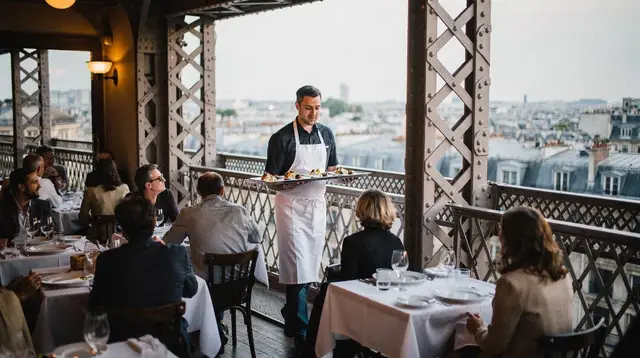
These sit alongside the wider set of Seine cruises covered in our Seine dinner cruises guide, and if you’re weighing a cruise against a straightforward sightseeing ride, Seine dinner cruise vs sightseeing cruise sets out the difference. For restaurant options actually inside the structure, on the first or second floor, see Eiffel Tower restaurants and dining, which covers reservations for those separately from general entry tickets.
Getting there and combining it with the rest of Paris
The Eiffel Tower sits within Paris itself, reachable by metro or on foot from nearby neighbourhoods, so no special transport arrangement is needed beyond the city’s own network; see our Paris metro guide if you haven’t used it yet. It pairs naturally in a single day with a Seine cruise or a walk along the river, and many visitors combine it with the Champs-Élysées and Opéra area or a Trocadéro stop on the same outing. If you’re building out a full day around it, our one day in Paris itinerary sequences the Eiffel Tower alongside other central sights without assuming you’ll rush the ticketed entry.
For a broader sense of what else the destination covers, beyond entry tickets and cruises, things to do at the Eiffel Tower rounds up the wider set of activities tied to this part of the city, and if going up isn’t the priority, our comparison guide Eiffel Tower summit vs second floor can help decide which ticket, if any, is worth booking for your trip.
Frequently asked questions about Eiffel Tower tickets
Do you need to book Eiffel Tower tickets in advance?
Yes. Entry is timed, and popular slots, especially for the summit elevator, sell out well ahead of the date. Booking a fixed time slot before you travel is strongly advised.
What is the difference between the second floor and the summit?
The second floor sits partway up the tower and is reached by elevator or stairs; it is included in most standard tickets. The summit, near the top of the roughly 330 m structure, requires a separate elevator from the second floor and a ticket that specifically includes it.
Can you walk up the Eiffel Tower instead of taking the elevator?
Yes, up to the second floor by stairs. From the second floor to the summit, only the elevator runs; there is no stair option for that final stretch.
Is the Eiffel Tower worth visiting if you don’t go to the top?
The second floor gives a full sense of the structure and a genuine view over Paris at a lower cost and with an easier booking window than a summit ticket, so it is a reasonable choice on its own.
Where is the best view of the Eiffel Tower itself?
The Trocadéro, across the Seine, faces the tower directly and is the standard spot for photographing the whole structure, particularly toward evening.
How tall is the Eiffel Tower?
About 330 m including its antennas, a height set when it was built for the 1889 World’s Fair and still unchanged.
Does the Paris Museum Pass cover the Eiffel Tower?
The Eiffel Tower is not included in the Paris Museum Pass. Tickets for the tower are booked separately, directly for a timed slot.
How long does an Eiffel Tower visit take?
Budget at least two hours once queueing, security screening, and elevator waits between floors are accounted for, more if you plan to eat or linger at the top.
Eiffel Tower tickets and tours on GetYourGuide
Verified deep-linked GetYourGuide tours. Book through these links and we earn a small commission at no cost to you.
GetYourGuide does not provide a product photo for this activity — the image shows the meeting point, photographed by us.