Trocadéro and Champ de Mars: a guide to the Eiffel Tower's two esplanades
What's the difference between Trocadéro and Champ de Mars?
Trocadéro is the terrace on the Rive Droite, facing the Eiffel Tower across the Seine, and is the classic spot for a straight-on photo of the whole structure. Champ de Mars is the long park on the Rive Gauche, directly beneath the tower, better for sitting on the grass or looking straight up. The two are a short walk apart across the Pont d'Iéna, in the same neighbourhood.
Most visitors treat Trocadéro and Champ de Mars as things you pass through on the way to the Eiffel Tower’s ticket queue. That misses what they actually are: two very different public spaces that work fine as a destination on their own, ticket or no ticket, ascent or no ascent. One sits above the Seine on the Rive Droite, the other stretches out below the tower on the Rive Gauche, and knowing which one suits what you actually want to do — a photo, a place to sit, an evening view — saves a fair amount of wandering.
This guide is about the ground, not the structure. For the question of whether to go up the tower, and how, see how to visit the Eiffel Tower. For where to eat nearby, see Eiffel Tower restaurants and dining. Here, the question is simpler: where do you stand, where do you walk, and what should you expect when you get there.
Trocadéro: the view from across the river
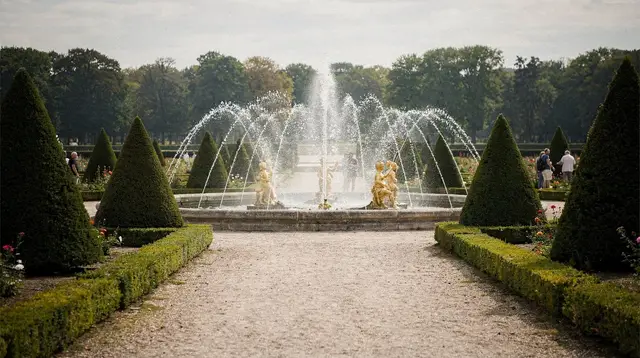
Trocadéro is the terrace of the Palais de Chaillot, on the hill above the Seine, facing the tower directly across the water. It’s the spot behind most of the postcard-style photos of the whole structure, because the elevation and the distance let the tower sit in frame without craning your neck. Between the terrace and the river, the Jardins du Trocadéro slope down with a set of fountains that run at intervals, though not on any fixed published schedule worth planning around.
The terrace itself is paved, open, and flanked by the two wings of the Palais de Chaillot, which house separate museums unrelated to the tower. There’s no admission charge to stand on the esplanade or in the gardens below it — it’s a public square, open around the clock.
What Trocadéro does well:
- A single wide shot with the tower whole, from base to antenna, without a wide-angle lens
- An elevated vantage point, useful for anyone who wants the view without walking uphill from the river
- A natural stop before or after a Seine river cruise, since the boats depart from docks nearby
What it doesn’t have: shade, grass to sit on, or much room to spread out once a tour group or two arrives. The terrace is stone underfoot the whole way across, and benches are limited relative to the number of people who stop there at any one time.
Champ de Mars: the park underneath
Cross the river on the Pont d’Iéna and you’re at the base of the tower, with the Champ de Mars stretching away to the southeast — a long rectangular park, originally a military parade ground, now the main green space in this part of Paris. This is where the tower stops being a distant shape and becomes something you have to tilt your head back to see the top of.
The park’s real asset is the grass. Unlike Trocadéro’s paved terraces, Champ de Mars has open lawns used for picnics, informal games, and simply sitting, particularly from spring through early autumn. It’s one of the few central spots in Paris where lying on the grass with a bottle of wine and a baguette is completely unremarkable rather than something to look for permission to do.
What Champ de Mars does well:
- A different kind of photo: tower filling the frame, shot from directly below, or people in the foreground with the structure looming behind
- Somewhere to actually sit and stay a while, rather than stand and move on
- Proximity to the tower’s base for anyone timing a visit around going up
What it doesn’t have: Trocadéro’s wide framing. From most points in the park you’re too close and too low to get the whole tower cleanly in one shot without lying flat or using a wide lens.
The two together
Trocadéro and Champ de Mars are not separate outings. They sit either side of the same stretch of the Seine, in the same neighbourhood, connected on foot across the Pont d’Iéna in roughly 15 to 20 minutes at an ordinary walking pace. No metro line, RER, bus or taxi is needed to move between them — it’s the kind of walk that’s faster on foot than working out a transfer would be. Doing both in one visit, ideally starting at Trocadéro for the wide view and ending at Champ de Mars to sit down, is the natural way to see the area without retracing steps.
| Trocadéro | Champ de Mars | |
|---|---|---|
| Side of the Seine | Rive Droite | Rive Gauche |
| Best for | Wide photo of the whole tower | Sitting, picnics, close-up views |
| Ground | Paved terrace | Grass lawns |
| Elevation | Above river level | Level with the tower’s base |
| Shade | Limited | More trees along the edges |
| Walk between the two | 15–20 minutes via Pont d’Iéna | 15–20 minutes via Pont d’Iéna |
Timing: when the crowds thin out
Both spaces are busiest around sunset, when the light flatters the tower and everyone with a camera converges at once, and through the middle of the day in the warmer months when tour groups move through on a fixed schedule. Early morning is the reliable window for a clear shot at Trocadéro without a crowd of shoulders in frame, and it’s also the quietest time to walk the length of Champ de Mars.
Evenings bring a different atmosphere once the tower’s lighting comes on after dark — the terrace at Trocadéro in particular fills up again for the illuminated view, and it stays busy later than the daytime crowd would suggest. A slow evening pass through the area, without any fixed itinerary, is also the kind of thing that works well from a private tour by classic car or a guided ride that loops past both banks — worth considering if walking the full stretch twice in one evening isn’t appealing. A night tour by Mercedes that takes in the illuminated landmarks with a glass of champagne covers this ground without requiring you to work out the walking route yourself, and a sidecar tour with a bottle of champagne included hits similar photo stops from a different angle, literally.
For visitors who’d rather cover the two esplanades and the wider riverside on their own schedule but without walking the whole way, a 1.5-hour guided Segway tour threads through this part of the city at a pace that leaves time to stop for photos at both viewpoints. And for the classic postcard experience of seeing the tower from a moving vehicle rather than on foot, a guided tour of Paris in a Citroën 2CV typically loops past this stretch of the Seine as part of a wider circuit.
Crowds and pickpockets: the honest part
Both Trocadéro and Champ de Mars sit on the same list of dense, high-turnover public spaces where pickpockets are known to operate, alongside the areas immediately around the tower’s base and the approach paths from the nearest metro stations. This isn’t a reason for alarm — it’s one of the most visited corners of the city, and the vast majority of visits pass without incident — but it’s worth the same ordinary caution used anywhere crowds bunch up around a fixed point: bags closed and in front of you, phones held rather than left in a back pocket, and a flat “no” for anyone approaching with a bracelet, a clipboard petition, or a “found” ring. For the fuller picture of common scams in this part of the city, see Paris scams and pickpockets.
The crowd itself is heaviest at the times already mentioned — sunset, and midday during the busier months — and thinnest early in the morning. If crowd density is the main concern rather than the view itself, an early visit solves most of it on its own.
What this isn’t
This is not a guide to going up the tower — the elevators, the levels, the booking window, and the practical differences between the second floor and the summit are their own subject, covered at how to visit the Eiffel Tower and at Eiffel Tower summit vs second floor. It’s also not a restaurant guide — options for eating near the tower, from a casual stop to something more formal with a view, are covered at Eiffel Tower restaurants and dining. And it isn’t a comparison of viewpoints across the city; for that, see best views in Paris and, if the Eiffel Tower’s own viewing levels feel too crowded a prospect, Eiffel Tower vs Montparnasse Tower views, which looks at the tower from a distance instead.
What this guide covers is simpler and, for a lot of visitors, more useful day to day: where to stand for the shot you actually want, where to sit down for a while, and how the two sides of the river relate to each other on foot. Whether or not a ticket up the tower is part of the plan, Trocadéro and Champ de Mars are worth the visit on their own terms.
Getting there and around
Both esplanades sit within the same central stretch of Paris, reachable by the city’s own transport network rather than anything specific to this neighbourhood — see the Paris metro guide for the wider system. For anyone staying nearby to build a visit around sunrise or sunset without a long trip back to a hotel, where to stay near the Eiffel Tower covers the options. And for a first visit to the city where this stop is one part of a longer day, one day in Paris shows how it fits alongside the rest.
Trocadéro and Champ de Mars: frequently asked questions
Is Trocadéro or Champ de Mars better for photos of the Eiffel Tower?
Trocadéro gives the classic wide shot, tower and fountains together, because it sits on the opposite bank and slightly elevated. Champ de Mars puts you directly under the structure, better for looking straight up or for a photo with people in the foreground and the tower filling the background rather than framed whole.
Do you need a ticket to visit Trocadéro or Champ de Mars?
No. Both are open public spaces, free to enter at any hour. Tickets are only needed to go up the tower itself, which is a separate question covered elsewhere.
How do you get from Trocadéro to Champ de Mars?
On foot, across the Pont d’Iéna, past the base of the tower. It takes about 15 to 20 minutes at a walking pace and needs no metro, bus or taxi, since both esplanades sit in the same stretch of Paris either side of the Seine.
Is it safe to visit Trocadéro and Champ de Mars?
Yes, but both are known spots for pickpockets, especially in the dense crowds around sunset and in summer. Keep bags closed and in front of you, and treat unsolicited approaches, like a bracelet offer or a petition, as a signal to walk on.
Can you picnic on Champ de Mars?
Yes, the lawns are used for picnics through the warmer months, and it’s one of the few central Paris green spaces where sitting on the grass is normal and expected. Trocadéro has no equivalent lawn; its terraces are paved.
When is Trocadéro least crowded?
Early morning, well before the tour groups and sunset crowds arrive, gives the clearest view and the easiest spot to stand still for a photo. Midday and the hour around sunset are the most crowded times year-round.
Are Trocadéro and Champ de Mars different from visiting the Eiffel Tower itself?
Yes. Going up the tower is a separate, ticketed activity with its own booking questions, covered elsewhere. This guide is about the public spaces around it, useful even for a visit where nobody goes up at all.
Eiffel Tower tickets and tours on GetYourGuide
Verified deep-linked GetYourGuide tours. Book through these links and we earn a small commission at no cost to you.
GetYourGuide does not provide a product photo for this activity — the image shows the meeting point, photographed by us.