How to visit the Eiffel Tower
What is the best way to visit the Eiffel Tower?
Book a timed entry slot in advance rather than buying on site, since queues for tickets and security can run long. Decide first whether you want the second floor or the summit, and whether you want to climb the stairs to the second floor or take a lift the whole way.
Getting the ascent right
The Eiffel Tower was built for the 1889 World’s Fair and still stands at roughly 330 metres including its antennas, which makes it one of the tallest structures a visitor can climb inside on a Paris trip. That height is exactly why the ascent needs a plan. There are three levels open to visitors, two very different ways to reach the second one, and only one way to reach the top. Getting this guide’s advice right, before you leave your hotel, saves more time than almost anything else on a Paris itinerary.
This page focuses narrowly on the climb itself: which floor to choose, stairs or lift, what to book, and what you will actually see once you’re up there. Where to eat on or near the tower is covered separately in Eiffel Tower restaurants and dining, and the best angles to photograph the tower from outside, including the Trocadéro and the Champ de Mars, are covered in the Trocadéro and Champ de Mars guide.
The tower sits in the Eiffel Tower and Trocadéro area of Paris, on the Left Bank side of the Seine, with the Champ de Mars gardens stretching out beneath it. It’s part of the same catalogue zone as the Trocadéro viewpoint across the river, which lists 94 products between tickets and guided visits. That volume of options is a sign of demand, not a sign that any time slot is easy to get on short notice.
Book a time slot before you queue for anything else
The single most important piece of practical advice here is to reserve a timed entry slot in advance. Walk-up visitors join two separate queues: one for tickets, one for security screening before entering the base of the tower. On a clear day in high season, both can run long, and there’s no guarantee the level you want will still have space by the time you reach the counter. A pre-booked, timed ticket does not remove the security queue, but it does fix your entry window and, for most products, your floor.
This is the reason a guide like this one keeps repeating the same point: reserve ahead, choose your floor before you arrive, and treat the Eiffel Tower as an appointment rather than a spontaneous stop. For a wider sense of how far ahead that booking should happen relative to the rest of a trip, see how far ahead to book Eiffel Tower tickets.
A standard lift ticket to the second floor, such as a second-floor access ticket with lift entry, is the simplest option for most visitors and the one that removes the most uncertainty from the day. For a first visit to Paris where a guide adds context to the tower’s history and construction, a guided tour that includes tower entry pairs the climb with commentary, which some travellers prefer to reading panels on the way up. Neither substitutes for checking your confirmed time slot the night before.
Second floor or summit: what each level actually gives you
The tower has three public levels: the first floor, the second floor, and the summit near the top of the structure. Most visitors choose between stopping at the second floor or continuing to the summit, and the two experiences are different enough to be worth thinking through before you book.
| Level | Approximate height | What you get | Typical wait |
|---|---|---|---|
| First floor | Lower level | Glass floor sections, exhibition space, views over the Champ de Mars | Short once inside |
| Second floor | Around 115 m | Close, detailed views over Paris rooftops, monuments identifiable by eye | Moderate, shorter than summit |
| Summit | Near 330 m with antennas | Wide panoramic views, weather more noticeable, extra lift queue | Longest, connecting lift adds time |
The second floor is the level most people find gives the best balance: close enough to make out individual streets, the Seine’s curve, and landmarks like the Louvre or Sacré-Cœur without binoculars, and reached without the extra queue for the connecting lift to the top. The summit trades that closeness for altitude. On a hazy day, the summit view can actually feel less sharp than the second floor’s, since you’re looking through more atmosphere. On a clear day, the summit adds genuine width to the panorama and lets you see further into the surrounding region. A side-by-side comparison of what’s visible from each level is in Eiffel Tower summit vs second floor, and if you’re weighing the tower against the city’s other elevated view, Eiffel Tower vs Montparnasse Tower views covers that comparison directly.
Whichever level you choose, ticket types are specific: a second-floor ticket does not include summit access, and summit tickets require passing through the second floor first, then queueing again for the final lift. Confirm exactly what your booking covers before you commit to a plan for the day.
Stairs or lift: how you get up matters too
Between the ground and the second floor, visitors can choose stairs or a lift. The staircase is public, physically demanding but manageable for most reasonably fit visitors, and it has one clear advantage: it usually moves faster than the ground-level lift queue, which is often the single longest wait at the tower. Climbing also gives a completely different, closer view of the ironwork than the lift ride does, which some visitors find is worth the effort on its own.
From the second floor to the summit, there is no public staircase. That final stretch runs by lift only, and it operates as its own queue even for visitors who already climbed the stairs to the second floor. This means a stair climb only ever gets you partway if the summit is your goal; plan on a further wait once you reach the second floor if you intend to continue.
Neither stairs nor lift are guaranteed to be open on every visit. Access can change with maintenance, weather conditions such as high wind, or operational decisions on the day, so it’s worth checking current access before you travel rather than assuming both options will be available exactly as described here.
Getting to the Eiffel Tower and back
The tower sits on the Left Bank of the Seine, in the Eiffel Tower and Trocadéro area, and it’s served by Paris’s public transport network of 16 métro lines and 5 RER lines run by Île-de-France Mobilités. Since the January 2025 fare reform, single tickets come in two forms — a Métro-Train-RER ticket and a separate Bus-Tram ticket — loaded onto a Navigo Easy card or a phone, while visitors staying several days often find a weekly Navigo pass or a Paris Visite pass more convenient than buying tickets one at a time. Full detail on which option suits a short stay versus a longer one is in the Paris métro tickets and Navigo guide, and the wider network, including how the RER differs from the métro, is explained in the Paris métro guide and the Paris RER and trains guide.
Driving to the tower isn’t recommended: central Paris has heavy traffic, limited and expensive parking, and a low-emission zone that requires a Crit’Air sticker on the windshield, so public transport or walking from a nearby hotel is almost always the simpler choice, and driving is on the right. If you’re weighing the métro against a taxi or a ride-hailing app for the day more broadly, métro vs taxi in Paris and taxis and ride-hailing in Paris cover that trade-off in more depth. For visitors arriving straight from the airport who want to fold the tower into their first day, CDG airport to Paris city centre and Orly airport to Paris city centre walk through the transfer options into the city before you even reach the métro network.
Choosing the right time of day and season
Paris has a temperate climate, and the tower is open year-round, but when you go changes the experience more than most first-time visitors expect. Spring (April to June) and early autumn (September to October) tend to bring the most comfortable mix of mild weather and manageable crowds, a pattern covered in more depth in best time to visit Paris and, month by month, in Paris weather by month. Summer is warmer, sometimes with spells of real heat, and it’s also when queues at the tower run longest; August in particular sees many Parisians leave the city, which can thin out some neighbourhoods even as visitor numbers around the main sights stay high, a pattern explored in what is Paris like in August.
Winter is colder and greyer, but a clear winter afternoon can give some of the crispest views from either level, and the tower’s evening lighting stands out more against an early-dark sky, which is part of why it’s a highlight of Paris in winter and, for anyone timing a trip around the holidays, Christmas in Paris. Whatever the season, rain is possible at any time of year, so build a little flexibility into the day rather than counting on clear skies for your booked slot.
Time of day matters almost as much as time of year. Early slots tend to have shorter queues and softer light for photos, while sunset slots are the most popular of the day and the first to sell out, especially in summer when the tower stays busy well into the evening. Mobility needs are worth planning for too: lifts serve every level that requires one, and a broader look at getting around the city, including the tower area, with limited mobility is in the accessible Paris guide.
A realistic timeline for the visit
Set aside more time than the ticket alone suggests. A typical visit breaks down roughly like this: arriving and finding the correct entrance for your ticket type, passing through security screening, the climb or lift ride itself, time actually spent on the viewing level or levels, and the return down. For a second-floor-only visit, two hours door to door is a reasonable minimum. For a summit visit, three hours is more realistic once you factor in the connecting lift queue at the second floor.
Arrive with buffer time before your booked slot rather than exactly on time. Security screening can take longer than expected depending on the number of visitors arriving in the same window, and being late for a timed slot can mean rejoining a general queue instead of using your reservation. If you’re building this into a longer day near the Seine, a Seine dinner cruise with tower views from the water, such as a Seine lunch cruise paired with an Eiffel Tower visit, is one way to combine the two without doubling back across the city.
What you’ll actually see, level by level
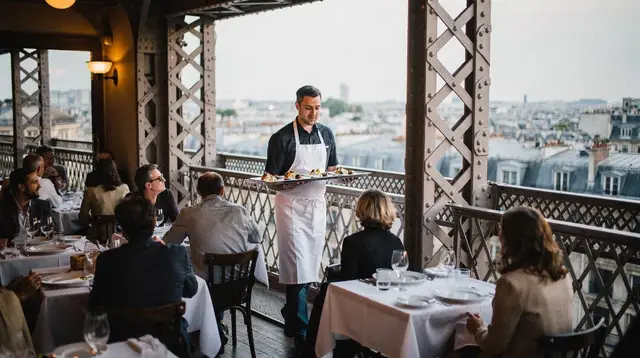
From the first floor, the view is mostly of the Champ de Mars gardens directly below and the surrounding Left Bank streets; it’s also where most of the tower’s exhibition content sits, covering the structure’s engineering and history. From the second floor, the city opens up: the Seine’s curve is clearly visible, along with the dome of Les Invalides, the towers of Notre-Dame de Paris on the Île de la Cité, and, on a clear day, Montmartre and the Sacré-Cœur to the north. This is the level most photographs of the city from the tower are taken from, because the detail holds up.
From the summit, the perspective shifts from a city view to a regional one. You can trace the Seine much further into the distance, and on an exceptionally clear day the view extends beyond the city limits. Wind is more noticeable at this height, and the platform is smaller and more exposed than the second floor. Some visitors find the summit view genuinely worth the extra wait; others find the second floor gives a more satisfying, readable picture of Paris for less time invested. There is no universally right answer, only a trade-off worth knowing about before you queue.
If you want the history behind why the structure looks the way it does and why it was nearly demolished after the 1889 fair, that story is told separately in the story of the Eiffel Tower, and whether the climb is worth it for a specific type of traveller is discussed in is the Eiffel Tower worth climbing.
Combining the tower with the rest of your visit
The Eiffel Tower sits inside a catalogue zone with dozens of other products, from guided history walks to hop-on-hop-off routes that pass nearby. A tour that pairs the tower with a broader look at Left Bank landmarks, such as a guided tour combining the Eiffel Tower with a historic Panthéon visit, is worth considering if you want the climb folded into a fuller half-day rather than a standalone stop.
If you hold a Paris Museum Pass, note that it does not cover the Eiffel Tower and does not exempt you from booking a timed entry slot; the pass and the tower ticket are separate systems, and both the Louvre and Versailles still require their own advance time-slot bookings even with the pass in hand. Treat the tower as its own booking regardless of what else you’ve arranged for the trip.
For first-time visitors mapping out a single day that includes the tower alongside other central sights, one day in Paris gives a sense of realistic pacing, and how many days in Paris helps decide whether the tower fits into a short stopover or a longer stay. For the wider set of viewpoints across the city beyond just the tower itself, best views in Paris rounds up the alternatives, and the full set of ticket and tour options for the tower itself is gathered in Eiffel Tower tickets and tours. The broader activity listings for this part of the city are also grouped under things to do near the Eiffel Tower and Trocadéro and the Eiffel Tower category page.
The honest summary
Booking a timed slot in advance, choosing your floor deliberately, and deciding upfront whether the stairs to the second floor suit you is nearly the whole visit sorted. The queues at the Eiffel Tower are real, not exaggerated for effect, and the difference between a two-hour visit and a half-day spent waiting usually comes down to whether you reserved ahead. Neither floor is objectively better: the second floor is closer and more detailed, the summit is higher and wider. Pick based on what you actually want to see, book it before you arrive in Paris, and build enough buffer into your schedule that a longer-than-expected security queue doesn’t unravel the rest of your day.
Eiffel Tower tickets and tours on GetYourGuide
Verified deep-linked GetYourGuide tours. Book through these links and we earn a small commission at no cost to you.
GetYourGuide does not provide a product photo for this activity — the image shows the meeting point, photographed by us.