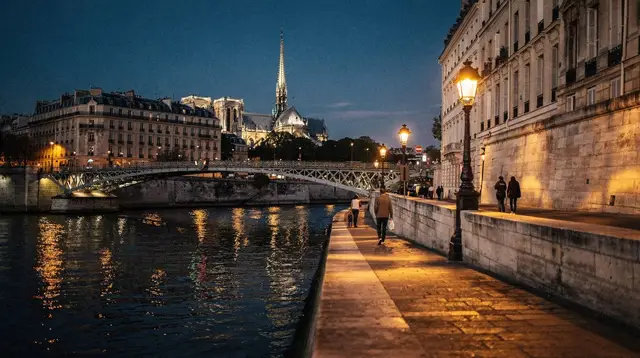
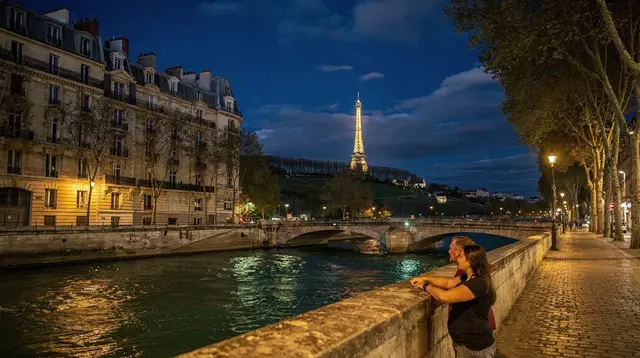
Paris in winter: cold light, short days and Christmas markets
What is Paris like in winter?
Cold and often grey, with short daylight hours and occasional rain or light frost. Major museums and monuments stay open year-round, but Giverny closes for the season and the city's mood shifts toward illuminations, Christmas markets and long indoor visits rather than outdoor strolling.
What winter actually feels like in Paris
Winter in Paris is defined less by any single number on a thermometer than by two things: the sky and the clock. Days are short, with darkness settling in by late afternoon, and the sky is grey far more often than it is blue. Rain is common, sometimes for days at a stretch, and a cold, damp wind off the Seine can make an afternoon feel colder than the temperature suggests. Frost on car windshields and rooftops is a regular winter morning sight; a real snowfall that settles on the ground is the exception, not the rule, and usually melts within a day.
None of that makes Paris unpleasant. It makes it a different city from the one in the postcards taken in June. Cafe terraces are half-empty or fitted with blankets and outdoor heaters instead of full of people lingering over rosé. Streets in the Latin Quarter and Saint-Germain and Le Marais feel calmer. Queues at the Louvre and the Eiffel Tower and Trocadero tend to be shorter than in the warmer months, especially outside the school holiday weeks around Christmas. Winter in Paris rewards travellers who plan around being indoors a lot: museums, covered passages, cafes, and long lunches, with outdoor time in shorter, deliberate bursts rather than all-day wandering.
This page is about that atmosphere specifically, not a month-by-month temperature comparison. For the numbers behind each month of the year, see Paris weather by month; for the rainy-day version of a winter afternoon, see Paris on a rainy day.
Daylight, cold and rain: the practical shape of the season
The single biggest adjustment for winter visitors is daylight. Where a June evening in Paris stays bright past nine, a December afternoon can be dim by five. That shortens the practical window for outdoor sightseeing and pushes a lot of a winter day toward museums, shopping arcades, and sit-down meals. Building an itinerary with one major indoor attraction in the morning and another after lunch, rather than a long outdoor walking loop, tends to work better for this season than for spring or summer.
Cold is manageable with normal winter clothing: temperatures a few degrees above freezing are typical, colder snaps happen but are not the norm, and wind chill near the river or on open squares like the Champ de Mars matters more than the number on a forecast. Rain is the more consistent nuisance. A compact umbrella and waterproof shoes do more for a winter Paris trip than a heavy coat alone, since the city’s stone pavements get slick and puddled quickly.
None of this changes what is open. Paris does not shut down for winter the way it thins out in August, when many residents leave and some small restaurants close for the month. Winter is a normal working season: restaurants, shops and neighbourhood life carry on much as usual, aside from the closures on Christmas Day and New Year’s Day themselves. A useful shorthand: August tests whether Paris is open, winter tests whether the visitor is dressed for it.
Illuminations and Christmas markets: what makes winter its own season
What sets winter apart from the other three seasons on this site is not the cold on its own, it is what the city does with the dark. From late November, shopping streets including the Champs-Elysees are strung with illuminations, and storefronts around the Opera and the grands magasins put on elaborate window displays that draw evening crowds. Christmas markets, smaller and more scattered than the large German or Alsatian versions, appear at several spots around the city through December, with wooden chalets selling mulled wine, roasted chestnuts, crafts and seasonal food. Exact dates and locations shift from year to year, so this is worth checking against current listings close to a trip rather than assuming a fixed calendar.
This is the identity winter has that no other season shares. Spring is about mild weather and gardens coming back to life, summer is about long evenings and heat, autumn is about mellow light and fewer crowds, but only winter has the lit-up boulevards, the market stalls, and the sense of a city dressed for the season after dark. A walk from the Champs-Elysees and Opera toward Montmartre in the early evening, past the lights and the Sacre-Coeur lit against the winter sky, is a distinctly winter version of Paris that does not exist in July.
For visitors timing a trip around the season itself, see Christmas in Paris and New Year’s Eve in Paris for the specifics of those weeks.
What stays open, and what quietly closes for the season
The reassuring news for winter planning is that almost everything that matters stays open. The Louvre keeps its usual rule of closing on Tuesdays and requiring a booked time slot, winter or not. The Musee d’Orsay keeps its Monday closure. Notre-Dame de Paris, reopened in December 2024 after the 2019 fire, has free entry with a recommended booked slot, and that does not change for winter. Versailles keeps its Monday closure too, and the palace interiors are, if anything, a better winter option than the gardens, which are bare and better suited to a spring or summer visit.
The one seasonal closure worth planning around is Giverny. Claude Monet’s house and gardens are a seasonal attraction by nature, open only from spring through autumn, and they close for winter entirely. A trip built around seeing the water lily garden simply does not work between late autumn and early spring; Giverny belongs on a warm-season itinerary, not a winter one. If the goal is a day trip from Paris in winter, Versailles, Fontainebleau and Vaux-le-Vicomte, or one of the region’s museums make better use of a short, cold day than an outdoor garden that is dormant anyway.
| Attraction | Winter status | Note |
|---|---|---|
| Louvre | Open | Closed Tuesdays, booked time slot required |
| Musee d’Orsay | Open | Closed Mondays |
| Notre-Dame de Paris | Open | Free entry, booked slot recommended |
| Versailles | Open | Closed Mondays; interiors better suited to winter than the gardens |
| Sainte-Chapelle and Conciergerie | Open | Indoor, good winter option |
| Giverny | Closed for the season | Reopens in spring |
Building a winter day around the weather
A winter day in Paris works best structured around indoor anchors with outdoor time in between rather than the other way around. A morning at the Louvre or the Musee d’Orsay, a warm lunch, an afternoon walking through Le Marais or the Latin Quarter and Saint-Germain with stops in covered passages and cafes, and an early evening pass through the illuminations near the Champs-Elysees covers a lot of ground without depending on long stretches outdoors in the cold.
A guided multi-day winter itinerary with a local guide can take the planning out of this entirely, threading indoor sights with shorter outdoor stops timed around the shortest daylight of the year. For repeat visits to several major museums and monuments across a few days, a multi-day Paris museum pass also suits winter well, since it rewards exactly the indoor-heavy pace the season calls for rather than a single rushed visit.
Food is a natural anchor for a cold day too. Long, warm lunches and dinners fit the season better than the picnic-in-the-park pace of summer, and a seasonal cheese tasting tour is a straightforwardly winter-appropriate way to spend a grey afternoon indoors rather than fighting the weather.
Arriving and getting around in winter
Airport arrival does not change with the season beyond the usual advice: the RER B connects Paris Charles de Gaulle (CDG) to Gare du Nord and Chatelet, and a private CDG to Paris transfer is worth considering on a cold, dark evening arrival when carrying luggage through cold stations and platforms is less appealing than in summer. From Paris Orly (ORY), metro line 14 has run since June 2024, and from Paris Beauvais (BVA) the shuttle to Porte Maillot still takes well over an hour regardless of season.
Within the city, the metro and RER network run to the same schedule year-round, and cold, wet weather is exactly when the Paris metro earns its keep over walking long distances outdoors. Renting a bike, by contrast, is a much less appealing winter option than in spring or summer; a guided bike tour of Paris in winter suits milder, drier days rather than a typical grey, damp one, so it is worth checking the forecast before booking rather than assuming good conditions.
Choosing where to stay for a winter trip
Winter’s short days make location matter more than it does in summer: with darkness settling by late afternoon, less time is left to cover ground on foot between a hotel and the day’s sights, and a long cold walk back at night is a worse trade in January than in June. Staying somewhere central and close to a metro station cuts down on how much of the day is spent moving in the cold rather than seeing anything. Where to stay in Paris runs through the main options across the city for a first look, while more specific guides cover basing a trip in Le Marais, in Saint-Germain-des-Prés, or near the Eiffel Tower for travellers who would rather stay close to one part of the city than commute across it after dark.
Planning a winter Paris itinerary
Because a winter day covers less outdoor ground than a summer one, it helps to plan fewer stops per day and to group them by neighbourhood instead of crossing the city back and forth. Paris in winter, in four days lays out a day-by-day structure built specifically around short daylight hours, pairing indoor-heavy mornings and afternoons with shorter outdoor stretches at the times of day when the light and the crowds are best. Travellers with less time can adapt a general plan such as three days in Paris, trimming the outdoor stretches and keeping an indoor backup in reserve for whichever day of the trip turns out coldest or wettest.
What to pack for a winter trip
Layers matter more than any single heavy item: a warm coat, a scarf, gloves, and comfortable, waterproof shoes cover most winter days. An umbrella is close to essential given how often rain figures into the forecast, more so than snow gear, which is rarely needed given how uncommon settled snow actually is. For a fuller packing list matched to the season, see What to pack for Paris.
Footwear deserves special attention in winter: Paris’s stone pavements, cobbled streets and metro stairs get wet and slick in the rain that defines the season, and shoes with real tread hold up far better than fashion boots with a smooth sole. A daypack with room to stash a folded umbrella and a scarf that can come off in an overheated museum or cafe is more useful than trying to guess one exact temperature for the whole day, since indoor heating swings the comfortable layer up and down several times between breakfast and dinner.
Winter in Paris: frequently asked questions
Is Paris worth visiting in winter?
Yes, for shorter queues at major sights, lower accommodation demand outside the December holiday weeks, and the illuminations and Christmas markets unique to the season. The trade-off is cold, often grey weather and short daylight hours compared with spring or autumn.
How cold does it get in Paris in winter?
Temperatures typically sit a few degrees above freezing, with occasional colder snaps. Frost is common on mornings; heavy snow is not.
Is Giverny open in winter?
No. Monet’s house and gardens close for the season and reopen in spring, so Giverny is not an option for a winter day trip from Paris.
Are the Louvre and Notre-Dame open in winter?
Yes. The Louvre keeps its usual Tuesday closure and time-slot booking requirement, and Notre-Dame de Paris, reopened in December 2024, keeps its free entry with a recommended booked slot.
When are the Christmas illuminations and markets in Paris?
Illuminations along the Champs-Elysees and other shopping streets typically start in late November, and Christmas markets run through December at various spots around the city. Dates shift year to year, so check current listings before planning a trip around them.
Does it snow in Paris in winter?
Snow is possible but not reliable. Most winters see only brief, light snowfall at most, with cold rain and frost being far more typical.
What shuts down in Paris in winter, compared with August?
Far less. Winter is a normal working season for shops and restaurants, unlike August when many Parisians leave and some small businesses close for the month. The main closures in winter are limited to Christmas Day and New Year’s Day.
Is Versailles worth visiting in winter?
Yes, for the palace interiors, which do not depend on the weather. The gardens and fountain shows are far better suited to spring and summer, so winter favours the state rooms over the grounds.
What should I pack for a winter trip to Paris?
Layers, a warm coat, a scarf and gloves, waterproof shoes with real tread, and a compact umbrella cover most winter days. Heavy snow gear is rarely needed, since settled snow is uncommon in Paris.
Seasonal Paris guides and events on GetYourGuide
Verified deep-linked GetYourGuide tours. Book through these links and we earn a small commission at no cost to you.
GetYourGuide does not provide a product photo for this activity — the image shows the meeting point, photographed by us.