The story of the Eiffel Tower
I did not expect a metal tower to hold my attention for as long as it did. I had seen it in a thousand photographs before I ever stood under it, and I assumed I already knew the shape of the story: an engineer, a fair, a famous silhouette. What I had not registered was how close the whole thing came to being scrapped, and how much of what I now think of as “timeless Paris” was, for its first couple of decades, a temporary structure on borrowed time.
A fair, a deadline, and a competition
The tower exists because of the Exposition Universelle of 1889, the World’s Fair that marked the centenary of the French Revolution. The organisers wanted a monumental entrance arch, something that would announce, from a distance, that Paris was the city of engineering and industry as much as of art and monarchy. Gustave Eiffel’s engineering firm won the commission, though the actual design work is usually credited to two of his engineers, Maurice Koechlin and Émile Nouguier, refined with the architect Stephen Sauvestre.
Construction ran on a genuinely tight schedule: a little over two years, most of it prefabrication in a workshop and assembly on site with wrought-iron lattice pieces bolted and riveted together. For an 1880s building site, that speed was remarkable, and it is part of why the tower reads today as an engineering story rather than an architectural one. Nothing about it was carved or sculpted. It was calculated, drawn, numbered, and put together like a very large kit.
Not everyone welcomed it. A group of prominent writers and artists signed a public protest against what they called a “useless and monstrous” tower looming over the city. Reading that protest now, after more than a century of postcards, it is a useful reminder that the most recognisable image of Paris was, at the time, a controversial gamble on the Champ de Mars.
A structure built to be temporary
Eiffel’s original permit was for 20 years. After that, the tower was supposed to come down, and the ground beneath it returned to ordinary parkland. That detail is easy to skip past, but it changes how I read the whole story: the tower was never meant to become what it became.
What saved it was not sentiment but usefulness. In the years after 1889, the tower’s height made it valuable for wireless telegraphy experiments, and later for radio transmission. The French military found it useful for signals and, during the First World War, for intercepting enemy communications. A structure that had been built to impress fairgoers for a season ended up doing quiet, practical work that made it worth keeping. By the time the original permit would have expired, dismantling it no longer made sense.
That pattern — a provisional structure that earns its permanence through use rather than through admiration — is, to me, the real story here. Paris tends to keep the things it finds useful and let the merely decorative ones fade. The Eiffel Tower did not survive because Parisians decided they loved it. It survived because it kept doing a job.
What the numbers still mean
The tower stands at roughly 330 metres including its antennas, a figure that has shifted slightly over the decades as broadcasting equipment was added to the top. It is still worth holding onto that number as a fixed point, because it is the one fact about the tower that people misremember most often, usually rounding up toward something more dramatic than it needs to be.
For scale, when it opened it was the tallest man-made structure in the world, a title it held for over 40 years. That is a long run for a “temporary” fairground attraction. It also explains something about the shape: the tapering, open lattice was partly an aesthetic choice and partly a practical answer to wind resistance at a height nothing else had attempted.
Going up, then and now
Visitors climbed it almost as soon as it opened, first by the original hydraulic lifts and by the stairs, both still part of the experience. You can walk the stairs as far as the second floor; the summit is reached only by lift. What has not changed since 1889 is that this is still a working structure with limited capacity, and what has changed a great deal is how people get access to it.
I will say this plainly because it is the one practical thing I think matters here: book a time slot before you go, whichever way you plan to go up. The tower does not sell entry the way a museum with a long open hall does — it manages a steady stream of people through lifts and stairwells that were never designed for modern visitor numbers, and unplanned queuing at the base can eat an entire morning. This is true whether you are taking the lift to the summit or walking the stairs to the second floor. It is the single most avoidable disappointment I have watched other travellers run into near the tower.
I am not going to give a time of day when it is quieter or a price for the ticket, because both change and neither tells you anything durable about the place. What is durable is the shape of the decision: reserve ahead, decide in advance whether you actually want the summit or whether the second floor view already does the job for you, and treat the climb as a planned event rather than something you slot in between other stops.
If you are still weighing the options, the guide to Eiffel Tower tickets and tours lays out the lift-to-summit and stairs-to-second-floor routes side by side, and the dedicated summit versus second floor comparison goes further into which view is actually worth the extra queue. Plenty of visitors also ask whether the climb is worth it at all next to simply admiring the tower from outside; I go into that trade-off separately in is the Eiffel Tower worth climbing, alongside the practical question of how far ahead to book Eiffel Tower tickets.
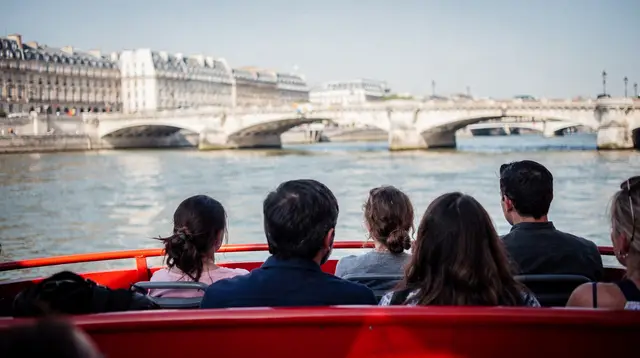
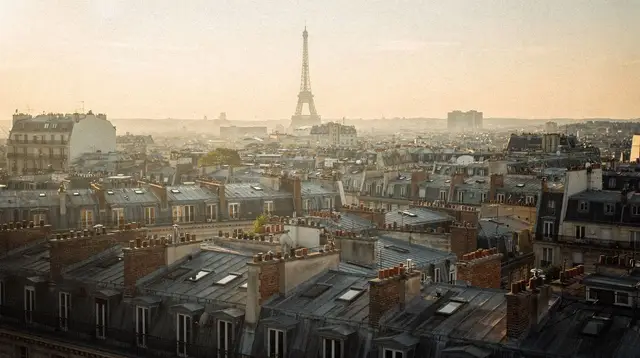
If you would rather see the tower from a distance than queue to go up it, the view from the Trocadéro terrace across the river is free and, for a first impression of the scale of the thing, arguably better than the view from inside it. The Trocadéro and Champ de Mars guide covers both sides of that view in more detail, including where each vantage point works best. A seine river cruise that passes beneath it gives you a third angle again, closer to water level, which is how most of its first visitors would have approached the Champ de Mars from the city.
a lunch cruise on the Seine that passes right beneath the towerWhy the silhouette still does work
What strikes me now, having read the engineering history, is how deliberately unfinished the tower still looks. It was not built to be smooth or monumental in the way a cathedral is. You can see the rivets, the crossed struts, the calculation showing through the surface. That transparency is, oddly, what has let it absorb over a century of new meaning without looking dated: it lights up at night, it appears in fireworks displays, it has hosted broadcast antennas that would have baffled the engineers who built it, and none of that additional weight changes the shape people recognise from a mile away.
I think that is the real reason it became the symbol of the city rather than staying a fairground curiosity: it was built as infrastructure, not decoration, and infrastructure that keeps being useful gets to stay. Notre-Dame’s story is a different kind of endurance, built over centuries and rebuilt after fire, and I have written about that separately rather than folding it in here. The tower’s story is shorter and sharper: a deadline, a protest, a demolition date that never arrived, and a shape that ended up defining how the rest of the world pictures this city.
If you want that other side of Paris endurance, Notre-Dame after the fire covers a monument that survived by being rebuilt rather than, like the tower, by being useful. The two make an interesting pair precisely because they were saved for opposite reasons.
I did eventually give in and photograph it properly, and if you are planning to do the same, Paris photo spots at sunrise and the wider guide to Paris photo shoots both cover the practical side of getting a clean shot without a crowd of other tripods in it.
Standing at the base of it now, on the Champ de Mars side or across the river near Trocadéro, it is worth remembering that none of this was inevitable. If a few engineering committees had made different calls in the 1900s, the tower would be a black-and-white photograph in a history book instead of the thing you are trying to book a time slot for. For a dinner with the view included rather than the climb, a cruise timed for the tower’s evening lighting is a reasonable alternative to the ticket queue.
an evening dinner cruise timed to the tower’s light showFor a different way to take in the wider city that grew up around the tower, a private tour through Le Marais by vintage car covers ground the tower itself cannot show you: the older, denser Paris that existed long before 1889.
a private vintage car tour through Le MaraisIf you would rather eat within sight of the tower than book a cruise, the guide to restaurants and dining near the Eiffel Tower rounds up options at different budgets, from a quick view over a coffee to a full dinner table facing it. And if you are weighing the tower’s own view against the wider Paris skyline, the Eiffel Tower versus Montparnasse Tower views comparison is worth reading before you decide which one to climb.
The Eiffel Tower: a short history, answered
Why was the Eiffel Tower built?
It was built as the entrance arch for the 1889 World’s Fair, marking the centenary of the French Revolution and showcasing French engineering.
Was the Eiffel Tower supposed to be temporary?
Yes. The original building permit ran for 20 years, after which the tower was meant to be dismantled. It was kept because it proved useful for wireless telegraphy and radio, and later for military signals.
How tall is the Eiffel Tower?
It stands at roughly 330 metres including its antennas, a figure that grew slightly over the decades as broadcasting equipment was installed at the top.
Who designed the Eiffel Tower?
Gustave Eiffel’s engineering firm won the commission, with the design largely credited to engineers Maurice Koechlin and Émile Nouguier, refined by architect Stephen Sauvestre.
Do I need to book ahead to go up the Eiffel Tower?
Reserving a time slot in advance is strongly recommended, whether you plan to take the lifts to the summit or the stairs to the second floor, since the structure manages a steady, limited flow of visitors.
Can you walk up the Eiffel Tower instead of taking the lift?
Yes, the stairs are open as far as the second floor. Reaching the summit requires the lift.
Why did some Parisians oppose the tower when it was built?
A group of well-known writers and artists signed a public protest calling it a “useless and monstrous” structure looming over the city, a controversy that has largely been forgotten given how the tower is regarded today.
What is the difference between viewing the tower from Trocadéro and going up inside it?
The Trocadéro terrace across the river gives a free, distant view of the whole structure, while going up inside it gives you the view outward over Paris instead of the view of the tower itself.
How far ahead should you book Eiffel Tower tickets?
As far ahead as you can once your dates are fixed. Time slots for the lifts and for the stairs are limited and sell out for popular dates, a pattern covered in more depth in how many days in Paris you should allow if a tower visit is one of several timed bookings on your list.
tours.Culture
Verified deep-linked GetYourGuide tours. Book through these links and we earn a small commission at no cost to you.
GetYourGuide does not provide a product photo for this activity — the image shows the meeting point, photographed by us.