Is the Eiffel Tower worth climbing?
What climbing the Eiffel Tower actually feels like
I get asked this a lot, usually by people standing at the base of the Eiffel Tower looking up and wondering if it’s worth the effort. The honest answer is: it depends on what you’re climbing for.
The tower was built for the 1889 World’s Fair, and it still stands at roughly 330 metres including its antennas. That number matters more than it sounds, because it shapes how you get up there. You can walk or take a lift as far as the second floor. Past that, to the summit, there is no staircase open to visitors — it’s lift only, for everyone, regardless of how they got to the second floor.
That single fact changes the decision. Climbing the Eiffel Tower isn’t really a choice between “stairs” and “lift” as two equal paths to the top. It’s a choice about how you want to experience the lower two-thirds, because the final stretch is the same for everyone.
Stairs to the second floor: what you’re signing up for
If you take the stairs, you’re climbing through the tower’s ironwork rather than being lifted past it. It’s a spiral, broken into two staircases, one to the first floor and a second one from there to the second floor. It’s several hundred steps in total, not a quick flight, but it’s not a mountain either — most reasonably fit adults manage it without much trouble, just with a few stops to catch their breath and look around.
What the stairs give you that the lift doesn’t is proximity to the structure. You’re moving through the same rivets and girders that made the Eiffel Tower an engineering statement in 1889, not just watching them slide past a lift window. For people who care about the “how it’s built” side of the visit as much as the view, that’s worth something on its own.
What it doesn’t give you is a shortcut to the summit. Once you reach the second floor on foot, you still queue for the lift if you want to go higher.
The second floor view versus the summit
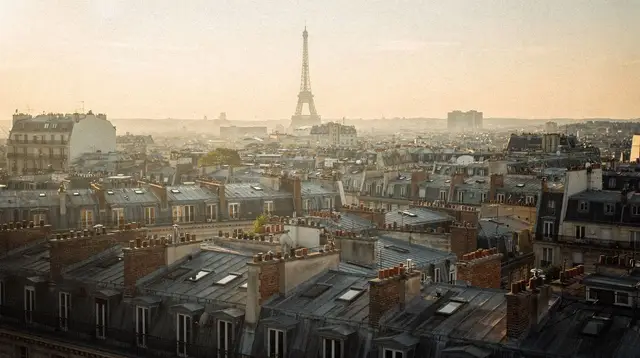
This is the part I think most first-time visitors get slightly wrong. They assume the summit is where the “real” view is, and the second floor is just a stopover. In practice, the second floor already puts you at a genuinely satisfying height over the city — you can pick out the Seine, the rooftops of the Latin Quarter and Saint-Germain, and the layout of the streets radiating out from the tower.
The summit adds altitude and a wider, flatter horizon. On a clear day it’s a genuinely different feeling — more exposed, more wind, more sense of scale. But it’s an addition, not a transformation. If your budget of time or energy is tight, the second floor alone is not a consolation prize; it’s a complete visit in its own right.
Where the summit earns its keep is if you want the single highest public viewpoint in the city and don’t mind the extra queue for the final lift. Where it doesn’t is if you’re mainly here for photos of the skyline — the second floor does that job almost as well, with less waiting.
The trade-off nobody puts on a postcard: crowds
Here’s the part I want to be blunt about, because it’s the thing that actually determines whether people leave happy or exhausted. The Eiffel Tower is one of the most visited monuments in the world, and both the stairs and the lift queues can be long, especially in the middle of the day and through summer. None of that is specific to one route — it’s simply what visiting a monument this popular involves.
Climbing the stairs doesn’t reliably dodge the crowds either. You’ll share the staircase landings with plenty of other visitors, and at the top of the stairs you still join the same lift queue as everyone else if you’re continuing up. The advantage of the stairs is mostly about your own experience of the climb, not about skipping lines.
What I’d say honestly: go in expecting some queuing, whichever way you go up, and don’t schedule the visit so tightly around it that a wait turns the whole thing sour. This page isn’t the place for how far in advance to book or queue-avoidance logistics — that’s covered separately if you want the planning side of things. What matters here is that the climb itself, stairs or lift, is genuinely worth doing once, but it rewards people who’ve mentally budgeted for some waiting rather than expecting a quick in-and-out.
So, is it worth climbing?
Yes, with a caveat. The view from the second floor is worth the trip on its own, and climbing the stairs to get there adds a physical, structural sense of the Eiffel Tower that the lift skips past. The summit is worth it if height and horizon matter more to you than avoiding an extra queue, but it’s not essential to feel like you’ve “done” the tower properly.
If you’re deciding between the stairs and the lift specifically, I’ve laid out the practical differences — steps, queue behaviour, exposure — in more detail in the Eiffel Tower summit versus second floor comparison. And if you’re weighing the tower against other high points in the city, the Eiffel Tower versus Montparnasse Tower views piece covers that from the other direction — including the fact that Montparnasse gives you a skyline with the Eiffel Tower actually in it.
Making the most of the visit around the climb
A few things shape how the climb feels beyond stairs versus lift. Time of day matters: early morning and just before closing tend to be calmer than midday. The Trocadéro and Champ de Mars area around the base is worth building slack time into, since it’s where the queues form and where you’ll likely end up afterwards for photos looking back at the tower.
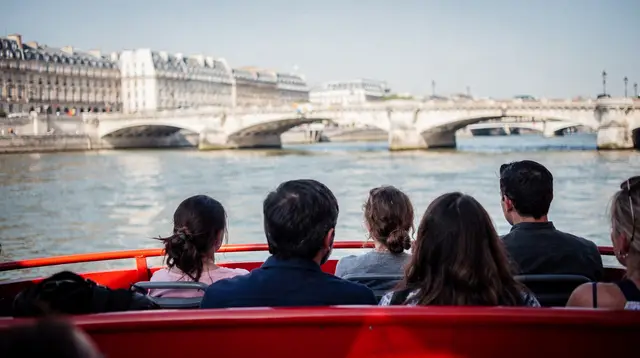
If you want to turn the visit into something more than a straight climb-and-descend, a few of the Seine river cruises pass right by the tower and give you the view from the water instead of from above it — a genuinely different angle on the same landmark. A lunch cruise departing near the Eiffel Tower is a good way to see the tower from below on the same day you climb it, and a dinner cruise past the illuminated tower in the evening works well if you climbed during the day and want to see it lit up later without going back up.
For dining without leaving the tower itself, the Eiffel Tower restaurants and dining guide covers what’s actually on each level. And if you’re building the climb into a longer day, the one day in Paris itinerary and the best views in Paris roundup both help you place it against everything else worth doing nearby, including things to do around the Eiffel Tower and Trocadéro. If sunrise photography interests you, Paris photo spots at sunrise covers the light around the tower before the crowds arrive.
Eiffel Tower climbing FAQ
tours.Practical
Verified deep-linked GetYourGuide tours. Book through these links and we earn a small commission at no cost to you.
GetYourGuide does not provide a product photo for this activity — the image shows the meeting point, photographed by us.