Paris in summer: what to actually expect from June to August
What is Paris like in summer?
Summer in Paris (June to August) brings long daylight hours, warm to hot weather with occasional heatwaves, and the year's heaviest crowds at major sites. In August, a large share of Parisians leave the city on their own holidays, and some smaller shops and neighbourhood restaurants close for part of the month.
June, July and August turn Paris into a different city from the one most guidebooks describe. The days stretch long, the terraces fill up, and the Seine becomes the default place to cool off in the evening. It is also the season when the gap between the postcard idea of Paris and the real, working city is widest — and the part most first-time visitors get wrong is not the heat itself, but what happens to the city around them in August.
This page covers what summer actually feels like on the ground: temperatures and the risk of heatwaves, the crowd pressure at major sites, and the one detail that trips up more visitors than anything else — the exodus of Parisians and the wave of small closures that hits in August. For a broader comparison across all twelve months, see Paris weather by month; this page stays focused on the June–August window and on what to do about it.
The heat, honestly
Summer in Paris runs warm to hot, with June and September at the milder end and July–August carrying the highest risk of a heatwave (canicule). A hot spell can push temperatures well above 30°C for several days in a row, and Paris is not built for it: most apartment buildings, many hotels below the top price brackets, and a good part of the metro fleet have no air conditioning. If heat sensitivity is a concern, it is worth confirming air conditioning directly with your accommodation rather than assuming it, and checking whether a hotel’s rooms face a street or a quieter courtyard.
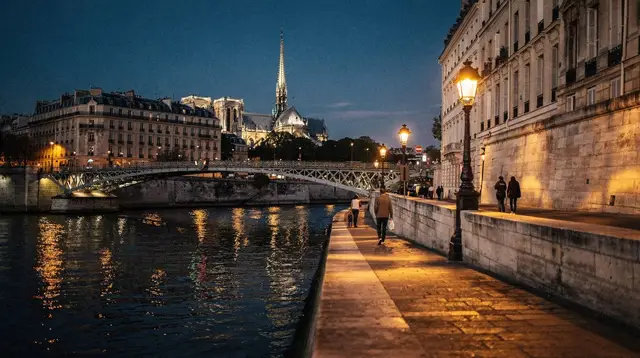
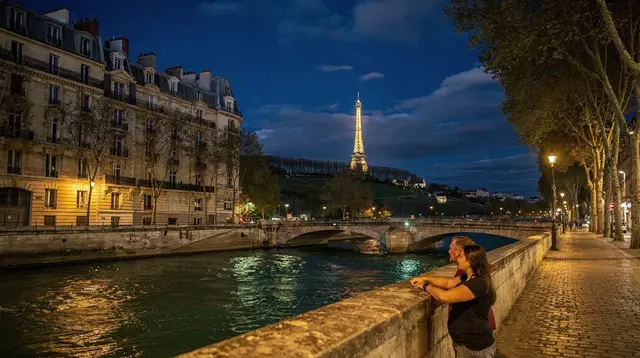
On an ordinary summer day, expect comfortable warmth in the morning, a hot early-to-mid afternoon, and pleasant evenings that make outdoor dining and riverside walks genuinely enjoyable. The long daylight hours — light lingers past 9:30pm in June — are one of summer’s real advantages: they stretch out the time available for sightseeing without needing to rush.
Rain is possible in any season in Paris, summer included, though storms tend to be short and heavy rather than the grey, prolonged rain more typical of winter.
Packing for the heat matters as much as timing your day around it. Light, breathable fabrics, a refillable water bottle — Wallace fountains around the city provide free drinking water — and a layer for cooler evenings cover most of what a summer trip needs; see what to pack for Paris for the fuller list. August carries its own particular rhythm on top of the general summer heat, covered in more detail at Paris in August.
Crowds and timed entry: the pressure point of the season
Summer is peak season at almost every major Paris site, and it shows most clearly at places that already require booked, timed entry. The Louvre and other reserved-slot sites sell out their entry windows further in advance in July and August than at any other time of year — see Louvre museum tickets and tours for how that booking system works. The same applies to the Eiffel Tower, where summer demand means popular time slots can disappear days or even weeks ahead; details are in Eiffel Tower tickets and tours.
The practical takeaway for summer specifically: book earlier than you think you need to, and treat morning slots as the most reliable way to avoid both the worst of the heat and the thickest crowds. Afternoon visits to open-air sites like the Champ de Mars or the steps of Sacré-Cœur can mean standing in direct sun with limited shade for long stretches.
Sites that don’t require timed entry — smaller museums, most churches, many walking routes — feel the crowd pressure less directly, but summer still means fuller streets, longer waits for popular restaurants without reservations, and more competition for outdoor terrace seating. The Musée d’Orsay tickets and tours page and things to do in Paris both work as useful starting points if you want alternatives to the very busiest names.
Sites that skip the booking system altogether are worth building into a summer itinerary specifically because they remove one layer of planning pressure — see free things to do in Paris and best museums in Paris for options beyond the handful of names that dominate the timed-entry conversation.
The part visitors don’t expect: August closures
This is the detail most worth knowing before a summer trip, because it runs against what a first-time visitor usually pictures. In August, a meaningful share of Parisians leave the city — it is the traditional period for France’s main summer holiday — and many independent, family-run businesses close along with them: neighbourhood bakeries, bistros, small boutiques, some hairdressers and repair shops. A closure sign reading fermeture annuelle (annual closure) for two to four weeks is a normal, expected thing to see in August, not a sign anything is wrong.
This does not mean Paris shuts down. Museums, major monuments, large restaurants aimed at visitors, chain stores and most attractions along the main tourist routes stay open and busy — arguably busier, since the visitor population is at its highest just as some of the everyday city empties out. What changes is the texture of the neighbourhoods: a favourite small restaurant recommended by a friend, a corner café, a particular boulangerie — any of these can turn out to be closed with no warning beyond a handwritten note on the door.
The practical fix is simple: if a specific small, independent address matters to your plans, check that it’s open in August specifically rather than assuming a summer visit works the same way as any other month. Larger, tourist-oriented restaurants and the well-known food halls are a safer bet if you’re visiting in the second half of August and want to avoid the lottery of closures. Paris Sundays and public holidays covers a related but separate pattern — weekly closures rather than the August exodus — and is worth reading alongside this if your trip spans a Sunday too.
Summer events worth planning around
Summer in Paris isn’t only heat and crowds — it also brings the year’s biggest national celebration. Bastille Day on 14 July fills the city with a military parade down the Champs-Élysées, packed public spaces, and fireworks at the Eiffel Tower in the evening, all of which add an extra layer of crowding on top of the usual summer peak; see Bastille Day in Paris for what to expect and how to plan around it. Outside that single date, the general shape of the season — long daylight, terrace culture, outdoor markets — holds steady across June, July and August.
A rough shape for a summer day
| Time of day | What works well in summer |
|---|---|
| Early morning (before 10am) | Timed-entry sites at their least crowded slots; walking routes in Montmartre or along the Seine before the heat builds |
| Midday to mid-afternoon | Indoor museums, covered passages, air-conditioned spaces; avoid long outdoor waits in direct sun |
| Late afternoon | Riverside walks, parks, shaded gardens such as the Tuileries |
| Evening | Long daylight makes early-evening outdoor dining and terrace time genuinely comfortable; river views and elevated viewpoints benefit from the later, softer light |
If you want a full booking-order guide across the classic sites rather than a season-specific view, how many days in Paris and best time to visit Paris both lay out the broader planning picture.
Getting around in the heat
The Paris metro is a mixed bag for summer comfort: some newer lines and most RER trains have air conditioning, but a number of older metro lines do not, and platforms can get uncomfortably warm during a heatwave. Carrying water and pacing metro connections rather than rushing between them helps more in summer than in any other season. For the mechanics of tickets and the Navigo system itself, see Paris metro tickets and Navigo guide.
Above ground, cycling is a genuinely pleasant way to move around in the long summer evenings once the day’s heat has eased. A guided ride is also a practical way to cover distance without relying on crowded midday metro cars — a guided cycling tour through the city’s streets and along the Seine works well scheduled for late afternoon or early evening. For a different angle on the same cooler-hours logic, an evening Segway route through the illuminated city avoids the daytime heat entirely and makes use of the long summer daylight fading into a lit-up Paris after dark.
If you’re arriving by air in summer, allow extra time: airports are busier too. CDG airport to Paris city centre has the transport options in detail, and for a more direct, door-to-door option in peak season, a pre-booked transfer from Charles de Gaulle into the city removes one variable from a hot, busy arrival day.
On hot days when walking or a packed metro car feels like too much, taxis and ride-hailing apps are a straightforward fallback, particularly for the return leg of a long day at a site with little shade — see taxis and ride-hailing in Paris for how that compares to the metro on cost and convenience.
Food in summer: what to know beyond the August closures
Outside the August closure pattern, summer is a strong season for Paris food culture: outdoor markets run their full schedule, terrace dining is at its best, and long evenings suit a slow, multi-course meal outdoors. If a favourite neighbourhood spot is closed for its annual break, a guided food experience is a reliable way to still eat well without relying on trial and error — a guided food and tasting route through several Paris addresses sidesteps the guesswork of finding what’s actually open. Markets themselves tend to run through summer without the August gap that affects individual restaurants, since many are open-air and staffed by rotating vendors rather than a single small business.
Markets are one of the most reliable ways to eat well through the summer months regardless of which small restaurants happen to be closed for their annual break — see best food markets in Paris for where to find them, and what to eat in Paris for a broader sense of what’s worth seeking out beyond the sit-down restaurant scene.
Making the most of high-demand sites
Because summer concentrates demand into the same window as every other visitor’s trip, a pass that bundles entry to multiple sites can reduce the number of separate bookings you need to manage, though it does not remove the need to reserve specific timed slots at sites like the Louvre or Versailles — see Paris Museum Pass guide for exactly what it does and doesn’t cover. A multi-day museum and monument pass is worth weighing against your itinerary if you’re planning to visit several paid sites in a short, high-season window, since it simplifies payment even where it doesn’t remove the booking step itself.
Day trips out of the city carry their own summer logic: Versailles draws its heaviest crowds of the year in July and August, and its gardens and fountain shows are genuinely more pleasant with an early departure — see Versailles tours from Paris and how to get to Versailles from Paris for timing advice. Giverny’s gardens are at their most colourful in summer, which also makes it one of the more crowded day trips of the season; Giverny day trip from Paris has the seasonal detail. Both benefit from the same principle as the Louvre and the Eiffel Tower: book ahead, go early, and expect the busiest version of the site you’ll see all year.
Day trips further from the city carry the same early-and-booked logic. Chartres and its cathedral draw a steady but more manageable summer crowd than Versailles or Giverny — see Chartres day trip from Paris — while Fontainebleau and Vaux-le-Vicomte offer château grounds with more room to spread out on a hot afternoon, detailed at Fontainebleau and Vaux-le-Vicomte day trip from Paris.
A river cruise is one of the lower-effort ways to see central Paris without much walking in the heat, and evening departures pair naturally with the season’s long daylight — Seine river cruises in Paris covers the range of options.
Choosing where to stay in summer heat
Air conditioning is far from guaranteed across Paris accommodation, so it’s worth checking directly rather than assuming any given neighbourhood has it as standard. Central, walkable neighbourhoods cut down on the amount of time spent in hot metro cars between a hotel and the day’s sites — see where to stay in Paris for an overview of the main options by area.
The bottom line for a summer trip
Summer gives Paris its longest days, its liveliest terraces and, at its best, some genuinely comfortable evening hours for walking and eating outdoors. Set against that: real heat risk in July and August, the year’s heaviest crowds at timed-entry sites, and the August pattern of Parisians leaving town and small businesses closing behind them. None of it should discourage a summer trip — it’s simply worth planning around rather than discovering on arrival. Book major sites earlier than feels necessary, keep a loose plan for small restaurants in August, and use the early morning and evening hours as the season’s real advantage.
Frequently asked questions about visiting Paris in summer
Seasonal Paris guides and events on GetYourGuide
Verified deep-linked GetYourGuide tours. Book through these links and we earn a small commission at no cost to you.
GetYourGuide does not provide a product photo for this activity — the image shows the meeting point, photographed by us.