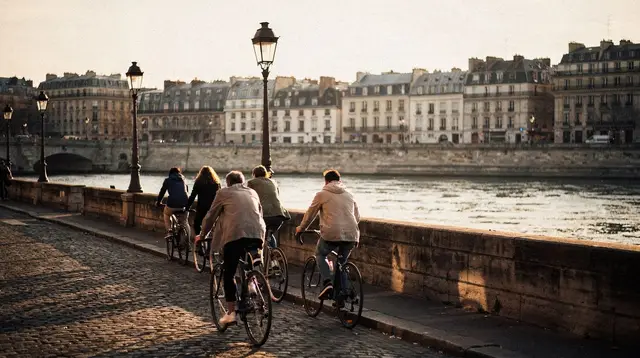
Bike and Segway tours in Paris
Are bike and Segway tours a good way to see Paris?
Yes, for covering ground along the Seine and past major monuments from the outside, at a pace faster than walking. They are an active, outdoor format, not a substitute for museum or monument visits, and around 63 bike and Segway products are listed for Paris.
Why cycling and Segway tours suit Paris
Paris is flat by the standards of a major European capital, and its widest, most scenic stretches run along the water. That combination is why bike and Segway tours have become a distinct category in their own right, separate from the private tours and cooking classes covered elsewhere on this site. Around 63 bike and Segway products are listed for Paris, ranging from a few hours on a shared city bike to themed rides built around street art, wine, or family groups.
The format sits between a walking tour and a private car. It moves faster than walking, so a single outing can string together sights that would otherwise mean several separate visits, and it avoids the one thing every visitor is told about Paris: driving in the city yourself is a hassle nobody recommends. Parking is scarce, the low-emission zone requires the right sticker on a vehicle registered outside France, and central streets were not designed for casual driving. A bike, on the other hand, uses lanes and paths built for exactly this kind of movement, which is part of why the format has grown alongside the city’s own cycling infrastructure.
What these tours actually cover
Bike and Segway tours in Paris are built around riding past landmarks, not entering them. A typical route follows the Seine and its quays, the stretch between the Eiffel Tower and Trocadero and the Ile de la Cite around Notre-Dame, which together form the riverside corridor inscribed on the UNESCO World Heritage list in 1991. Riding this stretch means seeing the tower, the cathedral and the bridges from street level and from the water’s edge, rather than from inside any of them.
Other routes head toward Montmartre, Le Marais, the Champs-Elysees and Opera district, or the area around the Louvre and Tuileries. In every case, the value of the tour is in the outside view and the ground covered, not in an entry ticket. If the goal is to go inside the Louvre, climb the Eiffel Tower, or see Notre-Dame’s interior, those are separate bookings with their own reserved time slots, covered on the Eiffel Tower and Notre-Dame and Sainte-Chapelle pages. A bike or Segway tour is the orientation ride, not the museum visit.
This is a genuinely useful distinction for a first-time visitor deciding how to spend a limited number of days. A route that loops past the Eiffel Tower, along the river toward the Ile de la Cite, and back through the Tuileries can cover in a few hours what would otherwise take a full day on foot, at the cost of stopping less often and seeing everything from outside rather than in. It pairs well with a plan that reserves a later, separate morning or afternoon for whichever one or two monuments are worth going inside for.
a standard city bike tour along the Seine and past the main riverside landmarks is the simplest starting point for a first outing, and it is the format most operators build their other routes around.
Who this format suits
Bike and Segway tours work best for visitors who are reasonably mobile, comfortable riding or standing for an extended period, and more interested in covering distance than lingering. A family with young children has different needs than a couple on a weekend trip, and operators have responded with distinct products rather than a single generic ride.
For families, a bike tour designed around children’s pace and shorter distances avoids putting a six-year-old on the same route built for adults doing 15 kilometres. This kind of tour tends to plan around parks and quieter streets rather than the busiest boulevards, which also makes it a reasonable option alongside the ideas on the family activities and escape games page.
For visitors who want a themed angle rather than a general orientation ride, options include a bike route built around the city’s street art, treated as an open-air museum, which heads through neighbourhoods that a standard monument-focused route would skip, and a bike outing that pairs riding with a wine tasting in a historic cellar, aimed more at an evening or a relaxed afternoon than a sightseeing sprint. A beer-bike format exists too, built around a moving group vehicle rather than individual bikes, which is closer to a rolling social outing than a sightseeing tour and worth reading the listing carefully before booking if the goal is actually seeing the city.
At the other end of the spectrum, a fuller discovery route that links several districts in one outing suits someone with a single free day who wants to see as much of the city’s layout as possible without committing to a private guide. For a different kind of pace and comfort, a sidecar tour in a vintage-style vehicle covers similar ground while someone else does the riding, which is closer in spirit to the vintage car and 2CV tours than to a bike outing, and a private luxury vehicle option exists for visitors who want the orientation drive without any physical effort at all.
Not every visitor is the right fit for a moving group ride on two wheels or a Segway. Standing or pedalling for an extended stretch, on cobbles and in city traffic, is a different proposition from a paced walking route, and anyone travelling with mobility considerations may find more relevant detail in the accessible Paris guide, which covers museum and monument access separately from this outdoor, physically active format. Families weighing a bike outing against other options can compare it with the broader ideas on the Paris with kids page, and visitors relying on step-free public transport between a hotel and the meeting point may want to check the guide to using the Paris metro with a wheelchair or stroller before booking a start time that depends on reaching a specific station on time.
Where routes tend to run
Operators do not usually publish an exact route or a precise duration in advance, and this page will not invent one. What can be said in general terms is which parts of Paris lend themselves to this format and which do not.
The riverside quays are the backbone of most routes, because they are wide, mostly flat, and largely free of the heaviest car traffic, especially on the stretches that have been progressively closed to cars over the past decade. This is also the stretch that carries the UNESCO designation, running roughly between the Eiffel Tower and the Ile Saint-Louis. A route that follows the river naturally passes the Eiffel Tower and Trocadero, the Ile de la Cite, and often continues toward Le Marais or back through the Tuileries.
Away from the river, Montmartre’s hill and narrow streets make it a harder area for a large group ride and better suited to walking, which is one reason dedicated Montmartre walking tours and Le Marais walking tours exist as their own category. Some bike routes do pass through the base of Montmartre or skirt its edges rather than climbing through the steepest lanes. The wide boulevards around the Champs-Elysees and Opera are rideable but busier with traffic, so tours through this area tend to time their route around quieter hours or side streets rather than the main avenue itself.
None of this is a reason to expect a fixed itinerary. Check the specific listing for the route it actually describes, and treat any general description on this page as context for what the format tends to cover, not a promise of what a particular tour includes.
The Left Bank, around the Latin Quarter and Saint-Germain, sees fewer dedicated bike tours than the riverside corridor or Montmartre, mostly because its appeal is in narrow streets, bookshops and cafe terraces rather than open stretches suited to a group ride. Visitors who want to spend time in that district in particular are usually better served on foot, at a pace that allows for stopping, than trying to fit it into a route built for covering distance. The same logic applies to smaller pockets of the city that reward slow exploration over ground covered.
Bike, Segway or something else
The practical difference between a bike and a Segway tour is less about the ground covered and more about the physical effort and the learning curve. A bike requires ordinary pedalling and balance that most adults already have; a Segway requires a short briefing to get used to leaning for direction and balance before the group sets off, which most operators build into the start of the tour.
For a visitor who wants to skip both the pedalling and the balance practice, a rolling group vehicle is closer to what a themed group tour in a fleet of decorated small vehicles offers, which trades the exercise element for a more social, guided experience while still moving through the city rather than sitting in standard traffic. It sits closer to the city sightseeing tours category than to true cycling.
Anyone weighing this format against alternatives should also consider the Seine river cruises covered elsewhere on this site. A cruise moves through the same UNESCO-listed stretch of river from the water rather than the quay, seated rather than active, and works well as a lower-effort complement to a bike tour taken on a different day, or as the better choice for anyone who would rather not cycle at all. For a slower, closer look at a single neighbourhood, the walking tours page covers routes through Montmartre, Le Marais and the Latin Quarter that a bike would move past too quickly to appreciate.
Getting to and from the ride
Most bike and Segway tours start from a fixed meeting point in central Paris, reachable on the metro or RER network rather than by car, which fits the city’s general advice against driving. The Paris metro guide covers how the network’s lines connect to the districts where these tours typically start and finish, including the areas around the Eiffel Tower and Trocadero, the Champs-Elysees, and the riverside meeting points near the Ile de la Cite.
Because these tours are outdoor and weather-dependent, it is worth checking the specific listing’s policy on rain or extreme heat before booking, particularly for a visit planned in August, when the city empties out somewhat, or in the depths of winter, when short daylight hours limit how late an afternoon ride can run. Spring and early autumn, when temperatures are milder and daylight lasts longer, tend to be the more comfortable seasons for spending two or three hours outdoors on a bike or Segway.
Summer heat can turn into a genuine spell of hot weather in some years, which makes an early morning or early-evening tour noticeably more comfortable than a ride booked for the middle of the afternoon. August is also when a share of Parisians leave the city for their own holidays, so a few smaller shops and restaurants along a given route may be closed for the day even though the tour itself still runs as scheduled. Winter tours run colder and greyer, with the shorter daylight limiting how late a ride can realistically start, though the citywide illuminations add a different kind of appeal to a late-afternoon loop past the main monuments once they are lit. The weather by month guide and the what to pack for Paris page both go into more seasonal detail than fits here, and are worth checking against the actual dates of a booking rather than relying on a general rule of thumb.
Budgeting and etiquette for a bike or Segway tour
Restaurant and café prices in Paris already include service, so there is no fixed expectation to tip on top of a bill, and the same relaxed approach generally carries over to a guided bike or Segway tour: rounding up or leaving a small amount for a guide who did a good job is appreciated rather than obligatory. The tipping in Paris guide covers this in more detail for other situations, from taxis to hotel staff, in case the question comes up elsewhere on the same trip.
For a visitor watching the overall cost of a trip, a single bike or Segway tour is one line item among several, and it is worth weighing against the free and lower-cost ideas covered on the Paris on a budget page, particularly on a trip that already includes several paid activities. A bike tour earns its place best when it replaces a stretch of walking time that would otherwise go into getting between sights rather than actually seeing them, not as an extra booked purely because it happens to be available.
Safety on a group ride is mostly the operator’s responsibility, from route choice to group management, but the is Paris safe for tourists guide is a reasonable general reference for the city beyond the tour itself, covering the ordinary precautions that apply to any dense capital rather than anything specific to cycling.
Choosing a route for the time available
A single bike tour, taken on its own, works well as one component of a longer stay rather than the only activity planned for a day. Visitors following one of the multi-day itineraries on this site, such as the plans covering three days in Paris or a Paris weekend, can use a morning or afternoon bike outing as the orientation ride early in the trip, then return to specific districts on foot later once the general layout is familiar. For a broader look at how this format compares with other ways of getting around and sightseeing, the category page for bike and Segway tours lists the full range of options, and the general things to do in Paris hub covers the wider set of activities this format sits alongside.
Paris bike and Segway tours on GetYourGuide
Verified deep-linked GetYourGuide tours. Book through these links and we earn a small commission at no cost to you.
GetYourGuide does not provide a product photo for this activity — the image shows the meeting point, photographed by us.