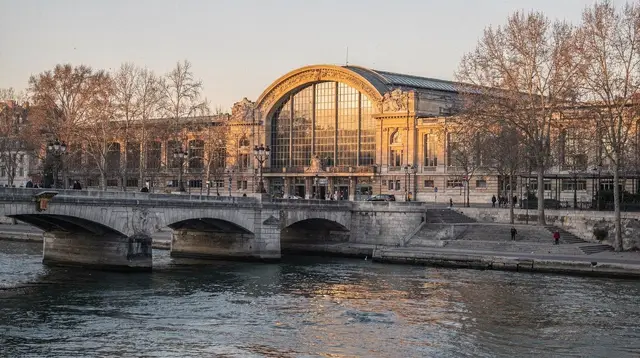
Musée de l'Orangerie guide
What makes the Musée de l'Orangerie worth visiting?
The Musée de l'Orangerie is a small museum at the western end of the Tuileries, built around two oval rooms designed specifically to display Claude Monet's large Nymphéas water lily panels. It also holds a compact collection of early 20th-century paintings, and most visitors see the whole thing in well under two hours.
The Musée de l’Orangerie is the smallest of the three big Rive Gauche and Tuileries-area art museums, and it is worth treating that way. It is not a rival to Musée d’Orsay or the Louvre in scale, and trying to see it as one leads to disappointment. What it does hold, and what neither of the larger museums replicates, is a pair of oval rooms built specifically to display Claude Monet’s Nymphéas water lily panels as a continuous, immersive sweep of canvas. That single feature, plus a compact secondary collection downstairs, is the whole case for visiting.
This guide treats the Orangerie as what it actually is: a short, focused stop that pairs naturally with a longer visit to Orsay or a walk through the Tuileries, not a destination that needs a dedicated morning of its own.
Where it sits and what it is not
The museum sits at the western edge of the Tuileries garden, near Place de la Concorde, on the Rive Droite side of the Seine. It is close enough to the Louvre and to Orsay across the river that all three are often mentioned in the same breath, and that grouping causes real confusion. They are not comparable in size or scope.
Orsay is a former railway station with multiple floors covering Impressionist and Post-Impressionist painting, sculpture, and decorative arts across a huge footprint; a proper visit takes half a day. The Louvre is one of the largest museums in the world, spanning multiple wings and thousands of years of art and artefacts. The Orangerie is neither. It is two rooms built around one artist’s late work, plus a modest collection in the basement. Most visitors are out the door within 90 minutes.
That difference in scale is the point. If Orsay or the Louvre is the anchor of a day, the Orangerie is the thing that fits into the gaps around it, not something that competes for the same block of time.
The oval rooms, and why they exist
The reason to come here is architectural as much as it is artistic. Claude Monet worked on the Nymphéas — his water lily paintings — for the final decades of his life at his garden in Giverny, and the largest panels were conceived as a connected, room-filling installation rather than individual framed works. The Orangerie’s two oval galleries were designed around that intention: naturally lit from above, curved so that each room’s panels wrap around the visitor in an unbroken band, with no corners to break the composition.
Neither Orsay nor the Louvre has anything built this way. Orsay holds other Monet paintings from earlier in his career, hung conventionally on walls among other Impressionist works, which is a different kind of encounter entirely. The Orangerie’s oval rooms are the only place in Paris where the Nymphéas are shown as Monet intended them to be seen: as an enclosing, continuous field rather than a series of separate canvases. Visitors who walk in expecting “more Monet paintings” tend to miss what actually makes the rooms distinctive — it is the scale and the curve of the space itself, not just the subject matter.
Plan to spend real time in both oval rooms rather than passing through quickly. Benches are placed at the centre of each room specifically so people can sit and look rather than walk the perimeter once and move on.
What else is in the museum
Below the two oval rooms, a lower level holds the Walter-Guillaume collection, assembled by two private collectors in the early 20th century. It is far smaller than the print or painting collections at Orsay, but it includes works by Cézanne, Renoir, Matisse, Picasso, Derain, and Soutine, among others, hung in a series of compact rooms.
This lower level is worth the extra twenty or thirty minutes it takes, but it should be understood for what it is: a good, tightly curated private collection, not a survey of an entire art movement. Visitors expecting an Orsay-sized selection of Post-Impressionist and early modern work will find it thin by comparison. Visitors who come without that expectation tend to enjoy it precisely because it is manageable — a handful of strong rooms rather than a maze of galleries.
The Walter-Guillaume rooms are arranged more or less chronologically, so the walk through them doubles as a short, legible survey of how painting moved from late Impressionism into the early 20th century, without the scale of Orsay’s equivalent galleries. It rewards visitors who read the wall labels rather than simply walking past; the collection is small enough that this adds only a few minutes.
How the Orangerie compares to Orsay and the Louvre
| Musée de l’Orangerie | Musée d’Orsay | Louvre | |
|---|---|---|---|
| Typical visit length | 60–90 minutes | Half a day | Half a day or more |
| Signature focus | Monet’s Nymphéas in two purpose-built oval rooms | Impressionist and Post-Impressionist collection across several floors | Encyclopaedic collection spanning antiquity to the 19th century |
| Secondary collection | Walter-Guillaume collection (Cézanne, Renoir, Matisse, Picasso, Soutine) | Sculpture, decorative arts, photography | Painting, sculpture, antiquities, decorative arts |
| Best paired with | A Tuileries walk, or the same day as Orsay | The Orangerie, or the Latin Quarter and Saint-Germain | A full day on its own, or the Île de la Cité |
| Where it sits | Western end of the Tuileries, near Place de la Concorde | Rive Gauche, facing the Tuileries across the Seine | Rive Droite, at the eastern end of the Tuileries |
This table is a rough guide, not a rule. A traveller with only one museum slot in a trip and a strong interest in the Louvre highlights or the full Impressionist story at Orsay should prioritise accordingly. The Orangerie earns its place as an addition, once one of the larger museums is already on the itinerary, or as a standalone stop for someone who specifically wants the Nymphéas experience and doesn’t have time for anything bigger.
Combining the Orangerie with the rest of the Tuileries area
Because the museum sits right at the edge of the Tuileries garden, it fits naturally into a longer walk through that part of Paris rather than standing alone. A common pattern: start at Orsay in the morning, cross the river or walk along the Seine, spend the early afternoon at the Orangerie, then finish with a walk east through the Tuileries toward the Louvre courtyard, or west toward the Champs-Élysées and Opéra area.
The Musée de l’Orangerie guide comparison is worth reading if Orsay is also on the list — the two museums answer different needs, and seeing them back to back on the same day works better than treating them as alternatives to choose between.
For visitors building a broader museum day, the best museums in Paris overview and the Paris Museum Pass guide both help decide which combination of stops makes sense for the time available, without duplicating the specifics covered here.
Travellers with a broader interest in sculpture and single-artist museums, rather than painting, may also want to look at the Rodin Museum guide, which sits on the Rive Gauche and follows a similar logic: one artist, a manageable visit, easy to pair with a bigger stop nearby.
a guided visit to the Rodin Museum with a digital audio guide, a good pairing for the same kind of focused, single-collection afternoonA short visit, done well
The mistake to avoid with the Orangerie is over-scheduling it. Because the museum is small, there is a temptation to squeeze it into a packed itinerary as an afterthought, rushing through the oval rooms in ten minutes on the way to somewhere else. That undersells the one thing the museum does that nothing else in Paris does: give the Nymphéas the physical space Monet intended for them.
The better approach is to give the two oval rooms unhurried time, treat the lower-level Walter-Guillaume collection as a bonus rather than an obligation, and build the rest of the day — Orsay, the Tuileries, the Louvre, or a walk toward Trocadéro and the Eiffel Tower — around it rather than the other way round.
For visitors who want a broader sense of what’s covered in this part of the city, the things to do in Paris overview and the three days in Paris itinerary both place the Orangerie in context alongside Orsay, the Louvre, and the Tuileries. For anyone building a trip specifically around galleries and museums, the Paris for art lovers in three days itinerary sequences the Orangerie with its larger neighbours in a way that avoids museum fatigue.
Two other tours worth considering for the same part of Paris, if the museum visit is paired with something more active outdoors:
a private guided walk through Paris built around Art Nouveau architecture and design, a good complement to a museum-focused day a guided tour of central Paris by vintage Citroën 2CV, a relaxed way to see the Tuileries and riverside areas around the museum without walking the whole routeVisitors interested in how art movements connect across the city, including street art well outside the traditional museum circuit, may also want a broader city walk rather than another indoor stop:
a guided street art walking tour through Paris neighbourhoods, a contrast to the formal museum setting of the OrangerieGetting there and planning around the rest of Paris
The Orangerie sits inside the Tuileries garden itself, at the Place de la Concorde end, which makes it one of the easier museums in Paris to reach without much planning. It is walkable from the Louvre, from Place de la Concorde, and from the riverside path along the Rive Droite, so travellers staying anywhere in central Paris can usually get there on foot rather than needing to work out a transit connection specifically for this stop. For anyone coming from further out, the Paris Métro guide and the Métro tickets and Navigo guide cover how the ticketing works across Île-de-France Mobilités’ network of metro, RER, tram and bus lines, including the Navigo Easy card and the Paris Visite pass aimed at visitors.
Because the museum is small and the visit is short, it slots easily into a day built around other transport-dependent plans, whether that is an airport transfer at the start or end of a trip, or a Seine river cruise departing from one of the embarkation points nearby. Travellers mapping out how many stops to fit into a single day, rather than treating each museum as a separate outing, may find the how many days in Paris guide useful for weighing the Orangerie against everything else competing for the same block of time.
Booking ahead and avoiding a wasted trip
Like the other major museums covered on this site, the Orangerie is popular enough that arriving without a plan can mean unexpected queueing, particularly in the middle of the day and during the warmer months when Paris sees the most visitors. A short, focused visit is exactly the kind of stop that is easy to slot into a gap between other plans, but only if that gap is not eaten up by a line at the door. Checking current opening arrangements before setting out, and building in flexibility around exact timing rather than aiming for one precise slot, avoids the most common frustration: showing up expecting a quick 60-to-90-minute visit and finding that the queue alone takes longer than the museum itself.
Because the Orangerie pairs so naturally with a wider Tuileries-area day, it is worth deciding in advance whether Orsay, the Louvre, or a walk toward Champs-Élysées and Opéra comes first. Visiting the Orangerie earlier in the day, before the anchor museum, tends to work better than trying to fit it in afterward when energy and attention are already spent on a much larger collection.
Musée de l’Orangerie: questions travellers ask
Is the Musée de l’Orangerie the same as the Musée d’Orsay?
No. They are separate museums a short walk apart. The Orangerie is much smaller and built around Monet’s Nymphéas, while Orsay holds a far larger collection across several floors of a former railway station.
How long does a visit to the Musée de l’Orangerie take?
Most visitors spend around 60 to 90 minutes inside, including time in both oval Nymphéas rooms and the lower-level collection. It is one of the shorter museum visits in central Paris.
Can the Orangerie be combined with the Musée d’Orsay in one day?
Yes, and it is a common pairing. The two museums sit close together on opposite ends of the Tuileries and Seine riverbank, so many visitors do both in a single day without rushing.
What are the oval rooms at the Musée de l’Orangerie?
They are two purpose-built oval galleries with natural overhead light, designed to hold Claude Monet’s large-scale Nymphéas panels in a continuous, curved sweep around each room.
Is the Musée de l’Orangerie only about Monet?
The Nymphéas rooms are the main draw, but a lower level also holds the Walter-Guillaume collection, with works by artists including Cézanne, Renoir, Matisse, Picasso, and Soutine.
Where is the Musée de l’Orangerie located?
It sits at the western end of the Tuileries garden, close to Place de la Concorde, on the Rive Droite side of the Seine near the Louvre and the Musée d’Orsay.
Is the Musée de l’Orangerie good for a first-time visitor to Paris with limited time?
It works well precisely because it is small: a focused visit rather than a half-day commitment, which makes it easy to fit alongside other Tuileries-area plans.
Louvre, Orsay and Paris museum tours on GetYourGuide
Verified deep-linked GetYourGuide tours. Book through these links and we earn a small commission at no cost to you.
GetYourGuide does not provide a product photo for this activity — the image shows the meeting point, photographed by us.