Palace of Versailles: a guide to the château
What is there to see inside the Palace of Versailles château?
The château holds the King's and Queen's State Apartments, the Hall of Mirrors, the Royal Chapel and the Coronation Room, spread across two main floors. It is a separate visit from the gardens and from the Trianon estate, and it closes on Mondays.
Inside the château: what the palace visit actually covers
The Palace of Versailles is the château itself — the building, not the wider domain around it. The gardens, the fountains and the Trianon estate are separate parts of the same UNESCO World Heritage site (inscribed in 1979), and each has its own guide on this site. This page is only about what’s inside the palace walls: the State Apartments, the Hall of Mirrors, the Royal Chapel and the rooms that follow the private and ceremonial life of the French monarchy before the Revolution.
Versailles sits about 20 km southwest of Paris, and it’s a day trip, not an overnight stop. Almost every visitor sleeps in Paris and travels out for the morning or afternoon. If you’re weighing whether it’s worth the trip at all, that question is answered separately in is a day trip to Versailles worth it; this page assumes you’ve decided to go and want to know what you’ll actually see once you’re through the door.
The State Apartments
The King’s and Queen’s State Apartments make up the core of a château visit. These are the ceremonial rooms — reception halls, drawing rooms, the King’s Bedchamber — decorated in the gilded, mythologically themed style Louis XIV commissioned to project royal power. Each room is named for a planet or a Roman god, following a decorative scheme that runs through much of the enfilade.
Walking the State Apartments is a linear route: you move from room to room in a fixed direction, following the flow of the crowd rather than choosing your own path. That’s worth knowing before you go, because it shapes the pace of the visit more than anything else. On a busy day, the apartments can feel like a moving queue as much as a museum.
That single-direction flow is also why a guided visit changes the experience more here than at most Paris museums: a guide can narrate the rooms as you’re carried along with the crowd, rather than you stopping to read panels and losing your place in the line. Independent visitors without a guide should expect to rely mostly on an audio guide or a pre-read overview, since there’s little room to linger and cross-reference a guidebook once the flow picks up.
The Hall of Mirrors
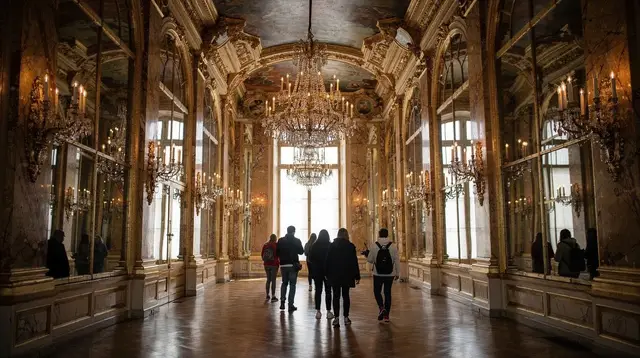
The Hall of Mirrors is the château’s best-known room, and the one most people picture when they think of Versailles. Seventeen mirrored arches face seventeen arched windows overlooking the gardens, a design conceived to reflect light and status in equal measure. It’s also where the Treaty of Versailles was signed in 1919, formally ending the First World War.
The hall connects the King’s and Queen’s Apartments, so it isn’t a detour — everyone passes through it as part of the standard route. Expect it to be the most crowded single room in the château, and budget a few extra minutes there rather than trying to move through quickly.
The windows along the hall face the gardens, so the light shifts through the day — brighter and harsher around midday, softer in the first and last hours the château is open. If seeing the room with fewer people in front of the mirrors matters to you, that’s another reason to aim for an early or late time slot rather than the middle of the day, when the hall is at its busiest.
The Royal Chapel and the Coronation Room
The Royal Chapel, visible from an upper gallery rather than entered directly on most visits, is where the royal family attended mass. Its white stone and gilded organ loft stand apart from the more heavily decorated apartments elsewhere in the palace.
The Coronation Room holds Jacques-Louis David’s large-scale painting of Napoleon’s coronation, a later addition to the château that reflects its role under the 19th-century French monarchy and empire as much as under the Ancien Régime. It’s one of the last rooms on most self-guided routes and a natural point to pause before heading back outside.
What isn’t covered here
To keep this guide focused and avoid duplicating other pages on this site, three things are deliberately left out:
- The gardens and fountain shows. The grounds, the Grand Canal, the bosquets and the seasonal fountain displays have their own guide: Versailles gardens and fountain shows.
- The Trianon and Marie-Antoinette’s estate. The Grand Trianon, the Petit Trianon and the Hameau de la Reine sit apart from the main château and require a separate walk or shuttle. See Trianon and Marie-Antoinette’s estate.
- Ticket prices and exact opening hours. These change and are best checked on the official Château de Versailles site before you travel — this guide won’t give you a number that’s already out of date by the time you read it.
Best time of year to go
Versailles is busiest through the summer, when the largest crowds coincide with the hottest weather and the longest queues for a timed entry slot. April to June and September to October tend to be calmer, with milder weather for the walk between the RER station and the palace as well as for any time spent in the gardens afterwards. Winter visits are quieter still inside the château, though the shorter, greyer days mean less useful daylight if you’re combining the palace with time outdoors on the grounds. For a broader sense of how the seasons play out across the wider city and how that affects a day trip like this one, see the best time to visit Paris.
When the château is closed
Versailles closes on Mondays. That’s the one closure day to build your trip around — don’t plan a Monday visit and don’t assume any other day of the week is the closed one. Beyond that, opening hours shift by season (shorter days in winter, longer in summer), so check the current schedule close to your travel date rather than relying on a fixed time.
| Day | Château status |
|---|---|
| Monday | Closed |
| Tuesday–Sunday | Open (hours vary by season — check before you go) |
Booking a time slot
Versailles is one of the most visited sites in the Paris region, and the entrance queue without a reservation can run long, especially in the morning rush and through summer. Booking a timed entry slot in advance is strongly recommended for anyone who wants predictable access rather than an open-ended wait.
The Paris Museum Pass includes château entry, but it doesn’t remove the need to reserve a slot — pass holders still book an entry window like anyone else. If you’re deciding between a guided visit and going it alone, the trade-offs are laid out in guided tour vs self-guided at Versailles.
Getting to the château
RER C is the most direct route from central Paris, terminating at Versailles Château Rive Gauche, a short walk from the palace entrance. Trains from Gare Saint-Lazare and Montparnasse also reach Versailles, but they arrive at different stations, further from the château gate, so factor in extra walking time if you take one of those instead. Full transport details, including which station suits which starting point in Paris, are in how to get to Versailles from Paris.
| Route | Station | Walk to château |
|---|---|---|
| RER C | Versailles Château Rive Gauche | Short, most direct |
| Train from Saint-Lazare | Versailles Rive Droite | Longer |
| Train from Montparnasse | Versailles Chantiers | Longer |
Driving into central Paris is generally not worth it for this trip, and it isn’t necessary for reaching Versailles either — the RER connection is built for exactly this journey. If you’re combining the château with other Paris sightseeing, some travelers pair the day with a walking tour with a local guide — a walking tour with a local guide — on a different day in the city itself, rather than trying to fit both into one afternoon.
Fares work the same way for Versailles as for any other trip on the Île-de-France Mobilités network: RER C is covered by the standard Metro-Train-RER ticket or by a Navigo pass loaded onto a Navigo Easy card or a phone, the same ticket you’d already be using to get around Paris itself. Anyone spending a full week in the region tends to come out ahead with a weekly Navigo pass rather than buying single tickets for each leg; short stays usually do better with a Paris Visite pass. Full guidance on which option suits a given trip length is in the Paris Metro tickets and Navigo guide.
Planning your visit
Most people spend one and a half to two hours inside the château alone. If you’re combining the palace with the gardens or the Trianon on the same day, plan for a half day at minimum, and a full day if you want to see all three without rushing. The Versailles destination page has an overview of the whole site if you’re still deciding how much time to give it.
A few practical notes worth keeping in mind:
- Go early or late in the day if your schedule allows — the mid-morning to early-afternoon window tends to be busiest.
- The State Apartments route is one-directional. You won’t be able to backtrack easily once you’re inside the crowd flow.
- Bag and security checks operate at the entrance, similar to other major Paris monuments — arrive with enough buffer before your booked slot.
- Mobility access is available but limited by the age of the building; if that’s a concern, see Versailles and the Louvre with limited mobility.
If Versailles is one stop in a longer Paris stay, see three days in Paris including Versailles for how to fit it around the rest of the city, or one day in Paris if you’re working with limited time overall. For comparing Versailles against other day trips from the city, best day trips from Paris lays out the alternatives. And for a broader look at what a châteaux visit involves if you’ve also got the Louvre on your list, the Louvre museum guide covers that separately — the two are different visits with different booking systems.
Beyond the château and its own grounds, Versailles is sold through Paris-based tour operators in a range of formats, from guided château tours to combined trips that add the gardens. Browsing the Versailles tours category is a good way to see what’s currently bookable if you’d rather join a guided group than navigate the reservation system alone.
Combining the visit with time in Paris
Because Versailles is a half-day to full-day trip on its own, most visitors treat it as a standalone day rather than squeezing in central Paris sightseeing on the same date. If you do want to add a Paris-based activity either before you head out or after you return, options that keep well to an afternoon slot include a guided city tour of Paris by Can-Am or, for a slower pace through the city’s streets, a guided tour of Paris in a vintage Citroën 2CV. Travelers visiting with a German-speaking guide sometimes prefer a dedicated city introduction the day before or after Versailles, such as a four-hour guided tour of Paris in German, to get oriented in the capital before the longer day trip out to the château.
None of these replace the Versailles château visit itself — they’re separate Paris activities some travelers layer around the day trip, not part of the palace admission.
Versailles château at a glance
| Question | Answer |
|---|---|
| Closed day | Monday |
| Distance from Paris | About 20 km southwest |
| Main train route | RER C to Versailles Château Rive Gauche |
| Typical visit length | 1.5–2 hours for the château alone |
| Advance booking | Strongly recommended, including for Museum Pass holders |
| Overnight stay | Not typical — visited as a day trip from Paris |
| Covers gardens or Trianon | No — separate guides and separate access |
Versailles château FAQ
Is the Palace of Versailles open every day?
No. The château is closed on Mondays. It opens the rest of the week, but exact hours change by season, so check the official schedule before you plan a specific arrival time.
Do I need to book a time slot for the château?
Booking a timed entry slot in advance is strongly recommended. Versailles draws large crowds year-round, and turning up without a reservation usually means a long wait at the entrance.
Does the Paris Museum Pass let me skip the line at Versailles?
The Paris Museum Pass covers entry to the château, but it does not replace the need to reserve a time slot. Pass holders still need to book an entry window for the palace.
Can I visit the château and the gardens on the same ticket?
Standard château entry covers the palace interior. The gardens are generally free to enter separately, while the Trianon estate and Marie-Antoinette’s estate are a further, separate visit with their own entrance.
How long does it take to see the château?
Most visitors spend one and a half to two hours moving through the State Apartments and the Hall of Mirrors. Add more time if you plan to also see the gardens or the Trianon on the same day.
Can I stay overnight near the château?
Versailles is a day trip from Paris for almost every visitor. Most people base themselves in Paris and travel out for the day rather than booking accommodation in Versailles itself.
How do I get from Paris to the château?
RER C runs from central Paris to the Versailles Château Rive Gauche station, a short walk from the entrance. Trains from Gare Saint-Lazare and Montparnasse also serve Versailles, landing at stations a longer walk from the palace.
Palace of Versailles and Trianon tours on GetYourGuide
Verified deep-linked GetYourGuide tours. Book through these links and we earn a small commission at no cost to you.
GetYourGuide does not provide a product photo for this activity — the image shows the meeting point, photographed by us.