Trianon and Marie-Antoinette's estate: the quiet side of Versailles
What is the Trianon at Versailles and is it worth visiting?
The Trianon is a separate part of the Versailles estate, built around the Petit Trianon and the hameau de la Reine, Marie-Antoinette's mock village. It sits apart from the main château and its formal gardens, reached by a further walk across the grounds, and suits visitors who want a quieter, more human-scaled counterpoint to the château's state rooms.
A smaller Versailles, tucked behind the main one
Most people who plan a day at Versailles picture the château: the state apartments, the Hall of Mirrors, the formal parterres in front of the palace. What that picture usually leaves out is that the estate keeps going well past the gardens most visitors photograph. Beyond the Grand Canal, on the far edge of the grounds, sits a second Versailles in miniature — the Trianon estate, built around the Petit Trianon and Marie-Antoinette’s hameau de la Reine. It is smaller, quieter and easier to get wrong if you show up expecting the château’s scale. This guide covers that estate on its own terms, as a companion visit to the palace of Versailles and its gardens and fountain shows, which each have their own separate coverage.
The whole domain, château, gardens and Trianon estate together, has been inscribed on the UNESCO World Heritage list since 1979, and the entire site closes on Mondays. Those two facts apply across the estate, not just to the main building, and they are worth keeping in mind before you plan a route.
The Petit Trianon: a private house, not a palace
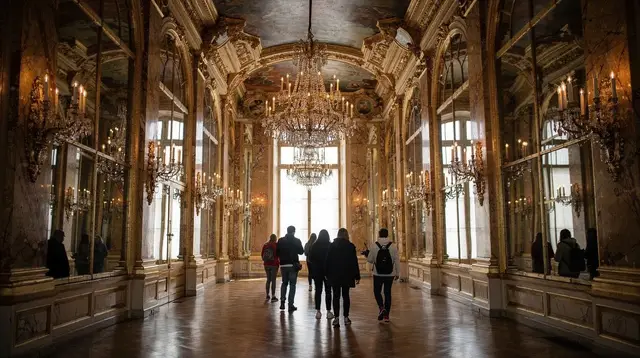
The Petit Trianon is a compact, elegant house rather than a palace in its own right. It was built in the eighteenth century and later became strongly associated with Marie-Antoinette, who used it as a retreat away from the formality of the main château and the court that came with it. The interiors are domestic in scale — rooms sized for a household, not for the reception of an entire court. That contrast is the whole point of visiting: after the gilded enfilade of the château’s state rooms, the Petit Trianon reads as almost restrained.
Because it was built as a private house, the visit tends to move faster and draw a thinner crowd than the château’s main circuit. It rewards visitors who want to understand Marie-Antoinette as a historical figure with her own tastes and habits, distinct from the ceremonial version of royal life on display in the main building.
The hameau de la Reine: a mock village with real intent
Close to the Petit Trianon, Marie-Antoinette had a cluster of thatched, half-timbered buildings built around an artificial lake, arranged to resemble a small farming hamlet. This is the hameau de la Reine — the queen’s hamlet — and it is one of the more unusual set pieces anywhere in the Versailles estate. It was never a working farm in any serious sense; it was a stage set for a particular fantasy of rural simplicity, built by and for someone who lived at the absolute center of European court life.
Walking between the cottages today, past the lake and the surrounding gardens, gives a very different sense of the estate than the château’s formal axis of gravel and clipped hedges. It is picturesque rather than monumental, and it photographs well without a single crowd barrier in sight most of the year. This is the part of Versailles worth budgeting real time for if the château alone already feels like enough grandeur for one day.
How far this actually is from the château
The Trianon estate is not a short annex you can duck into on the way out. It sits past the gardens and past the Grand Canal, on the far side of the grounds from the château entrance. Getting there on foot is a genuine walk across open parkland, not a five-minute detour, and visitors who underestimate that distance often end up rushing the estate or skipping it after already spending hours in the château and gardens.
If walking the whole distance does not appeal, the estate runs a shuttle service (locally called the petit train) that connects the château area to the Trianon estate, and rental bikes are another option some visitors use to cover the grounds more comfortably. Whichever way you go, treat the Trianon as a separate leg of the day, not a quick add-on, and plan your overall Versailles day around covering that distance rather than assuming it is a few extra steps.
When the estate is open, and when it is not
The full Versailles domain — château, gardens and Trianon estate — closes on Mondays, without exception. Beyond that, opening hours and the exact combination of buildings open to visitors can vary by season, so check current conditions before you travel rather than relying on a fixed schedule. What matters most for planning is the closure day itself: build any Versailles day, Trianon included, around a day other than Monday.
Ticket coverage for the Trianon estate is not always identical to a château-only ticket. Some passes bundle the château, the gardens and the Trianon estate together; others cover only part of the site. If your plan includes both the château’s state rooms and the Trianon, confirm that whichever ticket you are holding actually covers both before you set out, since this is one of the more common points of confusion for a first Versailles visit.
Making the most of a Trianon visit
A visit to the Trianon estate works best as a deliberate second half of a Versailles day, after the château and the main gardens, rather than something squeezed in at the end when energy and time are both running low. Comfortable shoes matter more here than almost anywhere else on the estate, given the distance from the main entrance and the amount of walking between the Petit Trianon, the Grand Trianon and the hameau de la Reine.
Because the estate is quieter than the château, it also suits visitors who prefer a slower pace: sitting by the lake near the hameau, walking the gardens around the Petit Trianon without the density of the main parterres, or simply taking the estate at a pace the château rarely allows in high season. Some visitors treat the Trianon as the calmer half of a two-part day, arriving early for the château and saving the Trianon estate for the afternoon once the busiest tour groups have moved on.
an afternoon tea experience themed around Marie-Antoinette, for visitors who want to extend the mood of the Trianon beyond the estate itself is one way to carry the theme of the day past the grounds. For the logistics of the visit itself, a pass that bundles entry to several parts of the domain, such as a multi-day museum pass covering major Paris and Versailles sites, can simplify planning if Versailles is one stop among several. Visitors who want to cover the distance across the estate at their own pace sometimes prefer a guided cycling route through Paris earlier in the trip as a way to get comfortable with longer days on two wheels before tackling the Trianon’s grounds on foot.
Trianon estate versus the main château
| Petit Trianon and hameau de la Reine | Main château and gardens | |
|---|---|---|
| Scale | A private house and a small mock village | A state palace with formal state rooms |
| Crowds | Generally lighter | Generally the busiest part of the visit |
| Distance from entrance | A genuine walk beyond the gardens and Grand Canal | At the estate’s main entrance |
| Mood | Domestic, picturesque, informal | Ceremonial, formal, monumental |
| Closure day | Monday, with the rest of the domain | Monday |
Getting to Versailles from Paris
Versailles is a day trip from Paris, not a place most visitors base themselves — it sits roughly 20 km to the south-west of the city. The RER C is the usual way to reach it, running to Versailles Château Rive Gauche station, with a walk from the station to the estate entrance. Trains also run from Gare Saint-Lazare and Montparnasse to other Versailles stations, which can be a useful alternative depending on where you start your day. See the Paris RER and trains guide for how the RER network fits into the wider Île-de-France system, and how to get to Versailles from Paris for a route-by-route comparison.
Because the Trianon estate adds real walking time on top of the château and gardens, a Versailles day that includes it is a full day, not a half-day excursion. Building the whole day around one destination, rather than trying to combine Versailles with something else, tends to work better once the extra distance to the Trianon is factored in.
Deciding whether to add the Trianon to your day
Not every Versailles visitor needs to see the Trianon estate. If your main interest is the château’s state rooms and the formal gardens, you can have a complete and satisfying day without walking as far as the Petit Trianon. The Trianon rewards visitors with a specific interest in Marie-Antoinette, in garden design away from the château’s formal geometry, or in simply having a quieter counterpoint after the busier main circuit.
For a broader sense of how a Versailles day fits into a Paris trip, the comparison between a guided and a self-guided Versailles visit and the Versailles tours from Paris overview both cover planning angles this page does not. A private guide, covered in hiring a private guide in Paris, can also be a practical way to manage the distance between the château and the Trianon estate without losing time working out the route yourself.
If you are weighing whether Versailles as a whole is worth a full day away from central Paris, the wider question is addressed directly in is Versailles worth a day trip, and fountain-show timing, which affects how you sequence a day that also includes the Trianon, is covered in when do the Versailles fountains run. For Versailles set alongside other options near Paris, see best day trips from Paris, the category page for Versailles tours, things to do at Versailles, and a structured three-day plan in Paris and Versailles in three days.
Trianon and Marie-Antoinette’s estate: your questions
Is the Trianon included in a standard Versailles ticket?
The Trianon estate is part of the wider Versailles domain, which is covered by the passport-style tickets that combine the château, the gardens and Marie-Antoinette’s estate. A ticket for the château alone does not automatically include it, so check what a given ticket covers before you buy.
How far is the Trianon from the main château?
It sits on the far side of the gardens and the Grand Canal, a genuine walk rather than a short stroll from the château entrance. Visitors who plan to see both in one day should budget real time to cover the ground between them, on foot or using the estate’s shuttle.
Is the Petit Trianon the same as the Grand Trianon?
No. The Grand Trianon and the Petit Trianon are two separate buildings on the same part of the estate, built decades apart for different residents. This guide focuses on the Petit Trianon and the hameau de la Reine, most associated with Marie-Antoinette.
What is the hameau de la Reine?
It is a cluster of thatched, rustic-style buildings that Marie-Antoinette had built near the Petit Trianon, made to resemble a small farming hamlet. It was a private retreat rather than a working farm, and it remains one of the more unusual corners of the Versailles estate.
Does the Trianon close on the same day as the château?
The whole Versailles domain, including the château, the gardens and the Trianon estate, closes on Mondays. Plan a weekday visit outside that closure and expect variable hours through the rest of the week.
Can you visit the Trianon without visiting the château?
Some tickets allow entry to the gardens and the Trianon estate without the château’s state rooms, which suits a second, calmer visit to Versailles. Check the specific ticket type carefully, since coverage varies.
Palace of Versailles and Trianon tours on GetYourGuide
Verified deep-linked GetYourGuide tours. Book through these links and we earn a small commission at no cost to you.
GetYourGuide does not provide a product photo for this activity — the image shows the meeting point, photographed by us.