Paris for solo travellers
Is Paris safe for solo travellers?
Paris is a safe city for visitors travelling alone, including women and first-timers. The real risk is petty theft, not violent crime: pickpockets work crowded metro lines, RER B, and the areas around the Eiffel Tower, the Louvre, and the Sacre-Coeur steps. Keeping bags closed and staying alert in crowds handles most of it.
How safe is Paris for someone travelling alone
Paris is a safe city for solo travellers, and the vast majority of visits pass without any incident worth mentioning. The risk that actually shows up in Paris is not violent crime against tourists, it is petty theft: bags opened in a crowd, phones lifted from a back pocket, and a handful of well-known street scams that rely on a moment of distraction. None of it requires the kind of vigilance that spoils a trip, but it does reward knowing where the risk concentrates and having a default reaction ready before you need it.
This guide skips the romantic itinerary angle and the cafe-culture etiquette, both covered elsewhere on this site, and stays on the two things a solo traveller actually needs: which situations in Paris deserve real attention, and the practical reflexes for getting through the city alone, whether that is your first solo trip or your tenth.
Where pickpockets actually work
Pickpocketing in Paris is concentrated, not random. It follows tourist density and distraction, and a short list of locations comes up again and again in reports from visitors and local police alike.
- Line 1 of the metro — runs past the Louvre, the Champs-Elysees, Bastille, and the Chatelet interchange, all high-tourist stops with heavy foot traffic and crowded carriages.
- RER B — the line connecting Charles de Gaulle airport to Gare du Nord and Chatelet, used by almost every arriving tourist, often with luggage that makes bags harder to watch.
- Around the Eiffel Tower — the queues and open plazas at the base draw dense, slow-moving crowds, ideal cover for someone working close.
- Around the Louvre — both outside, near the pyramid, and inside the busiest galleries.
- The steps of the Sacre-Coeur — one of the most reported spots in the city, partly because it is also where the friendship bracelet scam (below) is most common.
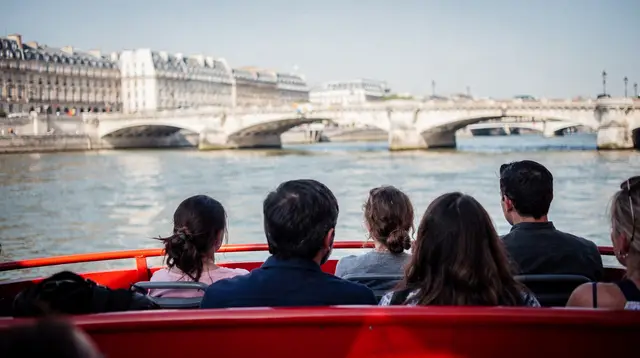
None of this means avoiding these places. It means treating them the way you would treat any crowded transit hub or major landmark anywhere in the world: bag zipped and worn across the front or against your body, phone and wallet not in a back pocket, and a bit more attention in the seconds when a crowd suddenly presses in around you. If you are combining a Seine cruise with a stop at the transfer service that gets you into the city from the airport without navigating RER B on your first, jet-lagged morning, that is a reasonable trade for a solo traveller carrying luggage.
Scams to recognise, not fear
A handful of scams recur often enough in Paris that recognising them on sight strips them of their effect. None are dangerous. All of them rely on you being polite for a few seconds too long.
The friendship bracelet. Usually near the Sacre-Coeur. Someone approaches, starts tying a woven bracelet onto your wrist before you can pull away, then demands payment once it is on. The fix is not to let a stranger touch your wrist in the first place — step back, hands down, keep walking.
Fake petitions. A person, often part of a small group, asks you to sign a petition, usually for a cause that sounds sympathetic (deafness awareness is a common framing). While you are focused on the clipboard, an accomplice can go through an open bag or pocket. Decline and keep moving; do not stop to read it.
The found gold ring. Someone “finds” a ring on the ground right in front of you and offers it to you, then asks for money as a thank-you, or claims you dropped it. It is not gold and it was not found. Walk on.
The shell game (bonneteau). Played on tables or cardboard on the bridges over the Seine, usually with a small crowd already gathered around, some of whom are working with the operator. It is rigged; walking away is the only winning move.
The common thread in all four: stay calm, keep your bag closed, say no, and keep walking. You do not owe anyone an explanation, and stopping to argue or apologise is what these scams are built around.
Practical reflexes for solo travel in Paris
Water and food. Paris tap water is safe to drink, and the city’s Wallace fountains — the green, cast-iron ones in parks and squares — are a free refill point, which matters when you are covering ground alone and do not want to keep buying bottled water. If you want a structured way to try the food scene without organising it yourself, a guided food-focused walk through a Paris neighbourhood is an easy way to eat well on a solo day without the trial and error.
Language. English is common in hotels, museums, major attractions, and any organised tour or activity. It gets thinner in small neighbourhood shops, on buses, and with some taxi drivers, but it is rarely a real obstacle for someone travelling alone with no French. A few basic phrases (hello, thank you, do you speak English, the bill please) smooth things considerably.
Emergency numbers. Save these before you arrive, not after you need them: 112 works for any emergency and is the simplest single number to remember. France also runs separate lines — 15 for medical emergencies (SAMU), 17 for police, 18 for the fire brigade. All of them work on a phone with no French SIM.
Staying connected. Being reachable and able to pull up a map matters more travelling alone than in a group, where someone else usually has data if your own connection drops. Sort out a SIM or eSIM before you land rather than relying on hotel wifi for your first day.
Getting from the airport without a hard start. Charles de Gaulle (CDG), about 25 km northeast of the city, connects to central Paris by RER B into Gare du Nord and Chatelet, or by taxi from the official rank — never from anyone approaching you inside the arrivals hall, which is itself a low-grade version of the same distraction tactics described above. Orly (ORY), about 13-14 km south, has been connected by metro line 14 since June 2024, alongside the Orlyval shuttle to RER B at Antony. Beauvais (BVA), roughly 85 km north and used mostly by low-cost carriers, requires a shuttle to Porte Maillot that takes well over an hour — factor that in if you are arriving alone and tired.
Orientation: reading the city so you do not feel lost
Paris is organised into 20 arrondissements, numbered in a clockwise spiral from the 1st (around the Louvre) out to the 20th, and postcodes run 75001 to 75020 in the same order — a useful shortcut for placing an address on a mental map before you have properly learned the city. The Seine splits the city into the Rive Droite (Right Bank, north) and the Rive Gauche (Left Bank, south), a distinction that comes up constantly in directions and neighbourhood descriptions.
For a solo traveller, this matters less for sightseeing than for picking a base: a central arrondissement on a well-served metro or RER line means shorter walks after dark and less time navigating alone late at night. It is worth reading through before you book anything.
Getting around alone
The metro (16 lines) and RER (5 lines), run by Île-de-France Mobilités, cover the city well, and travelling by metro alone in the daytime is entirely routine. Since the January 2025 fare reform, single tickets come in two forms — the Metro-Train-RER ticket and the Bus-Tram ticket — loaded onto a Navigo Easy card or a phone, with a weekly Navigo pass (Monday to Sunday) a better fit for a multi-day solo trip, or a Paris Visite pass aimed at tourists. None of the fares are printed here because they change; check current pricing when you buy.
Late at night, or on a route you do not know well, a licensed taxi or a mainstream ride-hailing app is worth the cost over an empty platform at 1 a.m. Driving yourself in Paris is not something most visitors should attempt: traffic, scarce parking, and a low-emission zone requiring a Crit’Air sticker make it more hassle than it is worth for a short stay, solo or otherwise. Remember that traffic in France runs on the right.
If wheeled transport on your own two feet appeals more than the metro, a guided cycling route through the city is a low-stress way to cover distance solo without navigating turn by turn, and it keeps you moving through daylight hours when the streets are busiest and safest.
Money and cards travelling alone
The euro (EUR) is the currency, and cards plus contactless payment are accepted almost everywhere, including on the metro and at the great majority of cafes and restaurants. There is little reason for a solo traveller to carry much cash; a small amount covers markets and the occasional card-only stall, and carrying less simply lowers what is at risk if a pocket or bag is picked. Split your cash and cards across two places (bag and a zipped inner pocket, for instance) rather than one, a basic habit that costs nothing and limits the damage from a single bad moment.
If museum queues are part of your plan and you would rather not stand in them alone after an early flight, the multi-day museum and monument pass covering the Louvre, Orsay, and dozens of other sites is worth comparing against paying per site, particularly if your days are packed and you are managing your own schedule without anyone to split queue duty with.
Museums, monuments, and the days they are shut
Two closures catch solo travellers out because they plan a single museum day without a backup: the Louvre is closed on Tuesdays, and the Musee d’Orsay is closed on Mondays. Both require a booked entry time slot, even with the Paris Museum Pass, so reserving ahead matters more than for a walk-in destination. Notre-Dame de Paris reopened on 7 December 2024 after the 2019 fire; the cathedral itself is free to enter, though booking a free time slot in advance is sensible, especially if you are visiting alone and do not want to lose time in a queue on a tight solo schedule. The towers are a separate, paid, reservation-based visit — check their status before counting on climbing them. The Centre Pompidou is closed for renovation for several years, with reopening expected around 2030, so it is not worth building into any Paris plan right now.
A quiet solo evening in Paris
Solo travel does not have to mean constant motion. A slow picnic by the Seine or in one of the city’s parks, away from the day’s pickpocket hotspots and requiring no reservation or itinerary, is one of the easiest ways to spend an evening alone in Paris without effort. A pre-arranged picnic set up in a Paris park or riverside spot removes even the small logistics of shopping for it yourself, which is sometimes exactly what a solo evening calls for after a full day of navigating a new city on your own.
For sorting out the basics before you fly — what to pack, how to handle entry rules, and where to stay — see paris for first-time visitors, what to pack for paris, and france visa and entry rules. For getting oriented on arrival, cdg airport to paris city centre, orly airport to paris city centre, and paris metro guide cover the practical transport questions in more depth than fits here, while paris metro tickets and navigo guide walks through the fare system. For staying connected and paying your way, see staying connected in paris and money cards and payments in paris.
On safety specifically, is paris safe for tourists and paris scams and pickpockets go deeper into what is summarised above, taxis and ride-hailing in paris covers getting around after dark, and where to stay in paris helps with picking a base that keeps late-night walks short. If you want the city laid out arrondissement by arrondissement before you book anything, paris arrondissements explained is the place to start, and for a first structured day alone, one day in paris gives a realistic single-day route. The paris destination page ties all of this back to the neighbourhoods themselves.
Solo travel in Paris, questions answered
Is Paris safe for a woman travelling alone?
Yes. Solo women travel through Paris every day without incident. The precautions that matter most are the same ones that matter for any solo traveller: watch your bag in crowds, keep your phone out of back pockets, and use official taxi stands or licensed ride-hailing apps late at night rather than unmarked cars.
What is the most common scam in Paris?
The friendship bracelet scam near the Sacre-Coeur is one of the most reported: someone ties a bracelet onto your wrist before you can object, then demands payment. Fake petitions, where a group crowds around you with a clipboard while an accomplice goes through your bag, and the found gold ring trick are also common. The reaction that works every time is the same: keep walking, say no, do not stop to engage.
Which metro lines have the most pickpockets in Paris?
Line 1, which runs past the Louvre, the Champs-Elysees, and the Bastille, and RER B, which connects Charles de Gaulle airport to the city centre, are the two most frequently mentioned in pickpocket reports. Both are heavily used by tourists carrying luggage or cameras, which is exactly what makes them targets.
Can you drink tap water in Paris?
Yes. Paris tap water is safe to drink, and the city’s public Wallace fountains, the green cast-iron ones found in parks and squares, are a free way to refill a bottle without buying anything.
Do people speak English in Paris?
In hotels, museums, major attractions, and organised tours, English is common enough that a solo traveller with no French will get by comfortably. It thins out in small neighbourhood shops and on the metro, where a few basic French phrases go a long way, but it is rarely a barrier to travelling alone.
What is the emergency number in Paris?
112 works for any emergency and connects you regardless of which service you need. France also has separate direct lines: 15 for medical emergencies (SAMU), 17 for police, and 18 for the fire brigade. Save 112 in your phone before you arrive; it works even without a French SIM.
Is it safe to walk around Paris at night alone?
The main tourist areas, including central arrondissements, the Seine banks near the centre, and well-lit shopping streets, are generally fine to walk late in the evening. Quieter side streets, empty metro platforms after midnight, and areas around some outer stations are where solo travellers should default to a taxi or ride-hailing app instead.
Should I carry cash or cards in Paris?
Cards and contactless payments are accepted almost everywhere in Paris, including on public transport and at most cafes and shops. Carrying a small amount of cash is useful for markets and the rare small business that is card-only, but there is no need to carry a large amount, which only raises what a pickpocket could take.
Paris trip planning guides on GetYourGuide
Verified deep-linked GetYourGuide tours. Book through these links and we earn a small commission at no cost to you.
GetYourGuide does not provide a product photo for this activity — the image shows the meeting point, photographed by us.