Who was Baron Haussmann?
The first time someone told me I was looking at “Haussmannian” Paris, I had no idea what they meant. I was standing on a wide avenue somewhere between the Champs-Elysees and Opera, looking at a row of buildings that all seemed to be wearing the same outfit: pale stone, tall windows, a wrought-iron balcony at the same floor on every building, the same grey roof sloping at the same angle. It looked designed, on purpose, at the scale of an entire street rather than one building. It was.
Why Paris has one face instead of many
That uniformity has a name attached to it, Baron Georges-Eugene Haussmann, and once you know it, you cannot unsee it. He was not an architect and did not personally draw the facades. He was the official given the job of rebuilding Paris in the 19th century, and what he actually controlled was the rulebook: how tall a building on a given avenue could be, what stone to use, where the balconies sat, how steep the roof pitched. Different architects built different buildings under those same rules, which is exactly why the result reads as one continuous streetscape rather than a collection of individual statements. It is consistency by regulation, not by a single hand.
Before that rebuilding, Paris looked like a lot of other old European capitals: a dense, tangled core of narrow medieval streets, alleys that turned and dead-ended, buildings that had grown up unplanned over centuries. Some of that older fabric survives if you know where to look, pockets of Le Marais and the Latin Quarter and Saint-Germain still keep those tighter, older streets, and walking from one of those pockets onto a Haussmannian avenue is a genuinely different physical sensation. The street widens, the sky opens up, and the buildings stop leaning in on you.
What the rebuilding did, in plain terms, was cut broad, straight avenues through that older tangle and line them with the regulated buildings I described. It is why Paris has none of the sudden claustrophobic medieval core that some other capitals kept intact, and instead has this long run of open boulevards that connect monuments, squares and train stations in straight sightlines. I will not pretend to know the exact length of boulevard involved or a precise year for when any one stretch went up; that level of detail belongs to a proper history, not a walking impression. What I can tell you honestly is what it does to the experience of the city on foot: you get long, legible views down a street toward a dome or an arch, instead of losing your bearings in a maze.
What to actually look for
Once you start noticing it, the pattern is everywhere and it stops feeling abstract. Stand on the Rive Droite near the Opera and look down almost any radiating avenue; the same cream stone, the same cornice line, repeats block after block. Cross to the Rive Gauche and you find the same discipline, just with a slightly different local texture. It is not decoration for its own sake. It gives Paris something a lot of cities its age do not have: a street-level rhythm you can read at a glance, buildings that agree with their neighbours instead of competing with them.
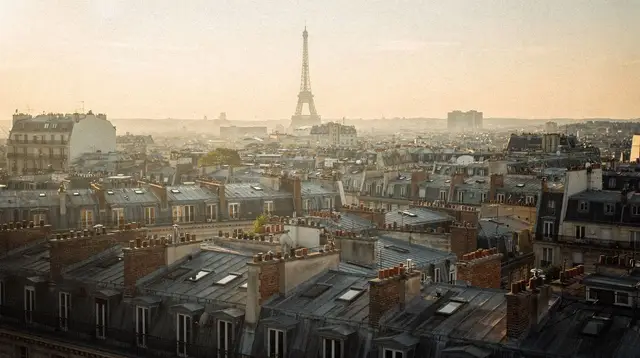
I find it easiest to see from a rooftop or a high viewpoint, where the uniform roofline turns into an actual visible pattern stretching toward the horizon; a few of the best vantage points for that are worth seeking out deliberately rather than stumbled into. It is also visible up close in specific buildings that were built as showpieces of the style, department stores among them, where the same facade grammar was applied at a grander, more ornamented scale.
a heritage-focused visit inside the Galeries Lafayette Haussmann building is one practical way to see that grammar applied indoors, under a stained-glass dome, rather than only from the street. If you would rather have someone narrate the rebuilding as you walk past it, a private guide can point out the details, cornice heights, balcony placement, roof angles, that are easy to miss on your own.
a vintage car ride through the city paired with a walk through Le Marais is a good way to feel the contrast directly, since it moves you between the broad regulated avenues and one of the older neighbourhoods that kept its pre-rebuilding street pattern, in the same outing.
Where it does not reach
It is worth being honest that not everything you will walk through is Haussmannian, and I do not think the city is better for pretending otherwise. Montmartre, up on its hill, kept a village-like layout that the rebuilding largely passed over, which is part of why it feels like a different town stitched onto the rest of Paris. The oldest corners of Le Marais and stretches of the Latin Quarter kept their narrower, older streets too. Knowing the difference helps you understand why one afternoon in Paris can feel like two different cities depending on which street you turned down.
If museums and monuments from the same broad period interest you alongside the streetscape itself, a multi-day pass that covers the major sites can be worth planning around rather than buying on a whim.
a multi-day Paris museum and monument pass covers a long list of sites across several consecutive days, which suits people who want to go deeper into the century that shaped the city rather than just walk past its surface.
None of this needs a history degree to enjoy. What changed my own visits to Paris was simply learning to look up at the roofline instead of straight ahead at shop windows, and to notice when a street suddenly narrows and the uniform facades disappear. That shift, from wide Haussmannian avenue to older tangled lane and back again, is one of the more honest ways to read this city as you walk it. For a first structured route through the center that will put you on both kinds of street in the same day, a one-day Paris itinerary is a reasonable place to start, and if you want the numbering logic behind the districts themselves rather than the buildings, that is explained separately in our guide to the arrondissements and in a companion piece on why Paris has twenty of them.
Questions about Haussmann’s Paris
Who was Baron Haussmann?
He was the prefect responsible for a large-scale rebuilding of Paris in the 19th century, the administrator who carried out the plan rather than an architect who designed individual buildings.
Did Haussmann design the buildings himself?
No. He set the rules, building height, facade material, balcony placement, roof pitch, that architects then followed, which is why the buildings look consistent without being identical.
Why did Paris need rebuilding?
Much of the city before the rebuilding was dense and narrow, with a medieval street pattern. The new plan cut wide, straight avenues through that older core.
Where can I see Haussmann’s work today?
Anywhere you find a broad avenue of matching cream-stone buildings with shared balcony lines and roof angles, on the Rive Droite near the Champs-Elysees and Opera, and just as much on the Rive Gauche.
Is all of Paris Haussmann’s Paris?
No. Pockets of older, narrower streets remain, notably parts of Le Marais and the Latin Quarter and Saint-Germain, and Montmartre kept its own village-like layout largely untouched.
Does this explain the arrondissement numbers?
No, the numbering system is a separate topic, covered in our arrondissements guide rather than here.
Is there a Haussmann museum or dedicated tour?
There is no single dedicated museum, but architecture-focused walks and heritage visits, including inside buildings built in the same style, regularly cover the rebuilding as part of a wider walking tour of the city or a private guide’s route.
What is the best way to actually notice it while walking?
Look at rooflines rather than shop windows, and pay attention when a street suddenly narrows; that shift between broad regulated avenue and older lane is the clearest sign you have crossed from one era of the city into another, something the best viewpoints in Paris make especially visible from above, and something you will also pass through on a route like the Le Marais walking tours or a stroll past Palais Garnier and the Arc de Triomphe.
tours.Culture
Verified deep-linked GetYourGuide tours. Book through these links and we earn a small commission at no cost to you.
GetYourGuide does not provide a product photo for this activity — the image shows the meeting point, photographed by us.